

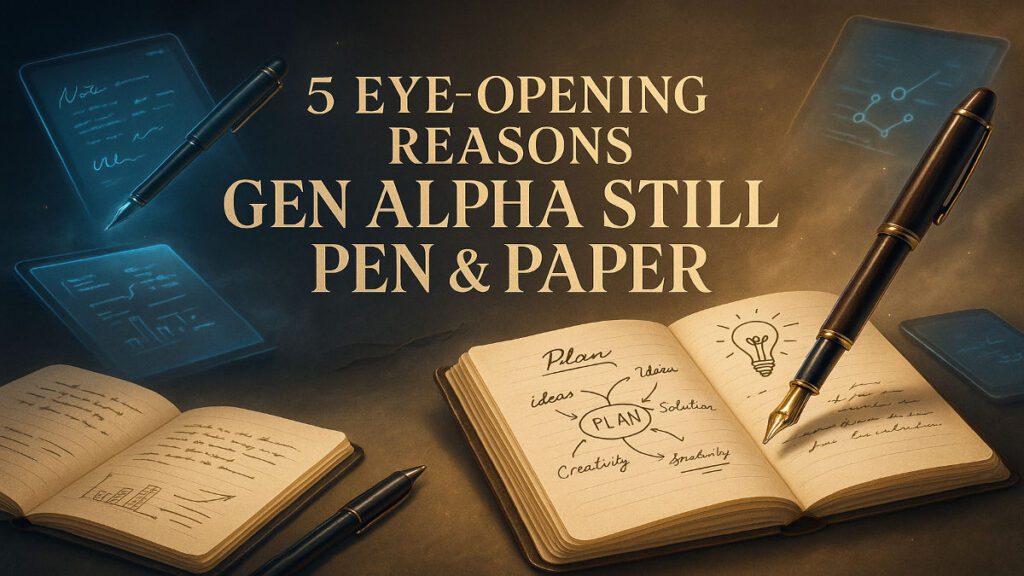
Short answer: Gen Alpha still needs pen and paper because handwriting boosts memory, builds fine motor skills, aids focus and supports creative expression. The goal is not tech versus paper. It is blended learning that uses screens for exploration and notebooks for reflection.
Toddlers swipe before they speak and tablets sit on school desks. It is fair to ask: Do kids today still need pens and notebooks to learn? Generation Alpha, born from 2010 onward, is the most technologically immersed generation yet. They grow up with AI assistants, smart classrooms and digital everything.
Despite that digital weight, traditional tools like pens and notebooks still matter in their education. The real question is not whether tech is better, but what kind of learning experience do we want our children to have?
Why does handwriting still matter for Gen Alpha?
1. Handwriting boosts brainpower
There is something in the movement of the hand. Neuroscientists have found that handwriting activates more brain areas than typing, including the motor cortex, visual processing centres and memory-linked regions.
A 2021 study from the University of Tokyo found that students who took notes by hand remembered information more accurately than those who typed. Writing forces the brain to process and prioritise rather than passively record. As Yomu AI notes, the slower pace of handwriting demands conceptual thinking and encourages summarisation, which improves retention.
2. Fine motor skills: the hidden superpower
Gripping a pen and forming letters is a workout for young fingers. Those motions sharpen fine motor skills, which are foundational for everything from tying shoelaces to typing accurately.
As The Conversation notes, these motor abilities extend beyond writing. They support artistic work, spatial awareness and hand-eye coordination. My niece, a Gen Alpha second-grader, started doodling in her diary during her “offline” time. We noticed her handwriting improve, and her cutting, gluing and colouring got sharper too.
How does pen and paper help focus?
3. Paper beats pop-ups for focus
Digital devices carry a world of knowledge and a world of distractions. One minute you are solving a math puzzle, the next you are watching cat videos. The steady stream of notifications makes it hard for adults to stay on task. It is harder for a 9-year-old.
Handwriting brings calm. A notebook does not buzz or ping. As Yomu AI points out, the analog approach encourages deeper concentration and lowers cognitive overload. As Quora users often note, it also gives young eyes a break from glowing screens, which helps prevent eye strain and fatigue.
How does writing by hand support creativity?
4. Writing is more than words
Handwriting is a form of self-expression. Kids develop their own styles, doodle in the margins and map out ideas with colourful pens. These touches, from messy mind maps to small sketches, help engagement and memory.
Digital tools often limit this kind of freeform creativity. Some apps allow drawing or annotation, but the tactile feedback and flexibility of pen and paper remain unmatched. Yomu AI highlights how personalised, visually organised notes can be a gateway to more meaningful learning.
What does a balanced Gen Alpha classroom look like?
5. A blended learning future
This is not an anti-tech argument. Technology is vital. It is how Gen Alpha learns coding, accesses global resources and collaborates in real time. Handwriting is just as essential. The path forward, as India Today suggests, is blended learning: screens for exploration, handwriting for reflection.
Writing stays useful in practical life. Forms, signatures and quick notes during a power outage all need a pen. Paper is not obsolete. It is adaptable, dependable and deeply human.
At Harvest International School in Bangalore, for instance, educators emphasise handwriting’s role in foundational learning, placing the school among the top institutions integrating tradition with innovation.
A pen can still shape a mind
As we move through 2025 and beyond, we should not rush to replace the notebook with a tablet. We can give Gen Alpha kids both. Let them swipe, tap and type. Let them scribble, sketch and sign their names in ink. When a child writes by hand, they are not only learning letters. They are building focus, forming memories and shaping a voice.
Parents, teachers and caregivers, do not toss the notebooks yet. Keep the pens rolling.
FAQs on Gen Alpha and handwriting
Does handwriting help memory better than typing?
Yes. A 2021 University of Tokyo study found that students who wrote notes by hand recalled information more accurately than those who typed, because writing forces the brain to process and summarise.
What age group is Gen Alpha?
Gen Alpha covers children born from 2010 onward. They are the first generation growing up with AI assistants and smart classrooms from toddlerhood.
Is pen and paper outdated in 2025?
No. Forms, signatures, quick notes during power outages and classroom reflection still rely on pen and paper. The best model is blended learning that uses both tools.
How does handwriting help fine motor skills?
Gripping a pen and forming letters trains small hand muscles, which supports drawing, cutting, gluing and later typing accuracy.
Should schools ban screens for Gen Alpha?
No. Screens are essential for coding, collaboration and global access. The goal is balance: screens for exploration and notebooks for reflection.