
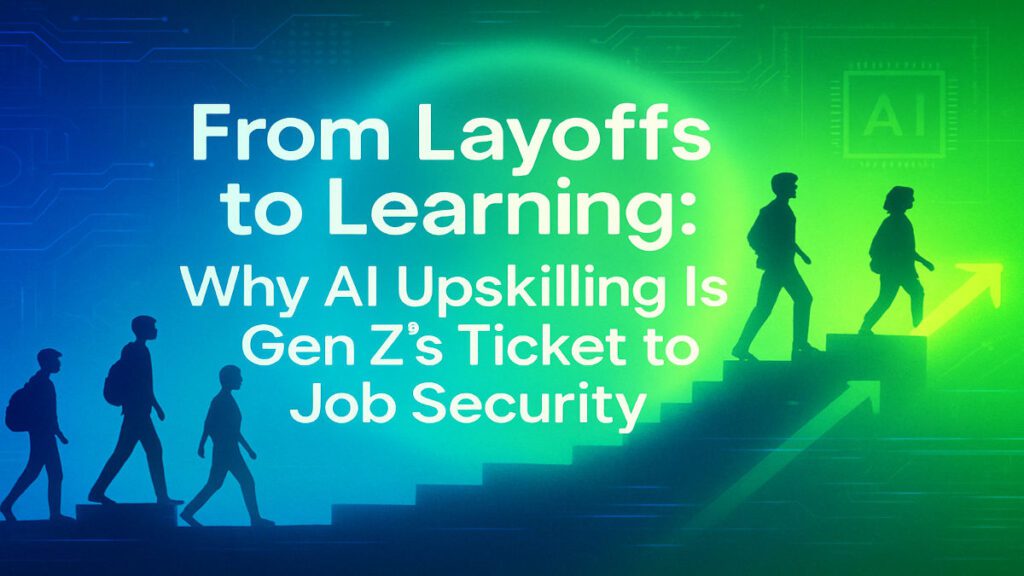
Short answer: A NITI Aayog report estimates nearly 2 million Indian tech jobs could be disrupted by AI, so Gen Z needs to move from being tech-savvy to AI-fluent. The fastest way is through micro AI courses, hands-on bootcamps and hackathons. TheYouthTalks.com runs crash courses, live industry projects and innovation challenges to help Indian students stay future-ready.
Why Gen Z must upskill fast and how TheYouthTalks.com is helping them stay future-ready
The shockwave hitting India’s tech industry
For decades India’s technology sector has been the country’s golden ticket, an industry that symbolised stability, aspiration, and progress. Yet, as Artificial Intelligence rapidly transforms global industries, even this secure domain finds itself at a crossroads.
A recent NITI Aayog report has sent ripples through India’s digital economy. The think tank estimates that nearly 2 million jobs in India’s tech sector may be disrupted by the rapid advancement and integration of AI. This isn’t speculation. It is already happening. Coding assistants are automating repetitive tasks, chatbots are replacing customer service agents, and machine learning models are optimising work that once required entire teams.
The message isn’t all doom. AI isn’t here only to replace humans. It is here to redefine how we work. The future won’t belong to those who fear change. It will belong to those who learn to harness it.
The great tech disruption: from stability to speed
Over the past year, major IT firms and startups across India, from Bengaluru to Gurugram, have faced mass layoffs. Entry-level engineers, data analysts, and project associates are finding their traditional roles shrinking as automation becomes more capable and affordable.
AI tools like GitHub Copilot, ChatGPT, and Claude can now write functional code, generate content, and assist in product design. The new professional landscape demands people who think beyond the machine, those who know how to use AI creatively rather than fear its power.
There is a silver lining. Every technological revolution in history, from the internet to mobile computing, has created new roles that did not exist before. The same is true for AI. Demand for AI-literate professionals who can prompt, train, and deploy AI systems is exploding across industries.
Why does Gen Z hold the key to the future?

Gen Z — today’s college students and early-career professionals — grew up surrounded by technology. They are digital natives, comfortable with apps, automation, and experimentation. But being tech-savvy is no longer enough.
The next decade will reward those who are AI-fluent, combining technical understanding with creative problem-solving, ethics, and empathy.
“The future workforce won’t just be about who codes the fastest — it will be about who asks the right questions to the machines,” says a senior AI researcher at Microsoft India.
To thrive in an AI-driven world, Gen Z needs to blend technical literacy with human intelligence, using AI to amplify thinking, creativity, and decision-making.
How should young learners stay ahead of the AI curve?
The traditional education system wasn’t designed for the pace at which technology evolves today. Four-year degrees often struggle to keep up with the tools and frameworks shaping modern industries. That is why micro-learning and experiential education have emerged as the new gold standard.
Micro AI courses
Short, focused online programs help students grasp new tools quickly. For instance:
- Prompt Engineering Workshops — designing effective AI prompts for ChatGPT or Claude.
- AI for Creators — mastering Midjourney, Runway, or Sora for visuals, music, and storytelling content.
- Data to Decisions — understanding how AI interprets datasets and powers predictions.
Micro-courses let learners stay agile, adapting skills every few months as technology changes.
AI bootcamps
Unlike theory-heavy college courses, bootcamps are hands-on and project-driven. In days or weeks, participants learn to:
- Build AI-powered chatbots
- Integrate APIs into apps
- Experiment with computer vision or generative models
- Deploy projects using cloud tools like Azure or AWS
These immersive experiences build knowledge and confidence.
Hackathons and live projects
Hackathons are the playgrounds of innovation. They simulate real-world challenges, from solving social issues with AI to improving business efficiency. Participants collaborate, ideate, build, and pitch under time pressure.
Live projects bring exposure to actual startup or corporate environments. Students see how AI solutions are built, tested, and scaled in the real world. Together, hackathons and live projects help Gen Z bridge the gap between learning AI and using AI.
TheYouthTalks.com: building India’s AI-literate generation
This is where TheYouthTalks.com steps in. As a youth-focused learning and innovation platform, TheYouthTalks has launched several initiatives to democratise access to AI education, particularly for young learners in India. The platform’s vision is simple: Learn by Doing.
What makes it different?
Rather than long, theoretical courses, TheYouthTalks curates micro learning experiences focused on skill-building, creativity, and problem-solving. Standout programs include:
- AI Crash Courses: four-week guided sessions on Generative AI, prompt design, automation tools, and the creative use of machine learning.
- Live Industry Projects: real-world assignments co-created with startups, giving students exposure to AI-driven business challenges, from marketing analytics to AI-powered chatbots.
- Hackathons & Innovation Challenges: events where young developers, designers, and storytellers collaborate on socially impactful AI solutions.
The platform encourages interdisciplinary learning, combining tech, design, and storytelling, because in the AI era creativity is as critical as code.
Real stories, real impact
In recent hackathons under the Code Without Barriers and AI Future India initiatives, TheYouthTalks saw hundreds of students from North Indian colleges participate, many of them first-time coders experimenting with AI tools.
Some built AI-driven mental health chatbots. Others created apps that detect misinformation or generate educational content in local languages. For many, it was their first tangible experience of building something that combined tech and purpose.
These experiences often lead to more than learning. They build communities. Students find mentors, teammates, and a sense of belonging in the evolving tech landscape.
The human side of AI: creativity and responsibility
While the focus often leans toward skills and jobs, the AI revolution is also about values. As machines become smarter, humans must become wiser.
Gen Z, known for empathy and activism, has the opportunity to lead a more ethical and inclusive AI future. Whether building unbiased datasets, ensuring data privacy, or designing AI tools that empower rather than exclude, the next generation must balance innovation with integrity.
A future built by learners, not fear
The NITI Aayog report is a wake-up call, not a prophecy of doom. Every disruption carries the seeds of renewal. TheYouthTalks.com stands as a beacon for this change, helping young Indians see AI not as a threat but as an invitation to reinvent themselves.
“The question isn’t whether AI will take our jobs — it’s whether we’ll be ready to take the new ones AI creates.”
The final call before it gets late
The AI revolution is here, and it is rewriting the playbook for careers, creativity, and collaboration. For Gen Z, the choice is clear: adapt, learn, and lead.
Whether you are a coder building your first chatbot, a designer exploring generative art, or a content creator experimenting with AI storytelling, this is your moment.
Head to www.theyouthtalks.com and explore AI Bootcamps, Live Projects, and Hackathons designed to help you stay future-ready. The future doesn’t wait, and neither should you.
FAQs on AI upskilling for Gen Z in India
How many Indian tech jobs are at risk from AI?
A NITI Aayog report estimates nearly 2 million jobs in India’s tech sector may be disrupted by AI. Entry-level engineers, data analysts and project associates are seeing traditional roles shrink as automation becomes more capable.
What is the best way for a student to learn AI quickly?
Combine short micro courses on prompt engineering and generative AI with hands-on bootcamps and hackathons. Project-based learning builds real skill faster than long theoretical degrees and gives you a portfolio employers can actually check.
Which AI tools should Gen Z learn first?
Start with ChatGPT and Claude for prompt engineering, Midjourney, Runway or Sora for creative AI, and cloud platforms like Azure or AWS to deploy small projects. GitHub Copilot is useful for coders who want to pair with AI day to day.
What does TheYouthTalks.com offer for AI learners?
TheYouthTalks.com runs AI Crash Courses, Live Industry Projects with startups, and hackathons under initiatives like Code Without Barriers and AI Future India. These focus on hands-on skills, creativity and community rather than long theoretical coursework.
Do I need a computer science degree to work with AI?
No. Being AI-fluent matters more than holding a specific degree. Learners from design, humanities and business backgrounds can contribute through prompt engineering, data ethics, product thinking and storytelling, as long as they practise with real tools.