

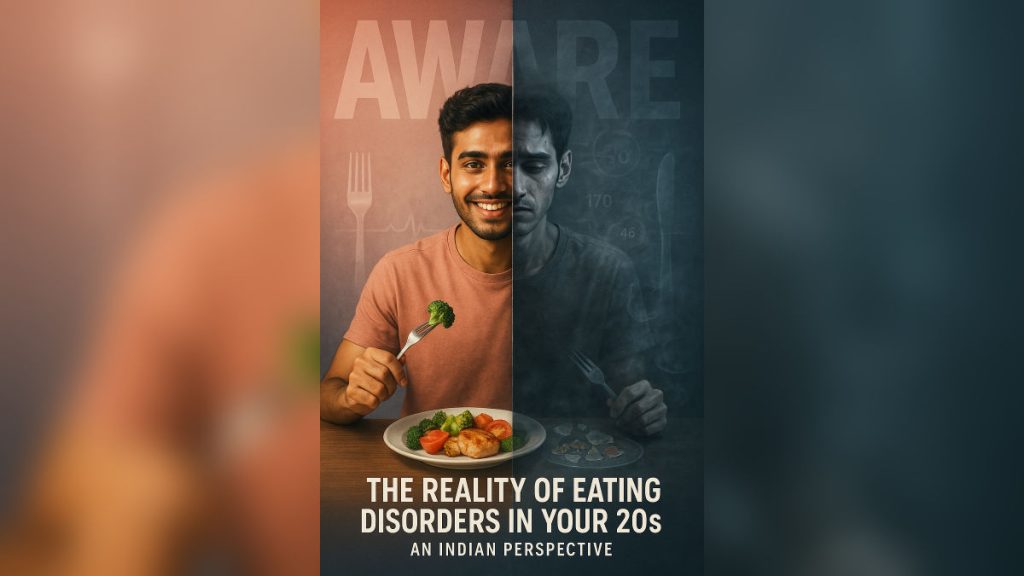
Short answer: Eating disorders in your 20s are rising fast in India, and most cases go unspotted because the symptoms get read as discipline or stress. The 18 to 25 window is a high-risk one, and the FREED study pegs the average untreated stretch at 29.9 months for anorexia and 67.4 for binge-eating. Help is possible. It’s just not asked for early enough.
In India, your 20s are sold as the years of self-discovery, independence, fresh starts. But for plenty of young adults, that decade gets shadowed by something quieter and meaner: an eating disorder. The Western framing of EDs (mostly teenage girls, mostly white) keeps the Indian version invisible. Silence, stigma and a thin layer of awareness don’t help.
This piece looks at what eating disorders actually look like in emerging adulthood here, threading together research, real stories, and the cultural quirks that make the Indian experience its own thing.
What are eating disorders, really?
Eating disorders (EDs) are serious mental health conditions. The marker signs: abnormal eating patterns, severe body image distress, and a churn of emotional pain underneath. The most common forms:
- Anorexia Nervosa (AN): Extreme food restriction and fear of gaining weight.
- Bulimia Nervosa (BN): Binge eating followed by purging behaviours like vomiting or excessive exercise.
- Binge Eating Disorder (BED): Frequent episodes of overeating without purging.
EDs often kick in during adolescence. But the 18 to 25 stretch, the so-called “emerging adulthood” window, is a high-risk one too. And help comes late. A 2020 UK study published in the Journal of Eating Disorders found the average untreated duration was 29.9 months for anorexia, 53 months for bulimia, and 67.4 months for binge-eating disorder. The delay is sharper in cultures like India, where awareness and diagnosis are thin on the ground.
Why do eating disorders go unnoticed in your 20s?
1. “This can’t happen to me” — denial and normalisation
Here’s the catch. Most young adults don’t read their own symptoms as symptoms. The FREED study showed that emerging adults often saw skipped meals or compulsive workouts as discipline, even something to be proud of. In India, where thinness is glamorised on Instagram and on Bollywood screens, the early signs of an ED can pass for ambition.
Personal anecdote: Rhea, 23, from Mumbai, used to fast frequently to ‘stay slim’ for Instagram photos. “I thought I was being disciplined,” she said, “but I fainted at work one day. That’s when I realised something was wrong.”
2. Stereotypes about who actually gets EDs
“I thought only white teenage girls got anorexia” — that quote from the FREED study captures a stubborn myth. In India, eating disorders still wear a foreign label. They aren’t seen as something a “normal Indian girl” goes through. So a lot of people quietly disqualify themselves from the conversation.
The reality? EDs cut across genders, ethnicities and body types. And Indian youth are squeezed by appearance pressure on every side — fair skin, the bridal figure, the gym-built body. Susceptibility is climbing.
3. Cultural pressure and the self-sufficiency trap
Many young Indians, especially those who’ve moved out of home for college or a first job, internalise this idea that they must be tough, independent, sorted. Admitting you have an eating disorder feels like a personal failure. The FREED study flagged this need to be self-reliant as a major reason for delayed help-seeking.
Mental health, in plenty of Indian families, is still taboo. Try bringing it up and you’ll often hear:
“Just eat properly, you’ll be fine.”
“It’s all in your head.”
Well-meant. Also corrosive. Replies like these, decent intentions and all, reflect a real gap in mental health literacy and they make it harder for someone in distress to ask for help.
How do life transitions in your 20s trigger eating disorders?
Emerging adulthood is one transition after another. New city, new course, new job, new relationship. The FREED study found that life shifts often triggered or worsened eating disorders.
Now layer in the Indian context — the brutal pull of competitive exams, the slow-burn pressure of marriage talk, the weird loneliness of a metro flat. That’s the perfect storm.
Amit, 24, who moved from Patna to Delhi for an MBA, shared: “I started binge-eating at night. It was my way to cope with loneliness. But soon I gained 10 kg, and I started starving myself during the day to ‘balance it out.’ I didn’t know it was a disorder until I took an online screening test.”
Is social media making it worse, or actually helping?
Both. Indian social media plays a strange double role. On one side, the curated bodies, the endless “What I Eat in a Day” reels, the casual fatphobia in comment sections — all of that fuels body dissatisfaction. On the other, it’s often the first place a young Indian even hears the term “eating disorder” and finds people who get it.
The FREED study underlined how much representation matters. If people don’t see themselves in the dominant ED narrative — wrong skin colour, wrong body, wrong country — they’re less likely to think it applies to them.
To be fair, Indian mental health creators on Instagram and YouTube are quietly shifting that. They’re talking about EDs in plain language and showing what recovery actually looks like.
What are the real barriers to getting help in India?
Awareness is rising. Several barriers haven’t budged:
- Cost of treatment: Specialist therapy and nutrition counselling are often expensive and rarely covered by insurance.
- Lack of trained professionals: India has a shortage of clinicians who specialise in eating disorders.
- Stigma: Seeking mental health care is still viewed with suspicion, especially in smaller towns.
- Confidentiality concerns: Many young adults fear their parents or employers finding out.
A 2019 study found that over 80% of Indian university students with ED symptoms never sought professional help. That number stings, especially when you remember that early intervention leads to far better outcomes.
What needs to change?
1. Wider public education
Eating disorders shouldn’t be a private confession. They belong in college mental health programmes, in awareness campaigns that take down the lazy myths — that EDs only affect women, that they’re about vanity, that you have to be underweight to qualify as “sick enough.”
2. Peer and parental involvement
Open talk inside families and friend groups can shave years off the diagnosis lag. Parents and friends are often the first to notice a behavioural shift, if they know what they’re looking at.
3. Policy and institutional support
India needs care models built for young adults — something like FREED, designed for early intervention. Government mental health programmes such as MANAS and Tele-MANAS should fold in dedicated ED treatment modules. And campus counselling centres need the training to actually screen for EDs, not just generic stress.
Breaking the silence, one voice at a time
Eating disorders in your 20s aren’t a Western problem. They’re here, they’re growing, and they’re widely misread in India. The trick is to design help around the specific shape of emerging adulthood — the moves, the independence, the family expectations all colliding at once.
If you or someone you know is wrestling with food, body image, or emotional eating, hold on to this: you don’t need to fit a stereotype to deserve help.
Asking for help isn’t weakness. It’s a real act of courage. Recovery isn’t easy, never is, but it’s always within reach.
FAQs about eating disorders in your 20s
Are eating disorders really common among Indian youth in their 20s?
Yes. The 18 to 25 age band is now recognised as a high-risk period, and Indian young adults are increasingly affected. A 2019 study found over 80% of Indian university students with ED symptoms never sought professional help, which means the visible numbers under-count the real load.
Why do eating disorders in young adults often go undiagnosed?
Three reasons stack up. Young adults often interpret restriction or compulsive exercise as discipline, not illness. The cultural script still treats EDs as a Western, teenage, female problem. And the strong pull to look self-sufficient in your 20s makes asking for help feel like failure.
How long do people usually wait before getting treatment?
Way too long. A 2020 UK study in the Journal of Eating Disorders found average untreated durations of 29.9 months for anorexia, 53 months for bulimia and 67.4 months for binge-eating disorder. In India, with thinner specialist coverage, the gap is usually wider.
Where can young Indians get help for an eating disorder?
Start with a campus counselling centre, a tele-mental-health service like Tele-MANAS, or a clinical psychologist with ED experience. Online screening tools can be a first nudge, but they aren’t a diagnosis. A trained professional, ideally one who works with EDs, is the right next step.
Do social media and Bollywood actually make eating disorders worse?
They feed the trigger and they fuel the recovery. Curated bodies, fatphobic comments and “What I Eat in a Day” reels normalise restriction. At the same time, Indian mental health creators are using the same platforms to break the stigma and point people to help.