

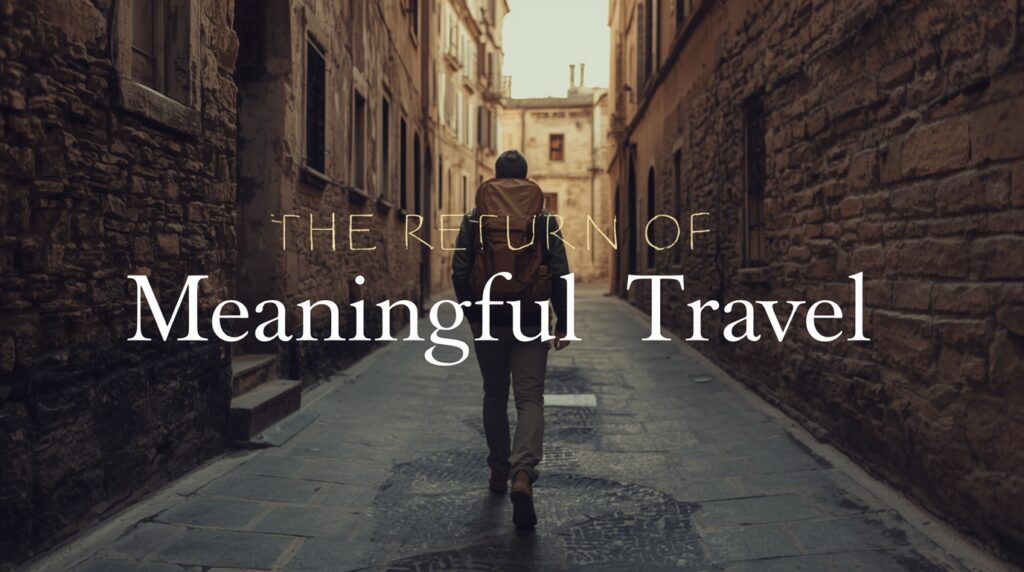
Short answer: Meaningful travel is the shift away from bucket-list tourism toward slower, more conscious journeys. This generation travels to understand themselves and the places they visit, not to escape. The goal is depth, cultural respect, and inner expansion rather than photo-ops and highlight reels.
There was a time when travel meant checking off locations, collecting photographs, and rushing through itineraries just to say, “I have been there.” Something in the culture of travel has shifted. The new generation is not travelling to escape responsibility or brag online. They are travelling to understand themselves, to understand the world, and to feel connected to something real.
Travel is no longer just motion. It is intention. It is perspective. It is belonging.
For young people today, a journey is not measured in miles, but in meaning.
How has travel become a mirror instead of a distraction?
Earlier, travel was a break from life. Today, travel is becoming a reflection of life.
People are not boarding planes to run away from themselves. They are leaving to meet themselves in new places. A foreign street, an unfamiliar smell, a new rhythm of daily life: these things soften the mind and open space for inner clarity.
Travel has become a mirror, showing who we are when habit and routine are removed. The more unfamiliar the surroundings, the clearer the self becomes.

Why are slower journeys creating deeper presence?
There is a growing rejection of rushed itineraries and over-planned trips. Travellers are choosing slow movement: walking through neighbourhoods without maps, staying longer in one place, eating with locals, learning greetings in unfamiliar languages, and letting the destination unfold naturally rather than forcing it into a schedule.
Slowness brings connection. Connection brings memory. Memory brings meaning.
The most unforgettable parts of travel are rarely the famous landmarks. They are the quiet conversations, unexpected detours, and small ordinary moments that feel deeply human.
Why is this generation choosing culture over comfort?
Today’s travellers are choosing discomfort, not as struggle but as experience. They are not searching for familiar foods or predictable hotels. They want authenticity: flavours with history, traditions with meaning, rituals that reveal how people belong to a place.
Instead of imposing their world on the destination, they are learning to let the destination reshape how they see the world.
Travel becomes an act of humility, a realisation that our way of living is only one version of what a life can look like.

What is the difference between seeing and experiencing?
Tourism is about seeing. Travel is about feeling.
This generation does not just want the view. They want the context. They want to know the stories, the histories, the struggles, the celebrations, the rhythms, and the soul of the place they are stepping into.
A sunset means more when you know the people who live beneath it. A market means more when you know the hands that shaped its goods. A tradition means more when you understand the identity it protects.
Travel becomes layered: sensory, emotional, intellectual.
How does travel become self-expansion?
The more places we see, the more versions of ourselves we discover. Travel is not just external exploration. It is internal expansion.
Some places teach patience. Some teach softness. Some teach courage. Some teach gratitude.
Travel reminds us that the world is larger than our fears and softer than our assumptions. Every journey leaves an imprint, not on luggage, but on the self.
What does conscious travel actually mean?
Younger travellers are becoming more aware of their impact, environmental, cultural, and ethical. The trend is shifting away from consumption toward contribution.
Instead of asking, “What can I take from this place?” people are beginning to ask, “How can I respect it?”
This shift represents maturity: travel as stewardship, not exploitation. Meaningful travel listens before it speaks.

Where is travel heading next?
The future of travel is not louder, faster, or more luxurious. It is quieter, slower, and more grounded.
Journeys will become less about distance and more about depth. Less about documentation and more about experience. Less about arrival and more about awareness.
Travel will continue to evolve into something deeply personal, not a highlight reel, but a chapter of identity.
Travel as a way of becoming
The new era of travel is not about escape. It is about transformation.
People are travelling to remember that the world is vast, diverse, unpredictable, and breathtaking, and so are they.
Some journeys change your environment. The meaningful ones change you.
FAQs about meaningful travel
What is meaningful travel?
Meaningful travel is a shift away from bucket-list tourism toward journeys focused on understanding, depth, and inner change. Instead of collecting destinations, travellers collect context, culture, and perspective.
Why is Gen Z choosing slow travel over rushed itineraries?
Slow travel creates connection, memory, and meaning. Walking without maps, staying longer in one place, and eating with locals build richer experiences than racing through landmarks for photo-ops.
What is conscious travel?
Conscious travel is an awareness of your environmental, cultural, and ethical impact on a place. It replaces “What can I take from here?” with “How can I respect it?” and frames travel as stewardship, not consumption.
What is the difference between tourism and travel?
Tourism is about seeing. Travel is about feeling. Tourism looks at a view; travel learns the stories, struggles, and rhythms behind it, turning a trip into something sensory, emotional, and intellectual.
How does travel change you internally?
Different places teach different lessons: patience, softness, courage, gratitude. Every journey leaves an imprint on the self and reminds you that the world is larger than your fears and softer than your assumptions.