

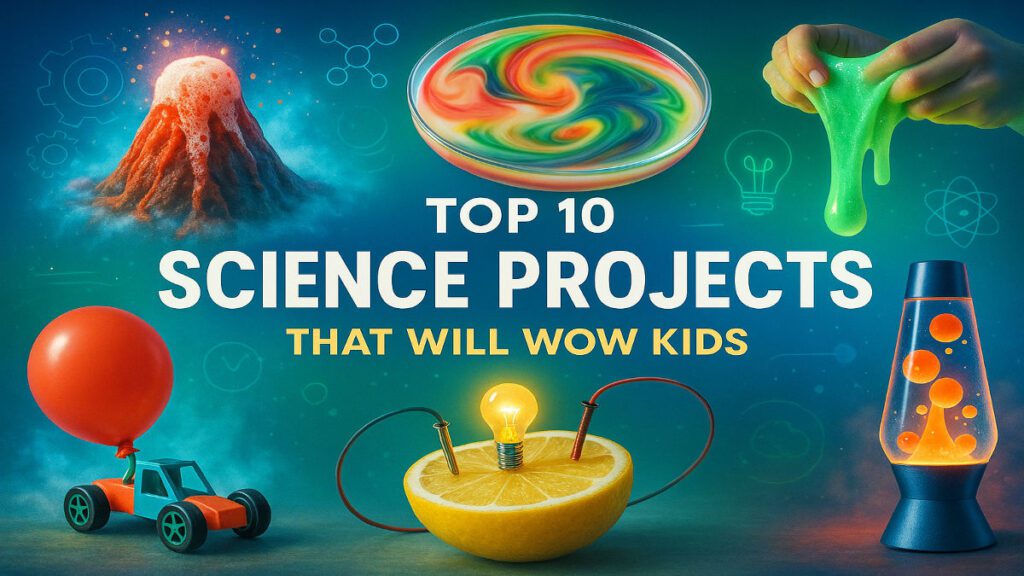
Short answer: The best science projects for kids in 2025 are hands-on experiments like a DIY volcano, magic milk, homemade slime, lemon battery and a water filtration system. They teach chemistry, physics and environmental science while keeping kids engaged and off screens.
Science does not have to live in textbooks and classrooms. The lasting lessons come when children mix, observe, build and experiment. With Gen Alpha’s curiosity running high, hands-on science projects turn screen time into discovery time. If you are a parent, teacher or someone who loves sparking young minds, here are 10 fun and educational science experiments kids will love in 2025.
1. DIY volcano eruption: science that fizzes and pops
There is something timeless about a bubbling, erupting volcano. You need baking soda, vinegar, dish soap, food colouring and a plastic bottle.
What it teaches: Chemical reactions, specifically acid-base interactions.
Why kids love it: It is dramatic, colourful and messy enough to feel like a real experiment. The wait before the eruption never gets old.
Personal note: My niece once added red glitter to hers, claiming it made the lava more “realistic.” It did not change the chemistry, but it added flair.
2. Magic milk experiment: a splash of colourful science
With milk, food colouring and dish soap, this project turns the kitchen table into an art-meets-science lab.
What it teaches: Surface tension and chemical reactions.
Why kids love it: The swirling patterns are hypnotic. One moment it is calm milk, the next a psychedelic swirl.
Bonus tip: Use different kinds of milk (whole, skim, almond) to see how fat content affects the result.
3. Homemade slime: stretching the science of matter
Slime is more than a trend. It is a gateway to understanding non-Newtonian fluids. Mix glue, baking soda and contact lens solution and you get a sticky, stretchy, fascinating mess.
What it teaches: States of matter and material properties.
Why kids love it: Slime is endlessly customisable with colours, glitter, scents and textures, and it gives a satisfying sensory experience.
4. Dancing raisins: bubble up some buoyancy
Drop raisins into a glass of soda and watch them dance. It sounds simple, but it is a clear visual of gas buoyancy and density.
What it teaches: Carbonation and gas behaviour.
Why kids love it: It looks like magic, but it is science in action. Predicting how long they will dance is half the fun.
5. DIY lava lamp: groovy science, reimagined
With a bottle, oil, water, food colouring and an Alka-Seltzer tablet, kids can make a lava lamp effect at home.
What it teaches: Liquid density and immiscibility.
Why kids love it: It is visually mesmerising, a bit like brewing a science potion.
6. Walking water: rainbow capillary action
This experiment uses cups, coloured water and paper towels to show how water can “walk” from one glass to another.
What it teaches: Capillary action and absorption.
Why kids love it: Watching primary colours blend into new shades makes this a two-in-one lesson in science and colour theory.
7. Balloon-powered car: racing with physics
Build a simple car from plastic bottles, straws, wheels and balloons. When you release the air, it zooms across the floor.
What it teaches: Newton’s Third Law of Motion.
Why kids love it: They build it, they race it and they pick up physics along the way.
Classroom tip: Host a balloon car race for friendly competition.
8. Lemon battery: powering lights with fruit
Insert zinc nails and copper wires into a lemon, connect them, and you get enough electricity to light a small LED.
What it teaches: Electrochemistry and renewable energy.
Why kids love it: It feels like a superpower, making electricity from something you eat.
9. Static electricity with a balloon: invisible forces at play
Rub a balloon on hair or a wool cloth, then use it to move paper scraps or bend a stream of water.
What it teaches: Electrostatic energy.
Why kids love it: Easy, no-mess, instant results. The hair-raising part is hilarious.
10. Water filtration system: clean water, clear minds
Using sand, gravel, charcoal and a plastic bottle, kids build their own water filter and watch each layer clean dirty water.
What it teaches: Environmental science and filtration.
Why kids love it: It has real-world application and opens up conversations about global water issues.
Safety first, always
These projects are kid-friendly, but adult supervision is a must, especially when sharp objects or chemicals are involved. Kids should wear gloves or goggles when needed and clean up afterwards.
Science is not just a subject—it is an adventure
In 2025, nurturing scientific curiosity matters more than ever. These hands-on projects teach scientific principles, and they also build confidence, critical thinking and a love for learning.
Whether you are a parent looking for a weekend activity or a teacher bringing more energy into the classroom, these experiments make science tangible and memorable. Grab baking soda, a balloon or a lemon, and let the experimenting begin. The future scientists are waiting to be inspired.
FAQs about science projects for kids
Which science projects are easiest for beginners?
Dancing raisins, static electricity with a balloon and magic milk are the simplest. They need only a few kitchen items and work in minutes.
Are these experiments safe for kids at home?
Yes, with adult supervision. Use gloves or goggles when handling vinegar, Alka-Seltzer or zinc and copper, and clean up right after.
What does the DIY volcano teach?
It shows an acid-base chemical reaction between baking soda and vinegar, producing carbon dioxide gas that drives the fizzy eruption.
How does the lemon battery work?
Zinc and copper act as electrodes, and the lemon’s citric acid acts as an electrolyte. The reaction moves electrons and produces enough current to light a small LED.
What age are these science projects for?
Most work well for primary and middle-school kids roughly 6 to 12, with adult help for younger children.