
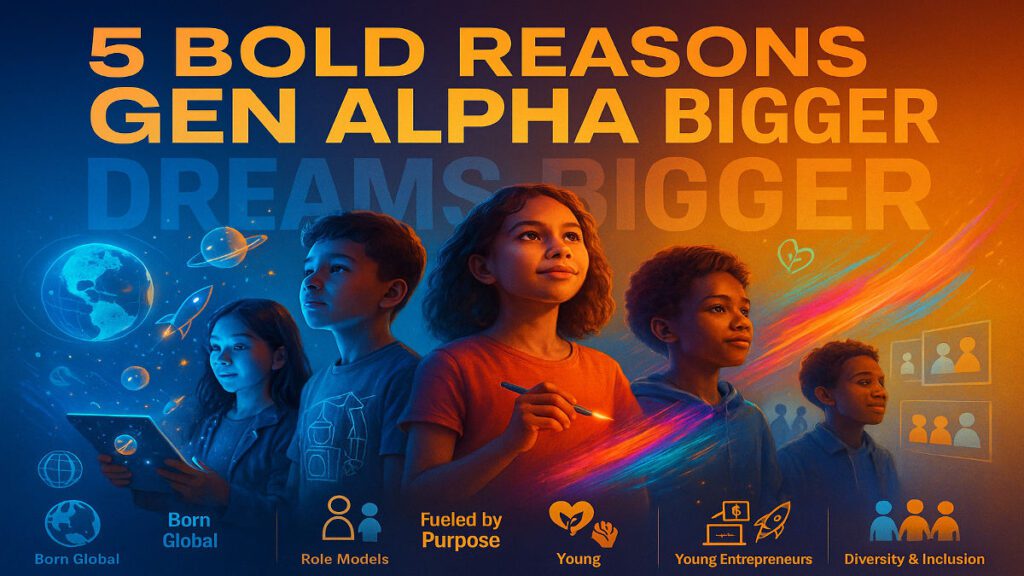
Short answer: Gen Alpha (born from 2010 onwards) dreams bigger because they are growing up with a global mindset, kid-aged role models on YouTube and TikTok, purpose-driven values, early entrepreneurial tools, and classrooms that mirror real-world diversity. Their 2025 aspirations stretch from solving world hunger to running online businesses before their teens.
From aspiring space explorers to 10-year-old YouTubers building global audiences, Generation Alpha is dreaming in high definition, and on a global scale. Born from 2010 onwards, these children are not only imagining the future, they are shaping it.
Their dreams may sound outsized to older generations. The truth is that Gen Alpha’s environment, influences, and tools have redefined what feels possible. Here is why their 2025 aspirations feel bigger, bolder, and braver than ever.
1. Why is the world Gen Alpha’s playground?
Gen Alpha has never known a world without Wi-Fi, smartphones, or instant translation tools. From the moment they could swipe a screen, the world sat at their fingertips. This constant connection to global content, whether K-pop, TED Talks, or climate activism in Sweden, shapes a generation that does not see borders the way earlier ones did.
Take Aarush, a 12-year-old in Mumbai who runs a gaming Discord server with friends from the Philippines, Brazil, and Germany. For him, collaborating across time zones is normal. As McCrindle Research points out, this generation has “an instinctive global mindset” and is more likely to dream about solving planet-sized problems, like ending world hunger or creating sustainable cities on Mars.
2. How do kid-aged role models change what Gen Alpha believes is possible?
Earlier generations looked up to distant celebrities or adult professionals. Gen Alpha watches kids like them: Ryan Kaji of Ryan’s World fame, 10-year-old authors, pre-teen coders, and teenage climate warriors like Greta Thunberg gaining real-world influence.
Social media has democratised success. A single idea, video, or invention can go viral overnight, giving children visibility and validation to pursue bold paths. YouTube, TikTok, and Scratch are launchpads for creativity, income, and purpose, not only entertainment.
A 2024 Common Sense Media study found that over 60% of tweens aged 8 to 12 had considered becoming content creators. Not for fame, but because they see it as a real way to express ideas, earn money, and change lives.
3. Why do Gen Alpha kids chase purpose, not just profit?
One of the most striking traits of Gen Alpha is the desire to make an impact. From a young age, they have been exposed to conversations around climate change, mental health, gender equality, and racial justice. These are everyday concerns, not optional topics.
Their dreams are shaped by a pull to “do good while doing well.” Many Gen Alpha children choose purpose-driven career goals before they fully grasp the job titles. A marine biologist protecting oceans or a vegan chef fighting climate change: their ambition carries empathy.
As UNICEF reported in 2023, more than 70% of Gen Alpha kids expressed worry about the environment, and many said they wanted to do something about it.
4. Are Gen Alpha kids becoming entrepreneurs before their teens?
This generation does not want to wait for adulthood to be their own boss. Gen Alpha is learning coding at age 7, designing NFTs by 10, and starting online stores with parental help by 12. Their comfort with Canva, Shopify, and ChatGPT gives them a real edge.
Ishita, an 11-year-old from Delhi, started a small online “eco-art” business during lockdown, selling handmade recycled crafts on Instagram with help from her older cousin. She proudly calls herself a “mini founder.”
With tech lowering barriers to entry, entrepreneurship is no longer an adult-only game. It is a sandbox Gen Alpha plays in naturally.
5. How does lived diversity shape Gen Alpha’s worldview?
Gen Alpha has grown up in classrooms that reflect the real world in race, gender identity, abilities, and opinions. For them, inclusion is not a buzzword. It is baked into their worldview.
This exposure to varied perspectives fuels creativity, compassion, and collaboration. Their bold dreams often revolve around redefining “normal,” whether by building apps for neurodiverse users or creating storybooks with heroes of all ethnicities.
In their world, a girl can lead a robotics team, a boy can become a fashion designer, and a child can invent solutions for challenges adults still fumble with.
Bigger dreams, bolder roads ahead
Gen Alpha’s dreams may feel wild, yet they are grounded in a new kind of reality. One shaped by limitless information, interconnected communities, and role models who break every mould.
Not every child will become the next Elon Musk or Malala Yousafzai. What matters is this: they believe they can. That belief is often the first step toward changing the world.
Stop asking if their dreams are too big. Ask how we can help build the bridge between those dreams and their reality.
FAQs about Gen Alpha dreams and ambitions
Who is Gen Alpha?
Gen Alpha refers to children born from 2010 onwards, the generation after Gen Z. They are the first to grow up entirely with smartphones, social media, and AI tools.
Why does Gen Alpha have a global mindset?
Gen Alpha has never known a world without Wi-Fi or instant translation. Platforms like Discord, YouTube, and TikTok expose them daily to global content, peers, and causes, creating what McCrindle Research calls “an instinctive global mindset.”
Do Gen Alpha kids really want to be content creators?
Yes. A 2024 Common Sense Media study found that over 60% of tweens aged 8 to 12 had thought about becoming content creators, mainly to express ideas, earn money, and make an impact.
Can kids start businesses at age 11 or 12?
Many already do. With tools like Canva, Shopify, and Instagram, Gen Alpha children run small online ventures. Ishita, an 11-year-old from Delhi, launched an eco-art business during lockdown and calls herself a “mini founder.”
Does Gen Alpha care about climate change?
Yes. A 2023 UNICEF report found that more than 70% of Gen Alpha kids expressed worry about the environment, and many said they wanted to act on it.