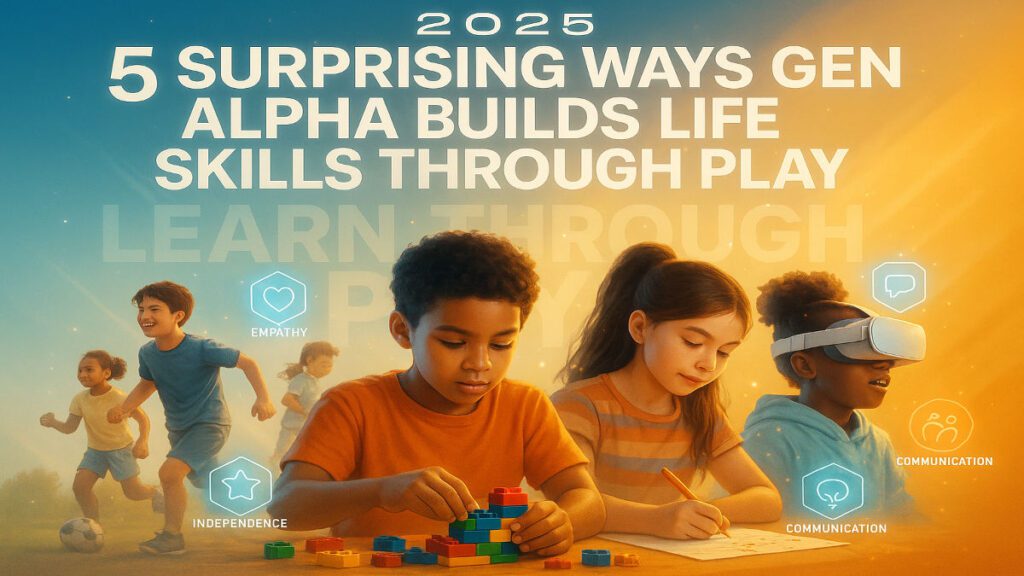
Short answer: Gen Alpha (born 2010-2024) learns essential life skills through play. Collaborative games build empathy, open-ended play sharpens problem-solving, pretend scenarios grow vocabulary, physical activity strengthens body and mind, and unstructured free play builds independence.
In 2025, play looks different for Gen Alpha. These kids move between LEGO bricks and iPad apps, outdoor tag and virtual reality quests. Play keeps them entertained, yes, but it also shapes who they become.
From emotional intelligence to creative problem-solving, today’s children pick up life skills in living rooms, playgrounds, and digital spaces. Most of the time they don’t even notice it’s happening.
Here are five ways Gen Alpha is learning through play, and why it matters.
How does play build empathy and emotional strength?
Watch a group of kids play a board game and you’ll see laughter turn to tears in seconds. That isn’t chaos. It’s emotional growth.
Collaborative play, whether it’s soccer or fort-building, teaches kids to cooperate, share, take turns, and empathize. They start to understand that others have different thoughts and feelings, a skill called theory of mind that sits at the heart of emotional intelligence.
In pretend scenarios like running a toy café or playing superheroes, children hit moments that need negotiation, compromise, and handling disappointment. An argument over the blue crayon is often the first lesson in conflict resolution.
As child psychologist Dr. Laura Markham explains, “Play gives children a safe space to process big emotions—and learn how to regulate them.” In other words, those tea parties and superhero battles are preparing them for real-life challenges.
How does play develop problem-solving skills?
Play is a mental workout too. Puzzle games, memory challenges, and digital simulations push Gen Alpha to analyse information, make decisions, and try again when they fail. Whether they are decoding a maze or building the tallest block tower, they are learning to think critically and to experiment.
Open-ended play matters even more. Drawing, storytelling, and crafting spark creativity and teach kids that most problems have more than one solution.
I watched my 7-year-old niece build an entire house from cardboard boxes during the pandemic. “I wanted to make a place where my toys could have parties,” she said. That wasn’t just cute—it was design thinking in action.
How does play boost communication skills?
From elaborate pretend games to simple back-and-forth banter, play is a language classroom in disguise.
When kids create stories, take on characters, or explain rules to friends, they build vocabulary, practise grammar, and sharpen their ability to express ideas. Digital play like Minecraft or Animal Crossing involves reading instructions, interpreting dialogue, and chatting with peers.
They also learn to listen actively, a skill that is getting rarer in a world full of distractions.
Play researcher Dr. Stuart Brown famously said, “Play is how children learn to talk with—not just at—others.” That difference matters for building strong relationships later in life.
Why is physical play important for Gen Alpha?
Despite Gen Alpha’s digital tendencies, physical play is non-negotiable.
Running, climbing, dancing, and jumping games build gross motor skills, which support coordination and overall health. Fine motor activities like LEGOs, drawing, and handling small tools sharpen hand-eye coordination and dexterity.
A 2024 study by the American Academy of Pediatrics found that active play improves physical development along with attention, memory, and emotional well-being.
That game of hopscotch is doing more for your child than you might think.
How does free play teach independence?
One of the most overlooked parts of play is what it does for autonomy.
When children engage in unstructured play, they learn to make decisions, solve their own problems, and follow what interests them. This self-directed learning fuels confidence and a stronger sense of identity.
Even pretend chores like sweeping with a toy broom or playing house teach basic self-care in a low-pressure way. Some educational toys cover safety concepts too, including emergency numbers and kitchen hazards.
As author and parenting coach Janet Lansbury puts it, “In play, children are practicing life. They’re rehearsing for a future they can’t yet see.”
Let Them Play, Because It’s Serious Work
In 2025, play is preparation. For Gen Alpha, every moment spent building, pretending, competing, or exploring is a moment spent learning resilience, empathy, problem-solving, and self-direction. These aren’t soft skills. They are life skills.
As parents, teachers, and caregivers, the best thing we can do is make space for every form of play: traditional, digital, imaginative, and physical. In the giggles, the disagreements, the make-believe, and the mess, our future leaders are figuring out how to navigate life.
Next time you see a child deep in play, don’t interrupt. You are witnessing growth in its purest form.
FAQs about Gen Alpha and play-based learning
What years define Gen Alpha?
Gen Alpha refers to the generation born between 2010 and 2024. They are the first cohort to grow up fully immersed in smartphones, tablets, and AI tools from birth.
Is screen-based play bad for Gen Alpha kids?
Not by itself. Digital play like Minecraft and Animal Crossing builds reading, planning, and social skills. The issue is balance. Kids still need physical, imaginative, and unstructured play alongside screen time.
What is theory of mind and why does it matter?
Theory of mind is the understanding that other people have thoughts and feelings different from your own. It develops through collaborative play and is a foundation for empathy and emotional intelligence.
How much free play do young children need?
There is no single number, but the 2024 American Academy of Pediatrics report backs daily active and unstructured play, pointing to benefits for attention, memory, and emotional well-being along with physical development.
How can parents support life skills through play at home?
Offer a mix of materials, like building blocks, art supplies, and outdoor space. Resist the urge to direct every activity. Let children lead, let them negotiate with friends and siblings, and let them solve small problems on their own.