
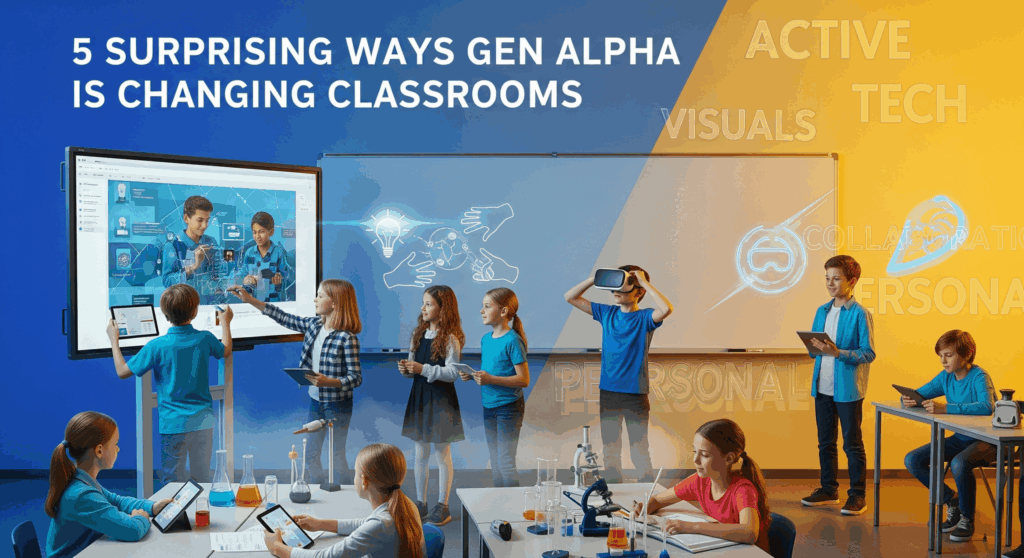
Short answer: Gen Alpha is reshaping classrooms by shifting participation from passive listening to hands-on projects, collaborative group work, digital tools like Kahoot and Padlet, AR/VR visuals, and personalised learning that connects to their world. Teachers in Hyderabad, Mumbai, Delhi and Pune are already seeing the shift in 2025.
From hand-raising to hands-on: the participation evolution
For decades, classroom participation meant raising a hand, answering a question or stepping up to the board. Walk into a school in 2025 filled with Generation Alpha students, those born from 2013 onwards, and the vibe is completely different.
These are kids who have grown up with tablets before textbooks, YouTube before encyclopedias and Roblox before recess. For them, “participation” is no longer about sitting still. It is about doing, questioning and creating. The way they engage is forcing educators to rethink lesson plans and seating arrangements.
Here are five powerful ways Gen Alpha is reshaping classroom participation and what it means for the future of learning.
1. How is Gen Alpha shifting from passive listening to active learning?
Remember when a teacher spoke for 40 minutes and students took notes? Not anymore.
Gen Alpha students, raised on interactive apps and real-time feedback, get bored by passive lectures. As per Punekar News, they thrive in environments that let them explore, experiment and engage. Think science kits over science notes, or group discussions over textbook recitations.
At a school in Hyderabad, a 10-year-old named Aarav shared how his favorite class involved building a solar oven from scratch. “It wasn’t just about reading how the sun works,” he said. “We cooked marshmallows using it!”
Hands-on learning, project-based tasks and problem-solving games now form the backbone of classrooms that want to keep up with Gen Alpha.
2. Why is collaboration the new competition?
Gen Alpha isn’t only learning with technology. They are learning with each other.
Raised on platforms like Minecraft, Roblox and Google Docs, they are naturally collaborative. According to United World Academy, they enjoy working in teams to solve challenges, often building on each other’s strengths.
Whether building a model city or co-writing a digital story, group projects are no longer chaotic exercises in herding cats. They are where deep learning and peer teaching happen. In one class in Mumbai, students even voted on roles within a team — coder, designer, presenter — mirroring real-world collaboration.
This shift toward social learning is also helping kids develop empathy, communication, and leadership — skills that go far beyond academics.
3. Which tech tools power Gen Alpha participation?
In the Gen Alpha classroom, participation does not stop at raising a hand. It extends into digital spaces where students take polls, post ideas and collaborate on shared platforms.
According to ScreenTechnics.in, smart classrooms with interactive whiteboards, tablets and apps are making participation more democratic and dynamic. Shy students who hesitate to speak in front of a class now feel able to respond through a live poll or quiz.
Teachers use apps like Kahoot, Mentimeter and Padlet not as gimmicks but as bridges to student voices. These platforms invite participation from every learner, not only the loudest ones, which is a game-changer for inclusive education.
4. Why do visuals and multimedia boost engagement?
Gen Alpha is a visually driven generation. Raised on YouTube tutorials, Instagram reels and TikTok explainers, they process information best when it is vivid, colorful and interactive.
Traditional blackboard notes or static slides do not cut it anymore. Educators now use infographics, animations, short videos and AR/VR tools to explain complex ideas. A science teacher in Delhi said showing a 3D heart model via augmented reality got her students far more excited than any textbook ever did.
Participation shoots up when kids are not just listening — they’re watching, interacting, and reacting in real time.
5. Why does Gen Alpha want learning that feels personal?
Perhaps the most striking thing about Gen Alpha is their desire for autonomy. They do not want to be told only what to do. They want to know why it matters.
Students engage far more when the lesson connects to their world. Climate change, gaming, social justice: Gen Alpha wants learning that is relevant, personalised and meaningful.
They also expect educators to adapt to their pace and learning style. “I like it when I can choose how to show what I learned — a poster, a story, or a video,” said Kiara, a sixth-grader in Pune. That level of choice boosts motivation and participation, and gives students ownership over their learning journey.
The future of participation is already here
As Generation Alpha continues to reshape education, participation is no longer about who speaks up first. It is about who engages deeply.
Educators who recognise this shift and adapt their classrooms will see more than better attendance or test scores. They will see curious, confident learners who are truly excited to be there.
The call to action is clear: If we want to prepare Gen Alpha for the world, we must first prepare the classroom for them.
FAQs about Gen Alpha classroom participation
Who is Gen Alpha in the classroom?
Gen Alpha are children born from 2013 onwards. They have grown up with tablets before textbooks, YouTube before encyclopedias and Roblox before recess, which shapes how they learn and participate.
How is Gen Alpha changing classroom participation?
Participation has moved from passive listening to hands-on projects, group collaboration, digital polls, AR/VR visuals and personalised learning. Students want to do, question and create, not just sit and take notes.
What tech tools work best for Gen Alpha students?
Teachers are using Kahoot, Mentimeter and Padlet for polls and quizzes, interactive whiteboards and tablets for smart classrooms, and AR/VR tools like 3D models to explain complex topics such as the human heart.
Why does Gen Alpha prefer hands-on learning?
Raised on interactive apps and real-time feedback, they get bored by lectures. As Punekar News notes, they thrive when they can explore and experiment, like the 10-year-old in Hyderabad who built a solar oven and cooked marshmallows with it.
How can teachers engage shy Gen Alpha students?
Digital tools help. Shy students who hesitate to speak can respond through a live poll, quiz or shared platform like Padlet. Giving choice in how to present work — poster, story or video — also boosts participation.