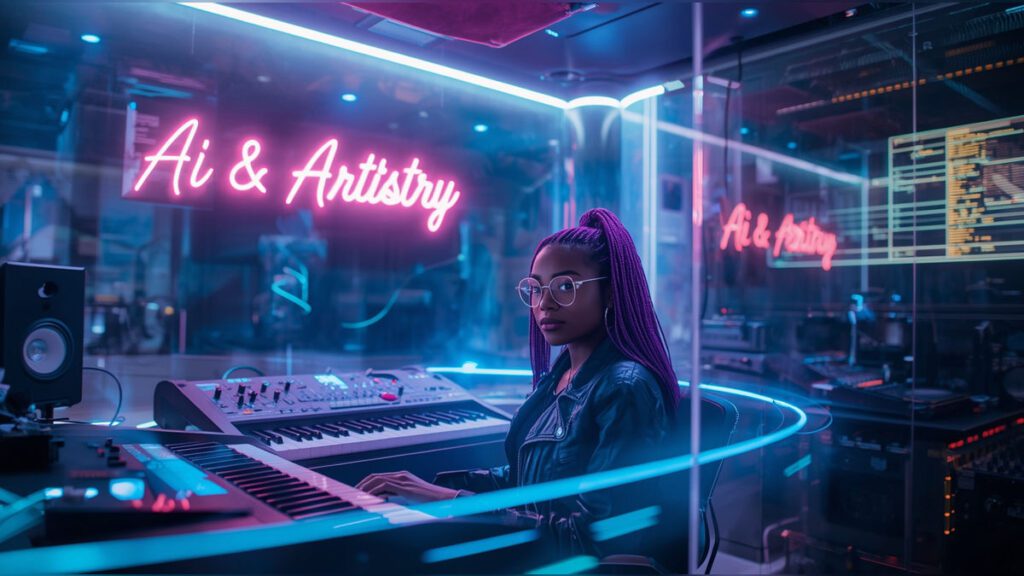
Short answer: AI music creation in 2025 has shifted from background tool to creative partner. Tools like Suno, Mubert, and Aiva generate songs from prompts, while artists like Grimes, David Guetta, and Holly Herndon are building AI voice models and collaborators. The U.S. Copyright Office rules AI-only work cannot be owned without significant human creative contribution.
What happens when technology composes symphonies, writes lyrics, and produces hit songs? In 2025, artificial intelligence is no longer a background tool in music production. It has become a creative partner. From AI-assisted songwriting to virtual artists performing on digital stages, the relationship between music and machine has evolved into something profound, controversial, and fascinating.
For artists, producers, and fans, this new frontier is redefining what it means to create and experience music.
Who are the AI musicians reshaping the industry?
AI-driven music tools like Suno, Mubert, and Aiva have changed how songs are made. These systems analyse massive datasets of melody, rhythm, and structure to generate original compositions within seconds. What once took hours in a studio can now be achieved by typing a few descriptive prompts.
Virtual artists such as FN Meka and Yameii Online are blurring the lines between human and machine creativity. They perform in metaverses, build social media followings, and collaborate with real-world musicians. Some see innovation; others see a threat to human artistry, raising questions about authenticity and emotional depth in AI-generated art.
How is AI changing the creative process?
Traditional musicians are starting to see AI as a collaborator rather than a competitor. Producers use AI-driven tools to generate melody ideas, harmonise tracks, or simulate instruments. Lyricists use AI models to break through creative blocks, with algorithms suggesting metaphors, rhymes, or emotional phrasing.
The studio of 2025 is no longer only microphones and mixers. It runs on algorithms that learn a creator’s style over time. This has democratised music creation: anyone with curiosity and internet access can make professional-quality songs without years of formal training.
As creativity becomes more accessible, one question sharpens: will convenience dilute originality?
Which artists are using AI in their music?
Despite fears of machines replacing musicians, many top artists are embracing the technology.
Grimes launched Elf.Tech, an open-source AI voice model allowing fans to produce songs using her vocal tone, as long as she shares royalties.
David Guetta famously used an AI-generated Eminem voice in a demo, sparking debates about deepfakes in music.
Holly Herndon, known for her AI collaborator Spawn, calls the tech “a creative instrument, not a replacement.”
AI is not eliminating artists. It is expanding their toolkit. The best music today often emerges from collaboration between human emotion and machine precision.
Who owns an AI-generated song?
The integration of AI has sparked major legal and ethical questions in the music industry. If an AI composes a song, who owns it: the user, the developer, or the machine itself?
Streaming platforms are already flooded with AI-generated music, and labels are struggling to track authorship. The U.S. Copyright Office has ruled that purely AI-generated works are not protected unless a human made a “significant creative contribution.” The precedent is clear: AI can inspire art, but it cannot yet own it.
Artists are calling for transparency, demanding that AI-generated music be clearly labelled to protect creative integrity.
How is AI shaping music discovery?
AI is not just making music. It shapes how we find and consume it. Spotify, YouTube, and Apple Music use advanced recommendation algorithms to curate playlists that predict your next favourite song before you search for it.
The convenience has created a paradox. While AI exposes listeners to new genres, it also narrows horizons through over-personalisation. By constantly feeding users familiar sounds, algorithms risk creating a musical “echo chamber” where true discovery becomes rare.
Some indie artists are pushing back, advocating for algorithmic transparency and human-curated playlists to preserve musical diversity.
What is emotionally intelligent music?
The next frontier for AI in music lies in emotional computation. Imagine a streaming service that detects your mood through wearable sensors or facial recognition and generates a personalised soundtrack in real time. AI could soon produce adaptive scores for games, films, and your daily routine, evolving dynamically based on your emotions.
This fusion of neuroscience and machine learning could transform how we connect with sound, creating experiences that feel uniquely human even when built by algorithms.
Can art survive automation?
The challenge now is not stopping AI. It is ensuring that art remains meaningful in an age of automation. True artistry comes from imperfection, vulnerability, and perspective, qualities machines cannot replicate. The future of music will likely not be human versus AI, but human amplified by AI.
The tools may change, but the essence of art, which is emotion, storytelling, and connection, will always be driven by people.
The new era of co-creation
AI is not the end of human creativity. It is the next chapter of it. The relationship between artist and algorithm is redefining how we compose, collaborate, and listen.
As technology becomes more sophisticated, the question is not “Can AI make music?” It already does. The real question is, “Can it make us feel something?” The answer, for now, still belongs to us.
FAQs about AI music creation
What are the best AI music tools in 2025?
Suno, Mubert, and Aiva are leading tools that analyse datasets of melody, rhythm, and structure to generate original compositions in seconds from text prompts. They let anyone with internet access make professional-quality songs without formal training.
Did Grimes really let fans use her voice with AI?
Yes. Grimes launched Elf.Tech, an open-source AI voice model that allows fans to produce songs using her vocal tone, provided she shares royalties on any commercial release.
Can an AI-generated song be copyrighted?
The U.S. Copyright Office has ruled that purely AI-generated works are not protected unless a human made a significant creative contribution. AI can inspire art, but it cannot legally own it yet.
What did David Guetta do with an AI Eminem voice?
David Guetta used an AI-generated Eminem voice in a demo, which sparked industry-wide debate about deepfakes in music and whether artists’ voices should be licensed before AI training.
Will AI replace human musicians?
Most working artists, including Holly Herndon who built an AI collaborator called Spawn, treat AI as a creative instrument rather than a replacement. The future points to human artistry amplified by AI, not erased by it.