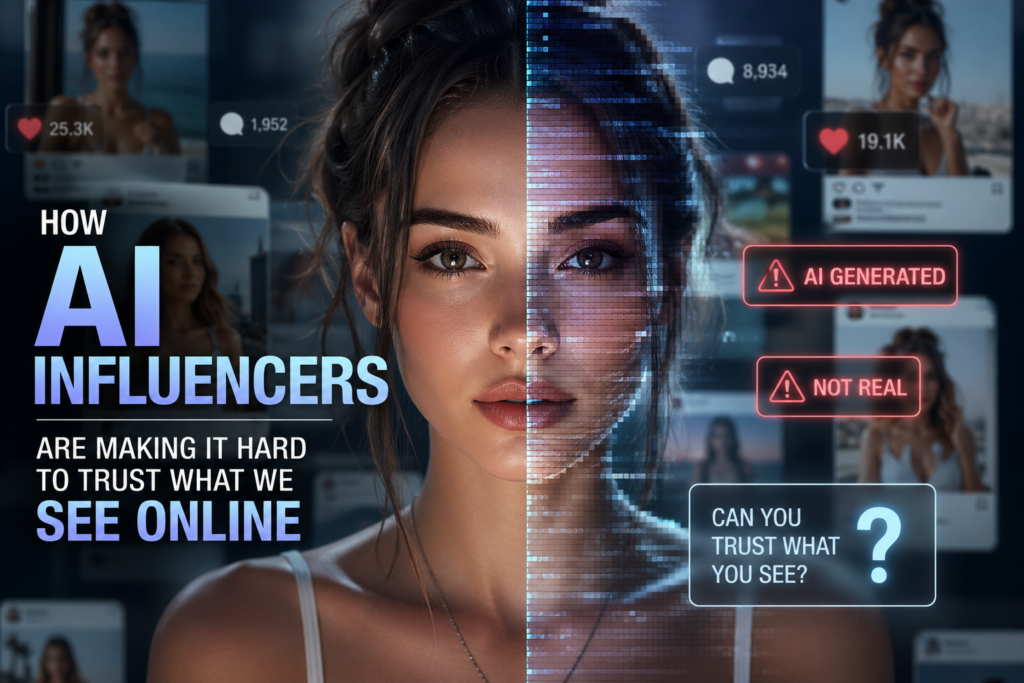
Short answer: AI influencers and deepfakes are now convincing enough to fool most viewers. Virtual creators like Lil Miquela (Dior, Prada) and India’s Kyra (boAt, Amazon Prime Video) have gone mainstream, while deepfake scams using Amitabh Bachchan, Shah Rukh Khan and Rashmika Mandanna’s likeness have already cost real victims real money. The fix isn’t paranoia, it’s a habit of pausing to verify.
Scroll for two minutes. You’ll see a face that doesn’t exist. A voice that was never recorded. A story that’s been generated by a model trained on a million stories before it, and somewhere in that feed, you’ll feel something genuine, which is the strangest part.
I’ve been watching this shift for a while now. The line between what’s real and what’s synthesised has gone fuzzy in a way it wasn’t even eighteen months ago. And the awkward truth is that most of us aren’t slowing down enough to notice.
Why does the rise of AI influencers matter right now?
Artificial intelligence has stopped being a tool. It’s a storyteller now. It generates faces, voices, and entire narratives that earn trust without earning the right to it.
Global virtual influencers like Lil Miquela have already worked with brands such as Dior and Prada. In India, virtual creators like Kyra are partnering with companies like boAt and Amazon Prime Video, blending into mainstream digital culture without much friction. The more we see these synthetic personalities, the more normal they feel, that’s the loop, and it’s a fast one.
Familiarity, oddly enough, builds trust even when the trust is misplaced.
When does “real” stop meaning authentic?
Round about the moment a polished video makes you nod along before you’ve checked the source.
This shift is subtle. But powerful. A confident endorsement can feel genuine even when it’s been algorithmically stitched together, and the human brain isn’t built for this kind of doubt at scrolling speed. We’re wired to trust faces. AI knows it.
How is AI being misused in India today?
The list keeps growing. What started as creative experimentation has turned, in stretches, into deception with real victims attached.
Financial scams using deepfaked celebrities
India has seen a surge in deepfake-driven scams involving well-known figures like Amitabh Bachchan and Shah Rukh Khan. Fake videos show them endorsing investment schemes or apps promising unrealistic returns. The clips usually push viewers towards Telegram or WhatsApp groups, where scammers play the long game, building rapport for days before convincing victims to transfer money. By the time the fraud is realised, recovery is nearly impossible.
And there have been cases where deepfake versions of business leaders and financial experts are used to promote cryptocurrency scams, lending borrowed credibility to operations that have none of their own.
Voice cloning frauds
Voice cloning has added another layer of realism. Using advanced tools like ElevenLabs, fraudsters can replicate a person’s voice with startling accuracy, sometimes from less than a minute of source audio.
In India, there have been reports of people receiving distress calls that sound exactly like their children or relatives, asking for urgent financial help. The emotional pressure leads to immediate action, no verification, no callback.
A friend told me about a businessman in their city who transferred a large sum after receiving a call that sounded exactly like his nephew. Turned out to be entirely fabricated. The nephew was, at that moment, in a college lecture.
Deepfake controversies in entertainment
The Indian entertainment industry hasn’t been spared. A widely circulated deepfake video involving Rashmika Mandanna sparked national concern about digital safety and consent, the kind of moment that briefly made everyone pay attention before the news cycle moved on.
Manipulated clips of actresses like Katrina Kaif have surfaced online too, raising hard questions about privacy and the misuse of AI in media. These incidents show how easily AI can warp reality, even in highly visible spaces with legal teams behind them.
Sextortion and blackmail
AI-generated explicit content has made sextortion easier and more dangerous. Unlike earlier methods, criminals don’t need real images or videos any more. A single photo from a public profile is enough to fabricate compromising material.
Victims are then threatened with exposure, leading to emotional distress and financial extortion, even though the content itself is fake. The damage isn’t fake, though. That’s the cruel bit.
Political manipulation
Deepfakes are being weaponised in political contexts. Edited videos of politicians making controversial statements can spread faster than fact-checkers can move, shaping opinion before anyone gets a correction in.
In a country as diverse and politically active as India, that kind of manipulation has the potential to create confusion, mistrust and even social unrest. Not theoretical. Already happening.
How widespread is the exposure?
It’s mainstream now.
During a single short scroll session, it’s highly likely that users will run into at least one piece of misleading or synthetic content, and most of them won’t realise it. The exposure is constant. Often invisible.
What makes this particularly worrying is that AI-driven deception isn’t picky about its targets. Anyone with a smartphone, students, professionals, retirees, can become a victim. The scammers don’t care who you are. The model doesn’t either.
What does AI-generated content do to our psychology?
It rewires the instinct to question, slowly, and in ways we don’t notice while it’s happening. That’s the part I find genuinely unsettling.
Repeated exposure dulls scepticism. People begin to accept what they see without checking, and over time this leads to:
- Greater vulnerability to misinformation
- Emotional attachment to virtual personalities
- Reduced effort to verify sources
The more we consume AI-generated content, the more we adapt to it. Instead of learning to spot manipulation, we get comfortable with it. That’s not detection getting better, that’s surrender getting normalised.
Why do AI influencers feel so human?
Because storytelling fools the heart faster than logic protects it.
Despite being artificial, AI influencers can pull genuine emotions out of real people. They share stories, respond to comments, present curated versions of “life” that feel relatable. I came across a post once from a virtual influencer talking about burnout, the comments were full of empathy and encouragement, real people writing real responses to a person who didn’t exist. For a moment it felt like a real human connection. Until the realisation set in that the entire narrative had been algorithmically generated.
Our emotional responses, it turns out, are driven more by storytelling than by reality.
How can you stay safe in a world of digital illusions?
The problem is complicated. The protection isn’t.
1. Look for subtle inconsistencies
AI-generated videos still leave fingerprints. Watch for:
- Slightly mismatched lip movements
- Unnatural facial expressions
- Overly smooth skin textures
- Inconsistent lighting or shadows
These details are small. But they’re tells.
2. Verify before you believe
If a celebrity or public figure appears to endorse something unusual, pause and check:
- Official social media accounts
- Trusted news sources
- Context around the video
A thirty-second search can stop a thirty-thousand-rupee mistake.
3. Use detection tools
Tools like InVID and Gemini SynthID help identify manipulated media and verify authenticity. They’re not perfect. They’re better than nothing.
4. Be wary of urgency
Scammers manufacture urgency, a limited-time investment, an emergency call from a “family member”, a deadline that’s somehow always five minutes away. Slowing down is the single best defence you have. Verify, then act.
What does the road ahead look like?
AI technology will keep getting more advanced, the realism of synthetic content will keep improving, and distinguishing truth from fabrication is going to get harder, not easier. That’s the honest forecast.
But trust doesn’t have to disappear. It can be rebuilt through awareness, education and critical thinking. Digital literacy isn’t optional any more, it’s essential, and understanding how AI works, recognising its limits, and questioning what we see are the skills this decade demands.
The rise of AI influencers and deepfakes is a turning point in how we experience the internet. It challenges our perception of reality and forces us to rethink what authenticity even means. The real issue isn’t the technology, it’s how easily we accept what we see without questioning it.
Every scroll, every click, every share carries a choice: believe instantly, or pause and verify.
In a world where illusions are getting more convincing by the month, awareness is our strongest defence. Next time something looks too real, or too perfect, take a breath and question it. Because in today’s digital landscape, seeing is no longer believing.
FAQs about AI influencers and deepfakes
How can you tell if a video is a deepfake?
Watch for mismatched lip-sync, unnaturally smooth skin, inconsistent lighting and odd blinking patterns. Cross-check the claim against the person’s official social media and trusted news sources. Tools like InVID and Gemini SynthID can also help verify whether a clip has been manipulated.
Are virtual influencers like Lil Miquela and Kyra real?
No, they’re computer-generated personalities. Lil Miquela has worked with Dior and Prada globally, while India’s Kyra has partnered with boAt and Amazon Prime Video. The teams behind them write the narratives, manage the brand deals and respond to comments.
What are the most common AI scams in India right now?
Three patterns dominate: deepfake celebrity endorsements (Amitabh Bachchan, Shah Rukh Khan) for fake investment apps, voice-cloned distress calls pretending to be relatives, and AI-generated explicit content used for sextortion. Most route victims through Telegram or WhatsApp groups.
Which tools detect AI-generated content?
InVID is widely used to verify videos and check their origin, while Gemini SynthID can detect AI-generated images and audio carrying its watermark. Neither is foolproof, so combine them with manual checks of the source account and surrounding context.
What should I do if I receive a suspicious AI-cloned voice call?
Don’t act on the call. Hang up, then ring the actual person back on a number you already have saved. Ask a question only they would know. Never transfer money based on a single voice call, however urgent it sounds.