
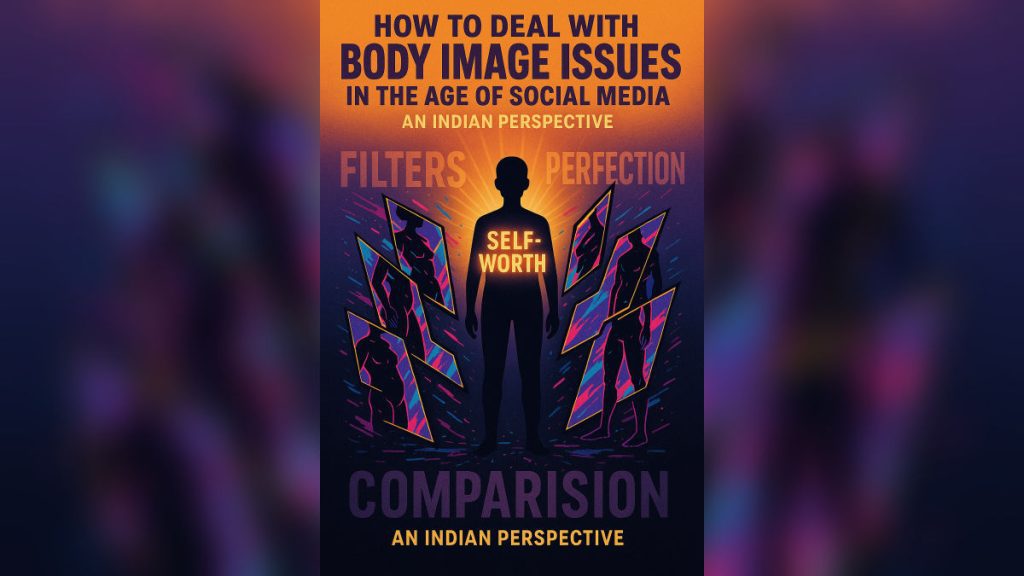
Short answer: Social media is a highlight reel, not a documentary, and treating it that way is the first step out of the body image trap. Curate your feed, set screen-time limits, practise self-compassion, and lean on Indian platforms like Rula, YourDOST and iCall when it gets heavy. Indian users spend roughly 2.6 hours a day on social media (Statista, 2023), so what you scroll through really does shape what you think of yourself.
In today’s hyperconnected world, social media platforms have become mirrors. Distorted ones. They reflect not who we truly are, but who we’re told to be, somewhere between a perfectly posed selfie and an airbrushed “candid” shot. For young Indians growing up inside this digital ecosystem, the pressure can be especially intense.
But body image struggles don’t have to be permanent, and they shouldn’t define how you see yourself. Here’s how to navigate the scroll mindfully, build self-worth, and step out of beauty standards that were never built for most of us.
Why is social media making body image worse?
One of the most important truths to hold on to. Social media is a highlight reel, not a documentary. People post their best angles, their most flattering selfies, the moments that look Instagram-worthy. What you don’t see are the dozens of deleted photos, the filters, the retouching apps, and the emotional weight hiding behind it all.
Take Rekha, a 19-year-old from Bengaluru. She’d spend hours editing photos before posting them on Instagram, only to delete them later because she didn’t get “enough likes”. It took her months to realise the validation she was chasing could never come from strangers scrolling through curated feeds. It had to come from within.
Remind yourself, what you see online is not the full picture. You’re comparing your real life, with all its ups and downs, to someone’s carefully crafted facade.
How do you curate your feed for better mental health?
Not all content is equal. Some posts lift you up, others quietly drag you down. Curating your feed mindfully can do more for your relationship with your body than any wellness app.
- Unfollow accounts that make you feel “less than”. Whether they push unrealistic beauty standards, excessive fitness pressure or that strange flavour of toxic positivity that says you should be smiling through everything.
- Instead, follow creators who embrace body diversity, talk openly about their mental health, or speak to body acceptance and self-love in a way that lands.
Platforms like Instagram now feature creators from all walks of life, plus-size fashion influencers, disabled models, dark-skinned beauty advocates, and many more. Healthline notes this kind of digital detox can actively rewire how you see bodies, including your own.
Why are digital boundaries actually self-care?
Let’s be honest. We spend too much time online, often mindlessly scrolling through content that doesn’t serve us. According to a 2023 Statista survey, Indian users spend an average of 2.6 hours per day on social media. That’s hours that could go to ourselves, offline.
A few ways to draw the line:
- Use screen-time tracking apps like Digital Wellbeing or Forest.
- Designate “no-screen” hours, especially in the morning and before bedtime.
- Take occasional social media detoxes, a day, a weekend, or longer if you can manage.
Many people report better self-esteem and lower anxiety after stepping away. Reconnecting with real life, nature, people, books, movement, can quietly restore your sense of worth beyond what you look like.
How do you fight negative thoughts with self-compassion?
Body image struggles often start in the head. We absorb impossible standards and treat them as truth, telling ourselves we’re not “good enough”. Here’s a gentle reminder, your body isn’t the problem. Your perception of it might be.
When a negative thought creeps in, pause. Ask yourself:
- Would I say this to a friend?
- What makes me believe this thought is true?
- Can I reframe this into something kinder?
Replace harsh self-criticism with affirmations. “My body is strong.” “I am more than my looks.” “I deserve respect, just as I am.”
As Indian psychologist Dr. Rachna K Singh puts it, “Self-compassion isn’t indulgence. It’s mental hygiene.” It teaches you to treat yourself with the same empathy you extend to anyone else.
Body positivity vs body neutrality, what’s the difference?
The rise of body positivity has been genuinely revolutionary, particularly in India where fairness creams and “size-zero” culture have shaped narratives for decades. Yet for some people, body neutrality, the idea that you don’t have to love your body every day but can still respect it, feels more achievable. More sustainable too.
Instead of forcing yourself to always feel beautiful, you can shift focus to what your body actually does for you:
- It lets you walk, dance and hug.
- It carries your dreams and your disappointments.
- It’s the vessel through which you live your life.
Both approaches have their merits. Whether you aim for self-love or self-acceptance, the goal is the same, freedom from shame.
How do you build a community that lifts you up?
Navigating body image struggles in silence can be isolating. But you’re not alone.
- Talk to trusted friends or family about how you feel, even when it feels awkward.
- Join online forums or support groups that promote healthy conversations around body image.
- Attend workshops or follow body-positive communities like “The Body Positivity India” or “Brown Girl Guilt”, which celebrate South Asian identities beyond stereotypes.
A supportive community reminds you that your struggles are valid, and that healing is possible.
When should you seek professional help?
If body image issues are deeply affecting your daily life, your eating, mood or self-worth, it’s okay to seek professional support. More than okay.
Indian platforms like Rula, YourDOST and iCall offer affordable, confidential counselling, sometimes even in regional languages. Therapists can help unpack deep-seated beliefs, challenge harmful thought patterns, and guide you toward a healthier mindset.
As the saying goes, “Asking for help isn’t giving up, it’s refusing to give up.”
Final thoughts, you are so much more than a mirror
In a culture where beauty standards keep shifting, increasingly dictated by likes and shares, it’s easy to lose sight of your own intrinsic worth. So remember this.
Your value isn’t measured by your waistline, skin tone or jawline. Your beauty isn’t defined by filters or followers. Your body is your home, not your enemy.
So next time social media tries to convince you you’re not enough, take a breath. Log off. Look inward. And remind yourself, real life isn’t filtered, and neither is your worth.
FAQs about body image and social media in India
Why does social media make me hate my body?
Because most feeds are filtered, edited and curated to show only the best version of someone’s life. Your brain compares your unedited reality to other people’s polished output and naturally finds itself lacking. Recognising this gap is the first step to breaking the cycle.
How do I stop comparing myself to influencers in India?
Start by unfollowing accounts that consistently make you feel worse, no matter how aspirational they look. Replace them with creators who show real bodies, real skin and real conversations about mental health. Communities like “The Body Positivity India” and “Brown Girl Guilt” are good starting points.
What’s the difference between body positivity and body neutrality?
Body positivity asks you to love your body actively. Body neutrality says you don’t have to love it every day, you just have to respect it and focus on what it does for you. Body neutrality often feels more sustainable for people exhausted by performative self-love.
Are there affordable Indian therapy options for body image issues?
Yes. Platforms like Rula, YourDOST and iCall offer confidential, affordable counselling, sometimes in regional languages. They’re a useful starting point if private therapy feels out of reach financially.
How much time on social media is too much?
The 2023 Statista survey put the average Indian user at 2.6 hours daily, and many people feel measurably better after cutting that down. There’s no fixed number, but if you finish a scrolling session feeling worse than when you started, that’s the cue to set firmer boundaries.