

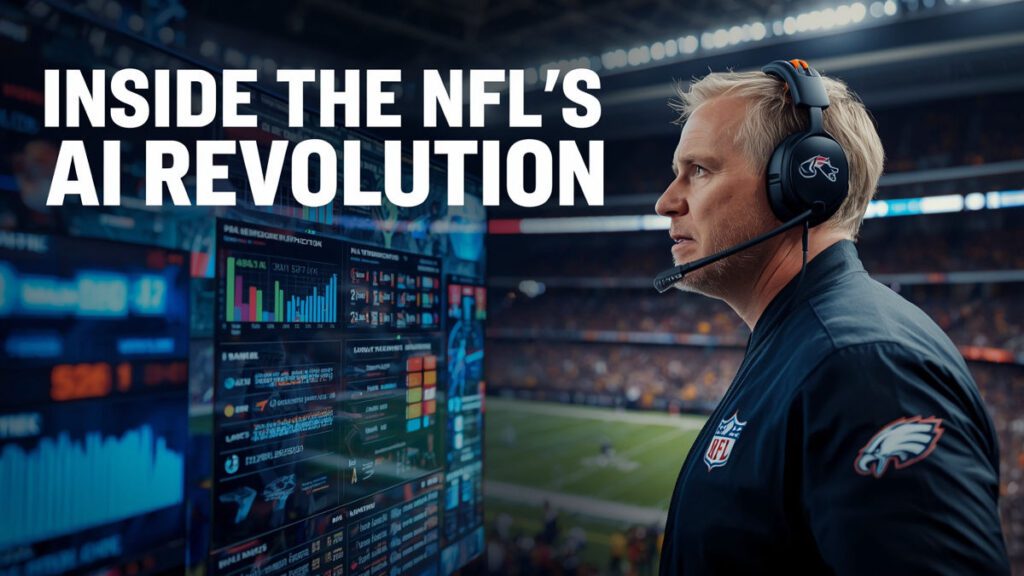
Short answer: The NFL AI revolution runs on tools like AWS Next Gen Stats that crunch millions of data points in real time. AI now shapes play-calling, injury prediction from wearables, fantasy football models, broadcast graphics, and officiating assistance. The league is moving from muscle to machine learning without replacing human judgment.
The NFL has always been a game of strategy, strength, and precision. In 2025 it is becoming a game of data and algorithms. Artificial Intelligence has quietly slipped onto the field, reshaping player performance analytics, injury prevention, and fan engagement.
The gridiron isn’t only about muscle anymore. It is about machine learning.
How is AI used behind the playbook?
Coaches and analysts use AI-powered platforms to break down game film faster than before. Systems like AWS’s Next Gen Stats process millions of data points in real time, from player speed and acceleration to ball trajectory and field coverage.
This data-driven insight lets coaches:
Predict opponent tendencies
Simulate plays before they happen
Optimize strategies based on live conditions
What used to take hours of manual video review now happens in seconds. The result is smarter decisions, faster adaptations, and fewer wasted plays.

Can AI predict injuries before they happen?
In a sport this physically demanding, injury prediction is the holy grail. AI systems analyze biometric and motion data from wearables to identify early signs of fatigue or stress.
Teams use these insights to adjust training loads, resting players before micro-injuries turn into major issues. Machine learning algorithms trained on years of injury data can flag players at high risk, potentially saving careers and millions in salary costs.
Technology is helping keep athletes in the game, longer and stronger.
Why is AI everywhere from fans to fantasy leagues?
The impact of AI extends beyond the sidelines.
Fantasy football platforms use predictive AI models to generate player rankings and game outcomes.
Broadcasters use real-time AI graphics and predictive stats to enrich fan experience during live games.
Sports betting platforms run on deep learning algorithms that assess probabilities with uncanny accuracy.
AI has turned spectators into strategists. Anyone can now access advanced analytics that were once reserved for pro teams.

How are AI referees changing fair play?
Officiating in the NFL is under more scrutiny than ever. AI tools are being tested to assist referees in making accurate calls, tracking ball placement, player movement, and subtle fouls invisible to the human eye.
While not yet fully automated, AI-assisted refereeing is reducing human error and improving fairness in real time. This tech does not replace the refs. It empowers them.
What are the risks of AI in football?
For all its benefits, AI in sports has flaws. Over-reliance on data can undervalue intuition and a human feel for the game.
Bias in training data can also affect player evaluations and scouting reports. If an algorithm is trained mainly on certain playing styles or body types, it may overlook talented outliers.
The challenge now is balance. Use AI to inform, not replace, human judgment.
What does the NFL AI revolution mean for football’s future?
The next decade could see an NFL where every team has its own AI operations department. Recruitment will be data-driven, playbooks will evolve dynamically, and personalized analytics will shape every athlete’s journey.
Imagine a game where coaches wear AR glasses displaying live AI insights, or where quarterbacks receive predictive feedback mid-drive. That is not sci-fi anymore. It is next season’s innovation roadmap.
The NFL’s AI revolution is already underway, and it is rewriting what it means to play, coach, and experience football.

The game just got smarter
Artificial Intelligence isn’t changing football. It is enhancing it. From play-calling precision to fan immersion, the sport is evolving beyond the physical into the analytical.
In a world where milliseconds matter, AI gives players and coaches a competitive edge. The future of football is fast, fair, and fiercely intelligent.
FAQs about the NFL AI revolution
What is AWS Next Gen Stats?
AWS Next Gen Stats is the NFL’s AI-powered analytics platform. It processes millions of data points in real time, tracking player speed, acceleration, ball trajectory, and field coverage to help coaches break down game film in seconds.
Does AI really prevent NFL injuries?
AI does not prevent injuries outright, but machine learning models trained on biometric and wearable data can flag players showing early signs of fatigue or stress. Teams use this to adjust training loads and rest players before micro-injuries escalate.
Are AI referees replacing human officials in the NFL?
No. AI tools are being tested to assist referees with ball placement, player movement, and subtle fouls, but officiating is not fully automated. AI-assisted refereeing supports human officials rather than replacing them.
How does AI power fantasy football and sports betting?
Fantasy football platforms use predictive AI models to generate player rankings and projected game outcomes. Sports betting platforms run deep learning algorithms that assess probabilities from historical and live game data.
What are the downsides of AI in the NFL?
Over-reliance on data can undervalue human intuition, and bias in training data can skew player evaluations, especially for athletes with unconventional styles or body types. Talented outliers risk being overlooked by algorithms.