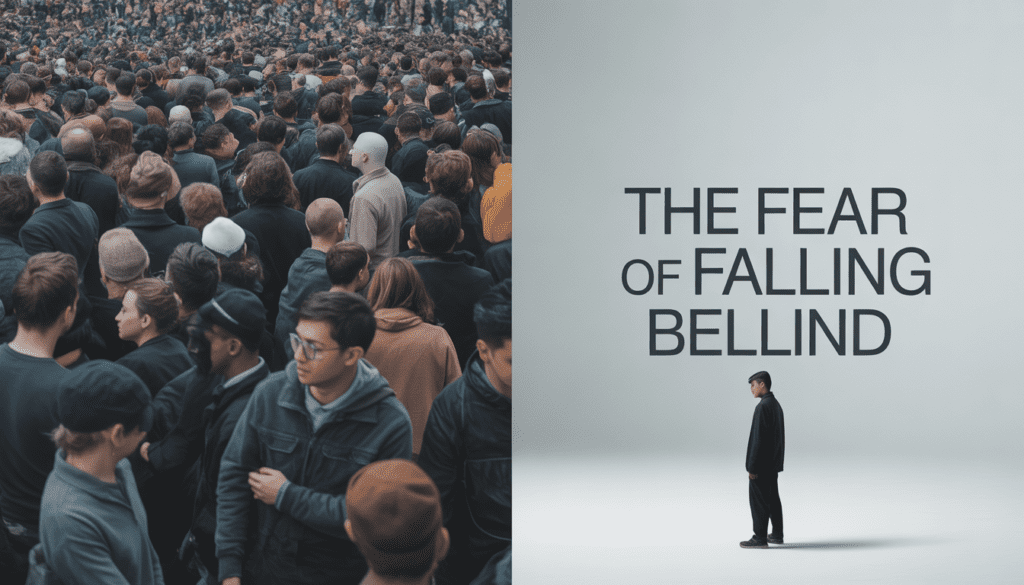
Short answer: The fear of falling behind is a social comparison trap, not a real deadline. When shared life scripts disappeared and social media started serving us curated highlight reels, progress became relative instead of personal. You are not late. You are measuring yourself against a timeline nobody actually agreed on.
There is a quiet anxiety that follows many people through adulthood. Not sharp enough to panic, not loud enough to name, but persistent. It shows up in small moments: when someone your age announces a promotion, an engagement, a startup, a move abroad. When relatives ask what you are doing these days. When social media reminds you of milestones you have not reached yet.
You do not feel unsuccessful. You feel late. Late to figure things out. Late to stabilize. Late to become who you are supposed to be.
The strangest part: no one ever agreed on a deadline, yet everyone feels like they missed one.
Why do timelines feel invisible but absolute?
Previous generations lived with clearer social scripts. Study, work, marry, settle. Even if those paths were imperfect, they were predictable.
Today the script is fragmented. Careers zigzag. Relationships start and end unpredictably. Success looks different for everyone. Stability arrives unevenly, if at all.
On paper this freedom should feel liberating. In reality it creates comparison without coordination.
When there is no shared timeline, everyone starts measuring themselves against everyone else. Progress becomes relative instead of personal. Your life feels like it is lagging behind an invisible standard you never consented to.
How does algorithmic comparison amplify the pressure?
Social media did not invent comparison. It industrialized it.
You are no longer comparing yourself to a small circle of peers. You are comparing yourself to hundreds of curated lives, filtered through highlights, milestones, and wins.
You do not see the uncertainty behind the promotion. The fear behind the engagement. The debt behind the lifestyle. The loneliness behind the achievement.
You just see progress, stacked neatly, endlessly, out of context. And even when you logically understand this, emotionally it still lands. Comparison bypasses reason. It goes straight to self-worth.
Why is being on track a moving target?
One destabilizing aspect of modern life is that on track keeps changing. A good job used to be enough. Now it has to be meaningful. Stability used to be the goal. Now growth is mandatory. Rest used to be earned. Now it feels unproductive.
You are not expected to keep up. You are expected to optimize.
Even when you reach something you once wanted, satisfaction is brief. There is always another level, another benchmark, another version of progress you have not unlocked.
You do not fall behind because you stopped moving. You fall behind because the finish line keeps relocating.
How do we internalize other people’s timing?
The pressure to catch up often has nothing to do with your actual life. It comes from internalizing timelines that were never meant for you.
You absorb expectations from family, culture, peers, and platforms. You treat other people’s milestones as indicators of where you should be.
Slowly, quietly, you stop listening to your own rhythm. You rush decisions. You question paths that feel right but look slow. You feel anxious during pauses that are necessary.
You mistake alignment for delay.
What is the cost of rushing a life?
When people feel late, they speed up. They take jobs that do not fit. They stay in relationships that feel wrong. They skip rest. They avoid reflection.
Not because they are careless, but because slowing down feels dangerous. Rushing creates motion, and motion feels reassuring.
But rushed choices cost more than delayed ones. They create lives that look complete but feel misaligned. They trade clarity for speed. They silence intuition in favor of optics.
Being early is overrated. Being honest is harder, and more sustainable.
Does everyone else actually know what they are doing?
One of the most damaging myths of adulthood is that everyone else has figured it out. They have not. They are adapting. Revising. Second-guessing. Rebuilding.
Most people are making decisions with incomplete information and hoping they can handle the consequences. Confidence is often comfort with uncertainty, not proof of certainty.
When you realize this, something softens. You stop treating your confusion as failure. You start seeing it as participation.
How do you redefine progress without a stopwatch?
Progress does not have a universal unit of measurement. It is not linear. It is not visible. It is not synchronized.
Sometimes progress looks like staying put to heal. Sometimes it looks like starting over. Sometimes it looks like doing less, not more.
The most meaningful progress often happens quietly, internally, before it shows up externally. That kind of progress cannot be rushed without breaking something important.
How do you learn to trust your own pace?
One of the hardest skills to develop is trusting your own timing. It requires resisting constant input. Resisting comparison. Resisting urgency that is not yours.
It means asking: “Is this pressure coming from my values, or from fear?”
And being brave enough to accept the answer. Your pace does not need to match anyone else’s to be valid. It needs to be honest.
The long view we rarely take
If you zoom out far enough, the idea of being behind starts to dissolve. Lives are not races. They are compositions.
Some people build early and refine later. Some wander first and consolidate later. Some restart multiple times. There is no single arc that guarantees fulfillment.
What matters is not how fast you arrive. It is whether you arrive somewhere you want to be.

Where this leaves us
Feeling late does not mean you failed. It means you are aware. Aware of possibilities. Aware of choices. Aware that life is still open-ended.
Openness can feel like pressure before it feels like freedom.
You are not behind. You are in motion, even when it does not look dramatic, even when it is not visible, even when it does not earn applause.
Your life is not overdue. It is unfolding. And unfolding does not follow deadlines.
FAQs about the fear of falling behind
Why do I feel like I am falling behind even when my life is fine?
Because the fear of falling behind is driven by comparison, not evidence. When traditional life scripts dissolved, people began measuring themselves against peers and curated social feeds instead of personal goals. The feeling is real even when the data says you are doing well.
Is the fear of falling behind a mental health issue?
It is not a clinical diagnosis on its own, but sustained comparison anxiety can fuel depression, burnout, and chronic self-doubt. If it is affecting sleep, relationships, or decision-making, it is worth speaking to a therapist.
How do I stop comparing myself to friends on social media?
Remember you are watching highlights, not full lives. Limit passive scrolling, unfollow accounts that trigger inadequacy, and replace comparison with curiosity: ask what you actually want, not what looks impressive.
What is the healthiest way to measure personal progress?
Measure against your own starting point, your values, and your current capacity. Internal markers such as clarity, energy, and honest relationships often matter more than external milestones.
Is it okay to pause or take a break from chasing goals?
Yes. Pausing often protects long-term progress. Rest, reflection, and recalibration are part of moving forward, not proof that you are stuck.