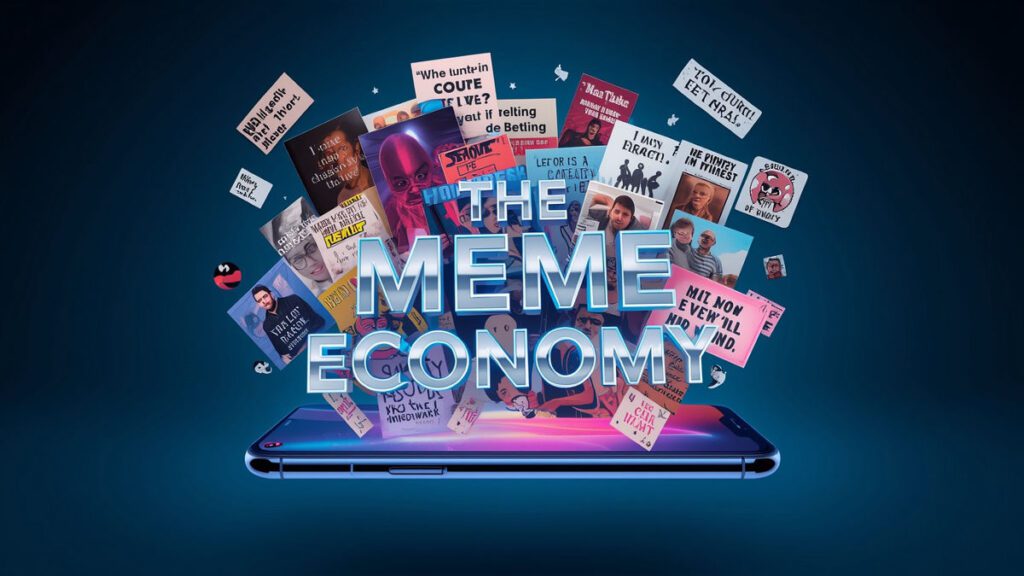
Short answer: The meme economy is the attention market where humour now drives influence, brand reach, and even political power online. Coined by Richard Dawkins in 1976 as cultural genes that spread through imitation, memes today shape how Gen Z expresses identity, how brands like Wendy’s and Netflix market, and how news travels before fact-checkers catch up.
A decade ago, memes were inside jokes on niche forums. Today they’re cultural blueprints — the fastest, funniest, and often most truthful way to capture the world’s collective mood.
Memes now move markets, start movements, and shape politics. They’re the new language of the digital age: quick to create, faster to spread, and impossible to ignore.
How did humour evolve into a global economy of attention, influence, and identity? The answer lies in how memes reflect the internet’s soul — chaotic, creative, and endlessly self-aware.
What is the DNA of a meme?
A meme is more than an image or phrase. It’s an idea wearing humour as camouflage.
The concept, coined by evolutionary biologist Richard Dawkins in 1976, described how cultural ideas spread like genes, through imitation. The internet turned that theory into reality.
A meme starts with a simple template — a reaction image, a clip, a phrase — and evolves as millions reinterpret it. It’s the fastest form of storytelling, one that relies on shared understanding and instant recognition.
Memes don’t only entertain. They communicate emotion faster than language ever could.
Why do memes go viral?
Every viral meme follows an emotional formula. It isn’t about perfection; it’s about relatability.
People share content that mirrors their feelings — joy, frustration, sarcasm, or solidarity. Humour makes that sharing safe. Instead of saying “I’m struggling,” a meme can say it for you, turning pain into punchline and tension into laughter.
Psychologists call this benign violation theory: humour emerges when something feels wrong, but not too wrong. Memes live perfectly in that space — edgy, but acceptable. That’s why memes spread faster than news: they express truth with a smile.
How does the attention economy fuel the meme market?
In the digital world, attention is currency. Memes are its stock.
Brands, influencers, and even governments now use memes strategically to connect with audiences. A single viral post can reach millions without spending a dollar — if it feels authentic.
From Wendy’s Twitter comebacks to Netflix meme marketing, humour has become the new language of engagement. It breaks walls, builds relatability, and cuts through algorithmic clutter.
The meme economy runs on speed, creativity, and timing — the same ingredients that drive modern influence.
How are memes cultural mirrors?
Every major global event in the past decade has spawned its own meme ecosystem, from elections and economic shifts to celebrity moments and internet meltdowns.
Memes don’t only reflect culture; they shape it. They document history in real time, through the lens of humour and shared sentiment.
When the world feels uncertain, memes provide relief — collective laughter amid chaos. In many ways, they’re modern folklore: short, repeatable stories that travel faster than truth. What used to be graffiti on walls is now graffiti on timelines.
Who are the new meme creators?
Behind every viral meme is a creator, often anonymous but highly influential.
These creators have become the storytellers of the internet. Some are comedians, others designers or teenagers with sharp wit and Wi-Fi. They share one trait: the ability to read the room and the algorithm.
Platforms like Instagram, Reddit, and X (formerly Twitter) have birthed entire meme pages with millions of followers. For many, it’s not art alone; it’s a career. In the digital economy, humour pays, literally.
How do memes shape politics?
Politics has discovered the power of humour.
Campaigns, activists, and even government agencies now use memes to influence opinion. A clever meme can dismantle propaganda faster than a press release. It also has a dark side: misinformation disguised as humour can manipulate public sentiment without accountability.
Political memes thrive because they compress ideology into entertainment. They make serious issues digestible — sometimes oversimplified — but always shareable. The meme is the modern-day pamphlet: fast, visual, and persuasive.
What is the dark side of the meme economy?
Not all memes are harmless fun. The same virality that spreads humour can spread hate.
Meme culture has been used to normalise racism, sexism, and extremism, often under the guise of “it’s just a joke.” Some meme pages act as echo chambers, weaponising humour to desensitise audiences to harmful ideas.
Because memes travel faster than fact-checking, they can distort narratives before truth catches up. The internet’s greatest strength — its speed — is also its greatest risk.
How are memes a form of digital identity?
For Gen Z, memes aren’t only entertainment; they’re self-expression. A meme can represent a mood, a worldview, or even a personality type. Sharing the right meme says, “This is who I am” — witty, ironic, or self-aware.
Memes form micro-communities of people who get it. They connect strangers through shared humour and collective experience.
In a world that feels increasingly fragmented, memes give people something universal: the ability to laugh together, even briefly.
What is the future of the meme economy?
As AI advances, meme creation is becoming automated. AI tools can now generate templates, captions, and trends in real time.
AI can produce humour, but it can’t understand context. The best memes work because they reflect genuine emotion — something only humans feel deeply enough to share authentically.
The future of meme culture will likely blend human creativity with machine speed, a collaboration between instinct and intelligence. Even then, the essence will remain the same: connection through laughter.
Why humour will always win
Humour disarms conflict, bridges differences, and reminds us that we’re all living the same absurd story.
In the noise of digital life, memes give us micro-moments of relief: a pause from outrage, a burst of joy, a reminder that we’re not alone.
The meme economy isn’t only about clicks. It’s about connection, the kind that only laughter can create.
FAQs on the meme economy
What is the meme economy?
The meme economy is the attention marketplace where humour becomes the dominant currency of influence online. Memes drive reach for brands, creators, and movements, often reaching millions without any ad spend when they feel authentic.
Who invented the word meme?
Evolutionary biologist Richard Dawkins coined the term in 1976 to describe how cultural ideas spread like genes through imitation. The internet turned that concept into a viral ecosystem.
Why do Gen Z and millennials share so many memes?
For Gen Z especially, memes are self-expression. A single meme can capture a mood, worldview, or identity, and sharing the right one says “This is who I am” to a wider micro-community of people who get the joke.
How do brands use memes?
Brands like Wendy’s and Netflix use memes to connect with audiences in the language they already speak. A well-timed meme builds relatability, cuts through algorithmic clutter, and often outperforms paid ads.
What are the risks of meme culture?
Memes can normalise racism, sexism, and extremism under the cover of “just a joke,” and political memes can spread misinformation faster than fact-checkers can respond. The same speed that makes memes powerful also makes them dangerous.