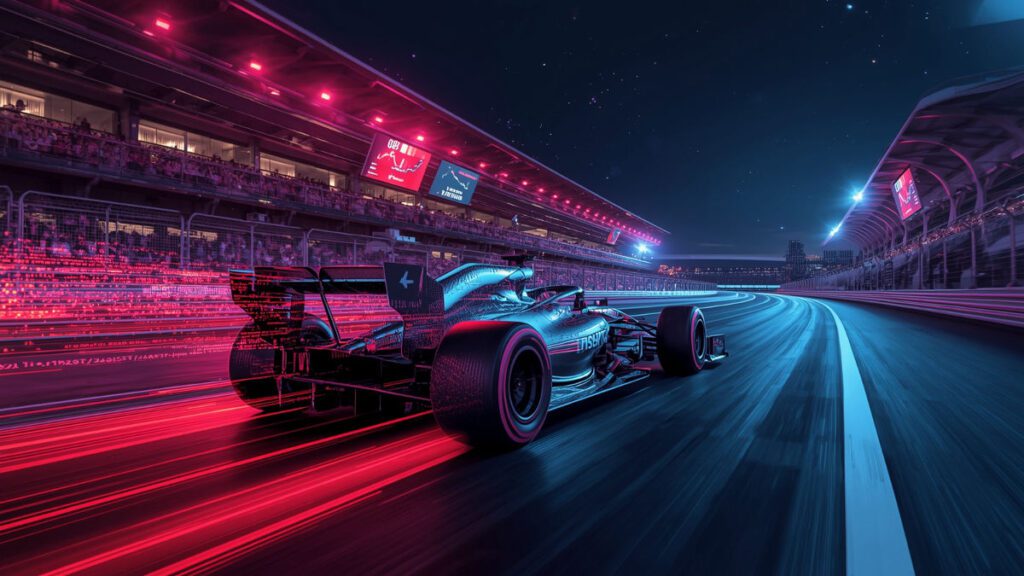
Short answer: Formula 1 technology has shifted the sport from raw horsepower to data science. Each car now produces over 1.1 million data points per second, AI models run thousands of pit-stop simulations before a call is made, and F1 has committed to net-zero carbon by 2030 with fully sustainable synthetic fuels from 2026.
How did F1 turn garages into data laboratories?
Pit crews used to be mechanics, engineers, and adrenaline junkies with wrenches. Today they sit next to software developers, data analysts, and AI specialists.
Each F1 car generates over 1.1 million data points per second, covering tire pressure, fuel flow, and micro-level vibrations in the suspension. That stream runs live to team headquarters thousands of miles away, where analysts monitor performance in real time.
Teams like Mercedes, Red Bull, and McLaren have become data laboratories. Race decisions no longer rely on gut feeling. Machine learning models predict tire degradation, weather shifts, and opponent behaviour. The fastest car is now the smartest one.
How does AI make pit-wall decisions?
The pit wall used to run on headsets and hand signals. It now looks like a mission control centre, with AI tools feeding strategists split-second calls that can decide a race.
When should a car pit? Soft or medium compounds? Will a safety car come out in the next few laps? AI simulations test thousands of virtual scenarios before a human commits. The algorithms draw on decades of racing history and adjust live to track conditions.
Driver training has changed too. Simulators powered by neural networks put drivers inside hyper-realistic virtual laps, from Monaco’s unforgiving corners to rain-soaked sessions at Spa. Formula 1 is now predictive science in motion.

What is F1 doing about sustainability at 300 km/h?
Speed is no longer the only obsession. F1 has set a net-zero carbon target for 2030, an ambitious goal for a sport built on fuel and fire.
Hybrid power units were the first step. They capture kinetic energy from braking and heat from exhausts and convert both into electric power. That same engineering doubles as a testing ground for future road cars.
Fuel is the bigger shift. F1’s 2026 regulations bring in fully sustainable synthetic fuels, with the potential to cut carbon emissions by up to 80%. Teams are also rethinking freight, reusable materials, and compact design to cut their footprint. A sport that once symbolised excess is now leading a green push at full throttle.
Does the human driver still matter in an AI-driven sport?
Amid the data and code, one question stays live: where does the human touch fit in?
Formula 1 remains deeply human. The feel of the car through a driver’s hands, the instinct to brake a fraction earlier, the nerve to dive inside a corner — software cannot replicate that. Lewis Hamilton and Max Verstappen combine analytical precision with human instinct. The fastest lap is as much about mindset as maths.
Teams are investing in mental performance coaching and biometric tracking to understand the human side of racing. Heart rates, stress levels, and cognitive focus are analysed so drivers can hold composure under pressure. The future of F1 is about empowering humans, not replacing them.
What does the future grid look like?
Picture an F1 race where AI co-drivers assist humans in real time, adjusting throttle response, braking, or downforce dynamically. Or fully autonomous exhibition races that test how machines handle the chaos of competition.
That future is already in motion. AWS and Oracle are pushing cloud-based systems that process live race data in milliseconds, feeding next-generation strategy models. 5G lets teams move massive datasets instantly, while augmented reality overlays help engineers visualise aerodynamic flow mid-race. Fan engagement is being rebuilt too, with live telemetry, virtual cockpit views, and AI-driven race predictions.
Formula 1’s future blurs the line between racing, technology, and digital experience. The winner won’t be the first across the line. It’ll be the team that innovates the fastest.
Why does this silent revolution matter?
Formula 1 has always been about more than cars. It is what happens when ambition meets technology. Every season, the sport reinvents itself: faster, smarter, cleaner.
This revolution doesn’t roar like a V10 engine, but its impact is seismic. The cars of tomorrow will shape how we think about innovation, sustainability, and human potential. In an age where machines can predict almost everything, F1 reminds us that courage, risk, and heart still can’t be coded. They have to be driven.
FAQs about Formula 1 Technology
How much data does a Formula 1 car generate per second?
Each F1 car generates over 1.1 million data points per second, covering tire pressure, fuel flow, and micro-level suspension vibrations. That data is streamed live to team headquarters thousands of miles away for real-time analysis.
When will Formula 1 switch to fully sustainable fuel?
F1’s 2026 regulations introduce fully sustainable synthetic fuels, capable of cutting carbon emissions by up to 80%. It is a key step toward the sport’s net-zero carbon target for 2030.
How does AI help F1 teams make pit-stop decisions?
AI tools run thousands of simulations covering tire compounds, safety-car probability, and weather shifts before a strategist commits to a call. The models learn from decades of racing history and adjust in real time to live track conditions.
Which tech companies work with Formula 1?
AWS and Oracle power the cloud systems that process live race data in milliseconds and feed next-generation strategy models. 5G networks and augmented reality tools are also part of the modern F1 stack for engineers and fans.
Do human drivers still matter in modern F1?
Yes. Drivers like Lewis Hamilton and Max Verstappen combine data-driven precision with human instinct that algorithms cannot replicate. Teams now use mental performance coaching and biometric tracking to help drivers stay sharp under pressure.