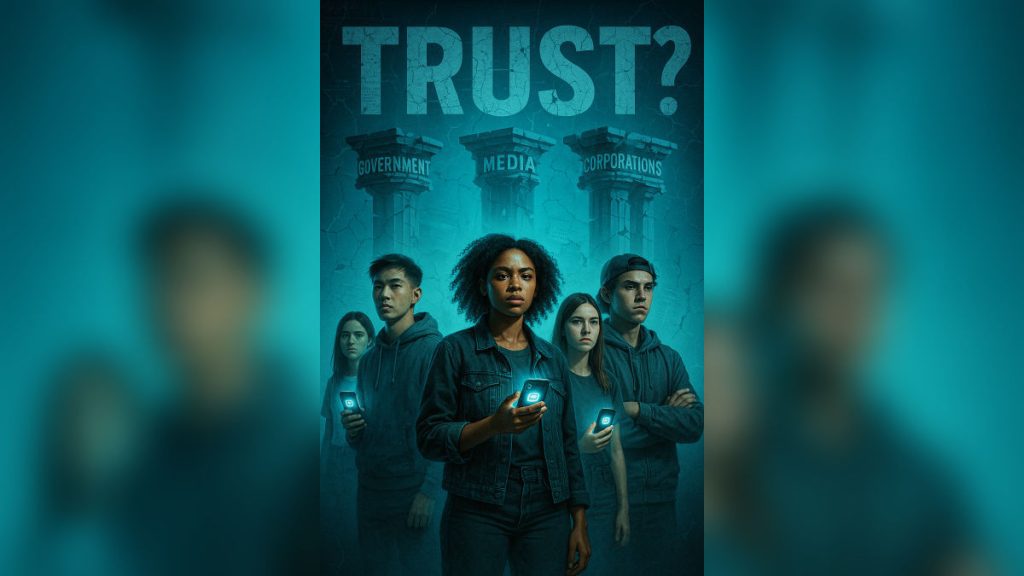
Short answer: Gen Z isn’t rejecting institutions out of laziness or rebellion. They’ve grown up with constant access to data, watched colleges balloon to $1.7 trillion in U.S. student debt, seen only 24% trust the federal government (Pew, 2022), and discovered media bias in real time. They want transparency, accountability and proof before they hand over loyalty.
Born between the mid-1990s and early 2010s, Gen Z is navigating adulthood through a lens no generation has worn before. Rapid tech, political turbulence, economic chaos, and an absurd glut of information, all of it is the air they breathe. So no, it’s not surprising that they regard traditional institutions, education, government, religion, media, with a raised eyebrow. But contrary to what op-eds keep claiming, this isn’t apathy. It’s pragmatism.
It’s the response of a generation that’s been told the system works and watched it sputter on prime time.
Let’s unpack the real reasons trust has eroded, and what it signals about the future.
Is college still worth it for Gen Z?
The cost-benefit math
One of the most personal pain points for Gen Z is higher education. The old line that a degree guarantees success? Nobody’s taking it at face value any more. Instead, Gen Z is asking blunt questions about return on investment.
With tuition skyrocketing globally and student debt now sitting at over $1.7 trillion in the U.S. alone according to the Federal Reserve, scepticism is the rational response. The thinking goes: Why spend four years and tens of thousands of dollars on a credential that may not get me a job, in a market that increasingly cares about skills, not titles?
Curriculum vs. the real world
Even more frustrating is the gap between what universities teach and what employers actually want. As one 22-year-old coding bootcamp graduate put it, “College taught me Shakespeare, but it didn’t prepare me for a job interview in tech.”
And the catch is, Gen Z isn’t anti-knowledge. They crave practical, current learning, the kind that universities, weighed down by accreditation cycles and tenured inertia, often deliver years late. In an era of AI and automation, a degree that hasn’t updated its syllabus since 2017 feels obsolete on graduation day.
Why does Gen Z distrust politics and government?
Growing up in polarisation
From early adolescence, Gen Z has witnessed political gridlock, climate inaction, widening inequality and the public erosion of democratic norms. The global climate strikes, the Black Lives Matter protests, the COVID-19 pandemic, every one of those baked in a sense that governments routinely fail to act in the public’s interest.
It’s not just disillusionment, it’s exhaustion. A 2022 Pew Research Center study found that only 24% of Gen Z Americans trust the federal government to do what’s right “most of the time.” That number isn’t an abstraction. It’s a generation telling pollsters they’ve stopped expecting much.
Hyper-awareness, hyper-exposure
Earlier generations relied on a handful of news outlets. Gen Z grew up with the internet, which means they’re constantly exposed to global perspectives, whistleblower accounts, and stories that go against the grain of mainstream political coverage. That access doesn’t always make them cynical. It makes them informed, cautious, and a lot harder to spin.
How does Gen Z view religion?
Identity over institution
One of the more subtle yet profound shifts in Gen Z’s worldview involves religion. They’re not necessarily turning away from spirituality, but plenty are stepping back from organised religion as a structure.
What drives this generation is individuality, inclusivity, and self-discovery. They’re more likely to question doctrine and explore personal belief systems, mindfulness practices, philosophy, blended faith traditions, whatever fits.
According to a Springtide Research Institute study, only 31% of Gen Z in the U.S. consider themselves religious, but 60% say they are spiritual in some way. That’s not a loss of faith. That’s a reorganisation of it.
Lack of inclusion
Another reason for the shift is that some Gen Zers feel alienated by religious institutions they see as outdated, non-inclusive, or resistant to change, especially on questions of gender, sexuality, and social justice. Where the answer is “that’s how we’ve always done it,” Gen Z tends to walk.
Why doesn’t Gen Z trust traditional media?
Misinformation and a sharper eye for bias
In the post-truth era, Gen Z is unusually attuned to misinformation. They’ve come of age in a world where fake news, manipulated headlines and clickbait are part of the default digital landscape. You learn to spot a doctored thumbnail by age 14.
The result? Trust in legacy media has cratered. A Reuters Institute report in 2023 found that only 26% of Gen Z respondents globally trust news they see on TV or in newspapers. They’re more likely to trust content shared by independent creators or peer networks, not because creators are inherently better journalists but because the lived-experience layer feels honest.
Decentralised, peer-driven information
YouTube, Reddit, TikTok, Instagram, these are Gen Z’s primary news sources now. Not necessarily because they trust influencers more, but because they value authenticity, lived experience, and viewpoints the mainstream skips.
That shift is democratising information. It also dumps more responsibility on Gen Z to fact-check, weigh bias, and curate their own news diet. And they’re doing it, often better than older generations give them credit for.
A pragmatic, analytical generation
Information access = demand for transparency
Gen Z grew up with Google at their fingertips. That level of instant access has shaped how they view authority. They’re not satisfied with vague explanations or top-down commands. They want receipts. Data. Clarity.
According to McKinsey & Company, Gen Z tends to be “highly analytical” in decision-making. Whether the choice is a university, a brand, or a political candidate, they don’t lean on reputation alone. They investigate.
Questioning, not rejecting
What sets Gen Z apart is not outright rebellion, it’s critical thinking. They’re not anti-institution by default. They simply expect better. Transparent, inclusive, genuinely accountable, that’s the bar.
Put another way: Gen Z isn’t burning the house down. They’re trying to renovate it, brick by brick, and getting frustrated when the contractor keeps disappearing.
What would earn Gen Z’s trust back?
Traditional institutions still have a place. Only if they’re willing to evolve, though. To win Gen Z’s trust, these systems must:
- Be transparent about their intentions and decisions
- Adapt to technological and societal change instead of resisting it
- Listen actively to diverse voices, not perform listening
- Act on issues that matter, climate change, inequality, mental health
Institutions that show authenticity, humility, and a real willingness to change can still win Gen Z over. But trust is earned now, not assumed.
Final Thoughts: Don’t Mistake Skepticism for Cynicism
Gen Z’s mistrust of traditional institutions isn’t apathy. It reflects their experience, their access to information, and their hunger for a more equitable, truthful world. They aren’t naïve. They’ve seen what happens when systems fail, repeatedly, on camera, in real time.
And rather than give up, many are quietly building alternatives that reflect their values. That’s the part the headlines miss.
FAQs about Gen Z trust in traditional institutions
What percentage of Gen Z trusts the U.S. federal government?
According to a 2022 Pew Research Center study, only 24% of Gen Z Americans trust the federal government to do what’s right “most of the time.” That figure aligns with broader generational distrust of large institutions and political gridlock during their formative years.
How religious is Gen Z compared to older generations?
A Springtide Research Institute study found that only 31% of Gen Z in the U.S. identify as religious, while 60% describe themselves as spiritual in some way. They’re less affiliated with organised religion but often more open to personalised, inclusive belief systems.
Where does Gen Z get its news?
Gen Z primarily gets news from YouTube, Reddit, TikTok, and Instagram, with independent creators and peer networks ranked as more trusted than legacy outlets. A 2023 Reuters Institute report found only 26% trust news from TV or newspapers globally.
Why is Gen Z skeptical of college degrees?
The combination of soaring tuition, $1.7 trillion in U.S. student debt (per the Federal Reserve), and a job market increasingly focused on skills over titles has made Gen Z question the ROI on a four-year degree. Many turn to bootcamps, certifications and direct industry experience instead.
Is Gen Z anti-institutional or just demanding more?
They’re demanding more, not abandoning institutions outright. Surveys show Gen Z wants transparency, accountability and inclusivity from the systems they engage with. Institutions that demonstrate genuine reform, rather than performative changes, can still win their trust.