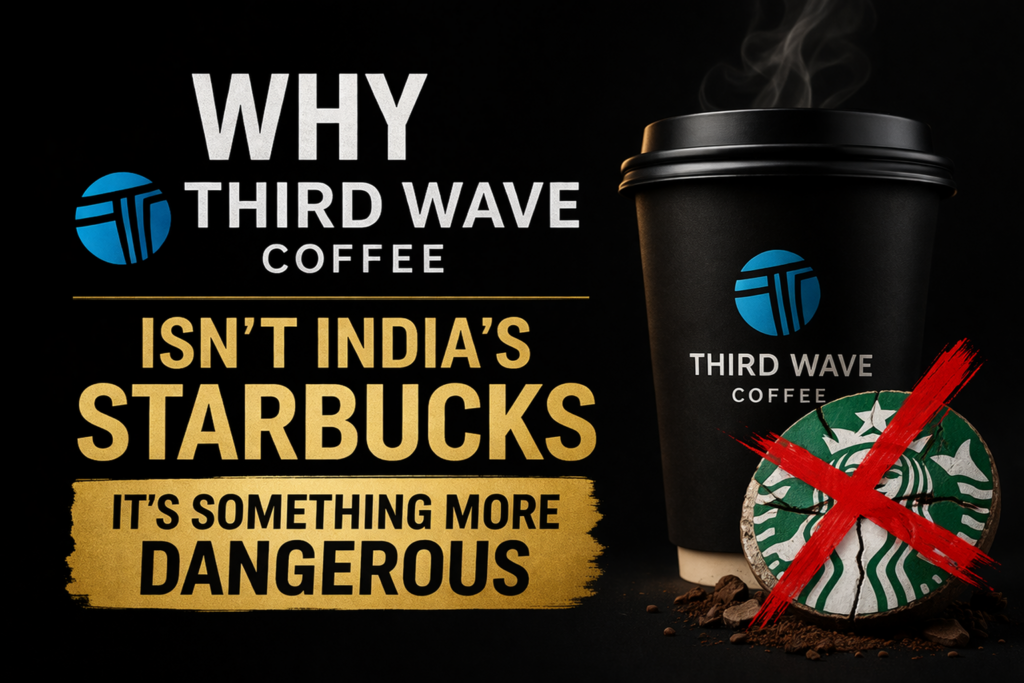
Short answer: Third Wave Coffee isn’t India’s Starbucks. Starbucks sells aspiration — a ₹400 drink as participation in global culture. Third Wave sells belonging — a reliable third space where you can sit for hours, open a laptop, and not feel judged. In a country where personal space is limited and public spaces are chaotic, that’s a bigger cultural shift than pricing.
Why is the café war in India no longer about coffee?
Walk into any café in urban India today, and you’ll notice something almost immediately. People aren’t only sipping coffee. They’re:
- working, but not calling it work
- catching up, but not in a rush
- scrolling, clicking, posting
- quietly building a version of their lives that feels curated
I remember sitting in a café in Gurgaon last year, laptop open, pretending to finish a presentation. Around me, no one seemed in a hurry. A couple was on a quiet date. A freelancer was deep in edits. A group of college students had ordered one drink and occupied a table for hours.
That’s when it hit me. Cafés in India are no longer about coffee. They are about space.
For years, this space was dominated by global giants like Starbucks and newer entrants like Tim Hortons. They defined what a “modern café experience” should look like. Then came Third Wave Coffee. Instead of following the rules, it quietly rewrote them.
Is Third Wave Coffee a Starbucks copycat?
At first glance, the comparison feels lazy. Minimal interiors. Aesthetic lighting. Iced beverages with complicated names. Tables designed for laptops and long sits. It looks familiar. Almost global.
Spend enough time inside, and you’ll feel the difference. Starbucks sells aspiration. Third Wave sells belonging. That distinction may sound subtle. It isn’t. It’s the difference between walking into a place to be seen versus walking in to be.
How did Starbucks and Third Wave split the Indian market?
For over a decade, Starbucks represented something larger than coffee in India. It was a symbol of affluence, a marker of exposure, a quiet flex. Ordering a ₹400 drink wasn’t only consumption. It was participation in a global culture.
According to a report by Statista, India’s premium café market has grown steadily over the past decade, largely driven by urban millennials seeking aspirational experiences.
Gen Z changed the equation. They didn’t reject aspiration entirely — they redefined it. Instead of asking, “How do I fit into global culture?” they started asking, “What fits into my life?”
Third Wave Coffee understood that early. Instead of positioning itself as a place you visit occasionally, it became a place you return to, again and again, without overthinking.
Is Third Wave Coffee actually cheaper than Starbucks?
Third Wave isn’t dramatically cheaper than Starbucks. But it feels more accessible.

In consumer psychology, perception often matters more than reality. Gen Z doesn’t want “cheap.” That word carries baggage. They want:
- value without embarrassment
- quality without intimidation
- aesthetics without pressure
Third Wave operates in that sweet spot. You don’t feel guilty spending there. You don’t feel judged for staying long. You don’t feel like you’re stretching your identity to fit the space. A subtle calibration, and incredibly powerful.
How did Third Wave shift from global aesthetic to Indian relatability?
Walk into a Starbucks anywhere in the world and it feels consistent. That’s the strength of a global brand.

But consistency can come at the cost of context. Third Wave feels local, not in an obvious, overdone way, but in a way that makes sense:
- The menu experiments more freely
- The crowd feels less performative
- The environment feels less intimidating
It isn’t trying to impress you. It’s trying to include you. In a country as diverse and layered as India, inclusion scales faster than aspiration.
Tim Hortons vs Third Wave — convenience or culture?
If Starbucks stands for aspiration, Tim Hortons stands for efficiency.
It’s quick. Familiar. Food-forward.
Third Wave is building something entirely different — what sociologists call a “third space”, a concept popularised by Ray Oldenburg. A third space is neither home nor work. It’s where people go to exist socially, informally, and comfortably.
In India, where personal space is often limited and public spaces are chaotic, the idea of a reliable third space is incredibly valuable. Third Wave isn’t only selling coffee. It’s selling time and permission.
Why did Third Wave Coffee build for permission?
This is perhaps its most underrated insight.

It gave people permission to:
- sit longer without ordering repeatedly
- open a laptop without looking out of place
- meet someone without worrying about the bill
- romanticise everyday routines
This matters more than it sounds. Modern urban life in India is increasingly compressed — physically, mentally, emotionally. Spaces that let you slow down, even slightly, become powerful.
Most brands focus on product. Third Wave focused on behaviour. And behaviour, once adopted, is incredibly hard to disrupt.
Why does this matter beyond coffee?
What we’re seeing isn’t a café success story. It’s part of a broader cultural shift.
India is moving from imported experiences to localised expressions:
- Fashion is becoming more indie and experimental
- Content is becoming more regional and personal
- Food is becoming more fusion-driven and expressive
According to a report by Deloitte, India’s young consumers increasingly prefer brands that reflect their identity rather than global status symbols. Third Wave is one of the clearest examples of that shift.
What’s the uncomfortable truth for global brands?
The real challenge for global giants isn’t competition. It’s adaptation speed.
Brands like Third Wave understand cultural nuance faster, iterate quicker, and build with context, not templates. Global players often operate within established systems that are harder to change.
Gen Z is less impressed by logos, less driven by legacy, and more interested in relevance. They don’t want brands that say, “This works everywhere.” They want brands that say, “This was made for you.”
So is Third Wave India’s Starbucks?
No.
That comparison belongs to an older narrative, one where India was seen as a follower market. That’s no longer true. Third Wave Coffee isn’t India’s answer to Starbucks. It’s evidence that India has started asking better, more relevant questions. In culture, the brand that asks better questions usually wins.
TheYouthTalks POV
Here’s the real shift, stripped down to its essence:
The flex for Gen Z is no longer “I can afford Starbucks.” It’s “I don’t need it anymore.”
That’s not rejection. It’s evolution.
What’s the future of cafés — and Indian culture?
If you’re building a brand in India today, this story offers a clear lesson. Don’t import what works globally. Don’t replicate what looks successful. Instead, ask:
- What does my consumer feel in this space?
- What behaviour am I enabling?
- What role do I play in their everyday life?
People don’t remember brands for what they sell. They remember them for how they fit into their lives. Right now, Third Wave Coffee fits in perfectly.
FAQs on Third Wave Coffee in India
What is Third Wave Coffee in India?
Third Wave Coffee is an India-born café chain that has grown rapidly by positioning itself as an accessible, everyday “third space” for Gen Z and young professionals, rather than an aspirational global brand like Starbucks.
How is Third Wave Coffee different from Starbucks?
Starbucks sells aspiration — walking in to be seen. Third Wave sells belonging — walking in to simply be. The experience feels more local, less performative, and less intimidating, even though the two aren’t dramatically different in price.
What is a “third space” in café culture?
A term popularised by sociologist Ray Oldenburg. A third space is a place that’s neither home nor work — where people go to exist socially, informally and comfortably. In India, where personal space is limited and public spaces are chaotic, a reliable third space is especially valuable.
How much does a drink cost at Starbucks in India?
A typical Starbucks drink in India costs around ₹400. For a decade that price was part of the aspiration — participation in a global culture, not only coffee.
Why do Gen Z prefer Third Wave Coffee?
Gen Z wants value without embarrassment, quality without intimidation, and aesthetics without pressure. Third Wave gives them permission to sit long, work, meet, and linger — without feeling out of place or watched.