Short answer: Gen Z isn’t trading down to Zudio, they’re trading sideways into relevance. Lower price points (think Rs 799 vs Zara’s Rs 4,999) free up experimentation, while local-first design beats global brand equity. Bain & Company finds younger consumers care more about individuality and value alignment than legacy logos.
For years, fashion in India followed a familiar script. Global brands defined aspiration. Walking into a Zara or H&M wasn’t only about buying clothes, it was about participating in a global narrative. It signalled awareness, access and in many ways arrival.
Then something shifted. Quietly, steadily and almost without anyone calling it, Gen Z consumers are rewriting that script. Instead of gravitating to international giants, they’re picking something closer to home. Brands like Zudio.
At first glance this looks like a price-driven pivot. But that explanation barely scratches the surface, what’s really happening is far more layered. It’s not just about affordability. It’s about relevance, speed and identity.
Why didn’t anyone see this shift coming?
To understand Zudio’s rise, you have to revisit how aspiration itself has evolved. Millennials grew up aspiring to global brands. Access was limited. Ownership carried symbolic weight. A Zara purchase wasn’t just clothing, it was a statement.
Gen Z grew up with access already built in. Malls, e-commerce and social media normalised global exposure, and when something becomes accessible it loses a chunk of its aspirational edge. According to insights from Bain & Company, younger consumers today are less driven by traditional status symbols and more influenced by individuality and value alignment. That changes the fundamental question. Instead of asking “is this globally trendy?”, Gen Z asks “does this feel relevant to me right now?”
How did aspiration turn into accessibility?
This shift from aspiration to accessibility is subtle but transformative. Global brands still hold cultural weight, sure, but they’re no longer the default destination. They’re now one option among many.
Zudio thrives in this new paradigm. It doesn’t lean on legacy or global perception, instead it focuses on accessibility, both in pricing and design sensibility. And accessibility today doesn’t dilute desirability. It enhances it.
Zara vs Zudio: what’s actually being compared?
On paper the comparison looks straightforward. Zara — premium, global, trend-forward. Zudio — affordable, local, mass-market. But Gen Z doesn’t see it as a simple trade-off between quality and price. They perceive something deeper. Zara feels polished, structured and slightly distant. Zudio feels immediate, relatable and culturally aligned.
This isn’t a downgrade in their eyes, it’s a recalibration. They aren’t moving away from quality, they’re moving toward relevance.
Why is Gen Z choosing Zudio?
Speed of trends
Fashion today operates at internet velocity. Micro-trends emerge on Instagram and disappear within weeks, the traditional seasonal cycle feels almost outdated now. Zudio’s strength lies in responding fast. Its collections often mirror what’s trending locally, not just globally. While Zara is known for fast fashion, brands like Zudio are often faster in context. They adapt not just to trends but to how those trends are interpreted in Indian cities.
Cultural relevance
Gen Z in India isn’t passively consuming global fashion anymore. They’re remixing it. They blend streetwear with ethnic elements, experiment with silhouettes, and follow creators who reflect their own environments. Zudio fits seamlessly into this ecosystem. It doesn’t try to replicate Paris or Milan. It reflects what’s happening in Mumbai, Delhi, Bengaluru — places where culture is being actively shaped. That proximity creates resonance.
Price as freedom, not limitation
Affordability gets misread a lot. It isn’t only about saving money, it’s about enabling freedom. With lower price points Gen Z can experiment with styles, switch aesthetics frequently and avoid overthinking every single purchase. That flexibility matters in a generation where identity is fluid and constantly evolving.
A Rs 799 purchase at Zudio feels low-risk. A Rs 4,999 purchase at Zara feels like a commitment. And Gen Z, more often than not, prefers flexibility over commitment.
Logos matter less now
One of the defining traits of Gen Z is their reduced attachment to brand labels. Logos matter less, legacy matters less, even global recognition carries limited weight. What matters instead is fit, aesthetic and the overall vibe. If an outfit looks good, it works regardless of where it came from. This mindset levels the playing field, letting brands like Zudio compete not just on price but on perception.
How has social media flipped the rules?
Social media has fundamentally altered how fashion is discovered and evaluated. Instagram and Pinterest prioritise visual appeal over brand identity, and an outfit styled well can outperform a high-end piece simply because it looks better in context.
In this environment, styling matters more than sourcing, presentation matters more than price, perception matters more than label. A well-curated Zudio outfit can match or even surpass the perceived value of a Zara look. Because online, the question isn’t “where is it from?” It’s “how does it look?”
The new retail energy
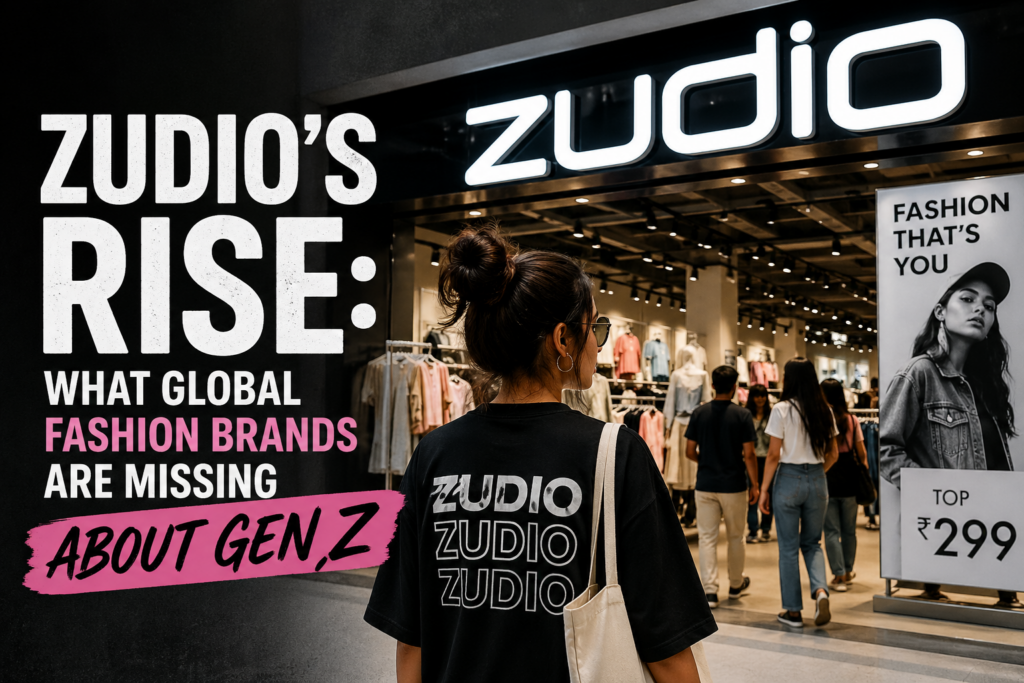
Walk into a Zudio store today and the atmosphere tells its own story. It’s crowded, lively, fast-paced. People move quickly, picking, trying, deciding. There’s a sense of momentum, almost like a real-time response to demand. I was at the HSR Layout Zudio in Bengaluru last weekend and the queue at the trial rooms was a steady twelve-deep, with a kind of cheerful chaos you don’t usually associate with shopping.
Now compare that to a Zara store. More curated. More spaced out. More deliberate. Neither is better or worse, they reflect different mindsets. Zara feels like a decision. Zudio feels like a flow. And increasingly, Gen Z prefers the flow.
What are global brands missing?
This shift doesn’t mean global brands are irrelevant. Far from it. But it does highlight gaps.
Slower cultural adaptation
Global supply chains and standardised processes can limit responsiveness to local nuances. By the time a global trend gets stocked in India, the local remix has already moved on.
Over-reliance on brand equity
What worked a decade ago doesn’t automatically resonate today. Brand equity is real but it’s no longer enough on its own.
Perceived value gap
Even when affordable for some buyers, higher prices invite scrutiny. “Is it really worth it?” is a question Gen Z asks out loud, not in their head.
What is Zudio getting right?
Proximity to consumer behaviour
Zudio operates close to the ground. It understands what people are actually wearing, not just what’s trending globally.
Simplicity in offering
No heavy branding. No complex positioning. Just wearable designs, quick turnover and easy purchase decisions. That simplicity reduces friction.
Strong perceived value
Even at lower prices, the sentiment is clear: “this is worth what I’m paying.” And in today’s market, perceived value often matters more than actual cost.
Why are people moving from ownership to experimentation?
Fashion is no longer about building a static wardrobe. It’s about movement. Trying new styles, switching identities, adapting to moods and moments. Gen Z doesn’t want to be defined by a single aesthetic, they want the freedom to evolve. Zudio enables that experimentation, it lowers the stakes and makes fashion feel less like an investment and more like exploration.
Is this the end of global brands?
Not quite. Brands like Zara and H&M still influence global trends, maintain strong brand equity and attract aspirational segments. But their role is changing. They’re no longer the default aspiration. They’re part of a broader consideration set.
Relevance beats reputation
If there’s one takeaway from Zudio’s rise, it’s this. Relevance will always outperform reputation. It doesn’t matter how global, established or aspirational a brand is. If it fails to reflect current culture, move at the right speed and feel accessible, it risks losing connection.
Zudio didn’t win by being louder. It won by being closer.
FAQs about Zudio’s rise
Why is Gen Z in India choosing Zudio over Zara and H&M?
Because Gen Z prioritises relevance, speed and cultural fit over global brand equity. Zudio’s lower price points (around Rs 799 vs Zara’s Rs 4,999) free up experimentation, while its locally-tuned designs feel closer to what’s actually trending in Mumbai, Delhi and Bengaluru.
What did Bain & Company find about Gen Z and brands?
Bain & Company’s insights show younger consumers are less driven by traditional status symbols and more influenced by individuality and value alignment. That’s a key reason logo-led aspiration has lost steam in this segment.
Is Zudio replacing Zara in India?
Not replacing — reframing. Zara and H&M still influence global trends and hold strong brand equity. But Zudio has shifted the default for everyday and experimental wardrobes, making global brands one option among many rather than the only option.
Why does affordability matter so much to Gen Z fashion?
Because affordability enables freedom. Low-stakes pricing lets Gen Z experiment with styles, switch aesthetics often and avoid overthinking purchases, which suits a generation whose identity is fluid and constantly evolving.
What can global fashion brands learn from Zudio?
Speed up local cultural adaptation, stop relying purely on brand equity and close the perceived value gap. Relevance, immediacy and accessibility matter more than legacy in the current Indian retail landscape.