
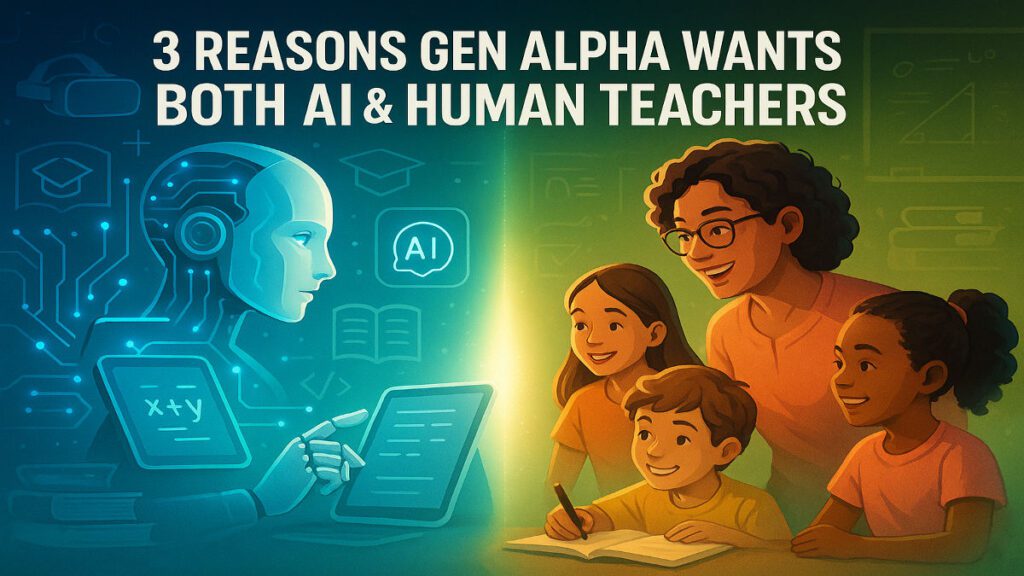
Short answer: Gen Alpha, born after 2010, does not want to pick between AI tutors and human teachers. They want AI for personalised, instant, gamified practice and human teachers for empathy, mentorship, and real conversations. The classroom that works in 2025 blends both.
Walk into a classroom in 2025 and you might see one student getting instant math feedback from an AI tutor while another debates a poem with her teacher. For Generation Alpha, that mix is normal. Raised on smart speakers, recommendation algorithms, and gamified learning apps, they have a clear view of how they want to learn: AI and human teachers, not one or the other.
Why does AI work so well for Gen Alpha?
Gen Alpha grew up with personalisation. From Netflix suggestions to YouTube Kids playlists, they expect experiences shaped around them. AI fits that world.
Adaptive learning platforms like Duolingo and BYJU’S adjust to each child’s pace, strengths, and weaknesses. According to Samsung Global Newsroom, this hyper-personalised approach keeps kids engaged and prevents the boredom of one-size-fits-all lessons.
Gamified elements like leaderboards, point systems, and interactive quizzes make learning feel like play. “I love doing math on my tablet,” says Aarav, an 8-year-old from Mumbai. “It gives me stars when I get answers right!”
Instant feedback matters too. AI corrects a wrong answer the moment it happens and points the student to the next challenge, something a teacher in a crowded classroom cannot always do. AI tutors are also available 24/7, which makes them useful for homework any time of day.
What do human teachers give that AI cannot?
Gen Alpha still wants something no algorithm offers: connection. They want an adult who can read their mood, encourage them, and be there when things get hard, both in class and outside it.
When Riya, age 10, moved to a new school, she felt overwhelmed. “My AI app was helpful for homework, but it couldn’t tell I was sad,” she says. “My teacher noticed, talked to me, and made me feel better. That mattered more than my marks.”
Human teachers bring empathy and presence. They pick up on a frown, a pause, a sigh, and change their approach to match.
They also build social skills. Learning is not only facts; it is teamwork, conversation, and sorting out disagreements. A classroom helps students practise real-world situations, which matters in an era of mostly digital communication.
Teachers also mentor. They shape how students see the world, point them towards passions, and nurture values, contributing to holistic growth in ways AI cannot match.
How does the blended classroom actually work?
The real gains come when AI and teachers work together. Gen Alpha and their parents are not looking for a binary choice. They want blended learning where AI handles repetitive practice and personalised drills, so teachers have more time for relationship-building and deeper instruction.
Picture an AI tool drilling students on grammar every day, while the teacher uses that freed time to run a creative writing workshop on emotions and empathy.
A LinkedIn study showed how AI can take on content delivery and administrative tasks, while teachers focus on individual needs and emotional support. That split works for modern classrooms.
There is also a growing push for AI ethics education. Parents and educators want kids to learn not just how to use AI, but how to use it responsibly. Human teachers guide students through ethical questions, critical thinking, and digital citizenship.
What is Gen Alpha really asking for?
Balance. They want learning that is fast, fun, and personalised, and also human, emotional, and real.
AI can teach them how to solve equations, but teachers show them why those equations matter.
So the question in 2025 is not AI versus human teachers. It is AI and human teachers, working together to unlock each child’s full potential.
FAQs: AI and human teachers in Gen Alpha classrooms
Why does Gen Alpha prefer both AI and human teachers?
Because each one solves a different problem. AI gives Gen Alpha personalised practice, instant feedback, and 24/7 access. Human teachers give empathy, mentorship, and social learning. Gen Alpha wants both because they grew up expecting both personalisation and real human connection.
Which AI learning tools do Indian students use most?
Adaptive platforms like Duolingo and BYJU’S are common, along with gamified apps that use leaderboards, points, and interactive quizzes. According to Samsung Global Newsroom, hyper-personalised AI tools keep engagement high and reduce boredom.
Can AI replace human teachers for Gen Alpha?
No. AI cannot read emotions or build trust the way a teacher can. Gen Alpha students say teachers notice when something is off and respond to it, which matters more than marks. AI handles drills; teachers handle mentorship, empathy, and values.
What is blended learning for Gen Alpha?
Blended learning uses AI for personalised practice and repetitive tasks, and frees the teacher to focus on creative projects, discussion, and emotional support. A LinkedIn study noted that this split lets teachers spend more time on individual needs.
Why is AI ethics education important for Gen Alpha?
Because Gen Alpha will use AI all their lives, and they need to know how to use it responsibly. Teachers guide them through ethical dilemmas, critical thinking, and digital citizenship, which AI tools alone cannot teach.