
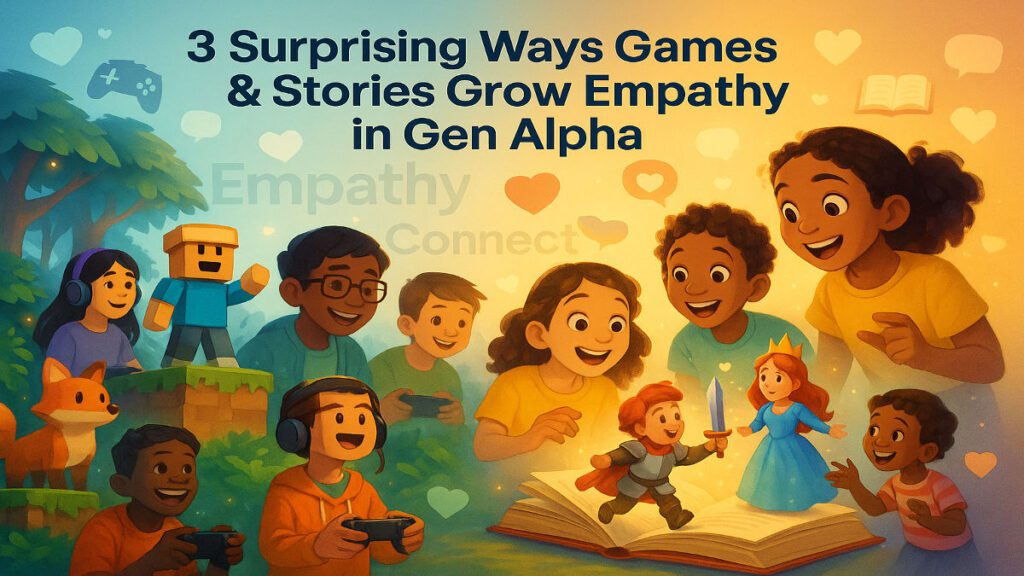
Short answer: Games like Roblox, Minecraft and Eco, along with children’s books such as Mambi and the Forest Fire, are helping Gen Alpha build empathy through role-play, storytelling, and reflection. A 2024 Common Sense Media study found kids who played collaborative or narrative-driven games scored 25% higher on empathy scales. A 2025 Global Education Futures Foundation report says 62% of primary schools using story-plus-game learning saw more empathy, collaboration and emotional awareness.
Screens dominate childhood and attention spans shrink, so you might assume empathy is fading with Generation Alpha (born 2013 onwards). The opposite is happening.
Their digital and story-rich upbringing is building a stronger emotional core. From the immersive worlds of Minecraft and Roblox to the heartfelt journeys in children’s literature, Gen Alpha is learning to care, connect and understand. Here’s how.
How does virtual roleplay build empathy in Gen Alpha?
When 9-year-old Devika logs onto Roblox, she doesn’t just play. One day she’s a doctor in a simulated hospital; the next, she’s running a pet rescue center. Through these avatars, she starts to understand lives far removed from her own.
This kind of role-playing, common in Minecraft and Roblox, lets Gen Alpha experience diversity. They’re walking in other people’s digital shoes.
Games like Eco, which ask players to build sustainable communities while managing limited resources, push children to think about environmental impact, teamwork and civic responsibility. These are empathy simulators as much as games.
The impact shows up in data. A 2024 study by Common Sense Media found that children who regularly engaged in collaborative or narrative-driven games scored 25% higher on empathy scales than those who didn’t.
Through decision-making, problem-solving and collaboration with players around the world, Gen Alpha learns that every action has a consequence, and every player has a story.
Which stories open young hearts and minds?
Digital worlds are immersive, but the analog power of storytelling still shapes emotional intelligence in ways screens can’t.
When 8-year-old Ishan read Mambi and the Forest Fire, a children’s book about a young girl protecting her village from environmental disaster, he didn’t just finish the story. He felt it. He later wrote a letter to his teacher about how he wanted to “save trees and help people like Mambi.”
Stories give children the vocabulary to make sense of the world. They watch characters overcome grief, wrestle with identity and stand up for justice. Along the way, they learn to name their own feelings and respect the emotions of others.
Books like Chumki and the Elephants, which explore conservation and kindness, or culturally rich tales from across the globe, broaden Gen Alpha’s understanding of humanity. These narratives introduce different customs and traditions while teaching tolerance, compassion and courage.
Discussing stories over dinner or in a classroom circle builds communication skills too. Children learn to listen, articulate their thoughts and respond with empathy. In a world racing toward AI and automation, these soft skills are the new superpowers.
Why does blending games with stories work so well?
What happens when rich narrative meets interactive play? Magic.
This blended approach is becoming a favorite among educators and parents. Picture a classroom where students first play a game simulating refugee life, then read a short story about a displaced child, and finally write journal entries reflecting on both. The learning is emotional, personal and hard to forget.
By experiencing challenges in a game and then reflecting on similar narratives in stories, Gen Alpha develops true empathy, not just sympathy. They start to recognise patterns of injustice, understand emotional nuance and appreciate cultural diversity in ways that stick.
Schools in India and beyond are adopting this model. According to a 2025 report by the Global Education Futures Foundation, 62% of primary schools that integrated storytelling with game-based learning reported a noticeable increase in student empathy, collaboration and emotional awareness.
Raising Kinder Digital Citizens
In an age of tech overload and global challenges, nurturing empathy in children isn’t optional. The tools are already in their hands: a joystick, a storybook, a screen, a story.
Parents, teachers and mentors have a role to play. Curate meaningful games. Read powerful, diverse stories. Start conversations that matter. And listen.
Today’s Gen Alpha isn’t just learning to win at games. They’re learning to win at humanity.
FAQs about empathy in Gen Alpha
Do video games really build empathy in children?
Yes. Collaborative and narrative-driven games let children take on different identities and make choices that affect others. A 2024 Common Sense Media study found kids who regularly played these games scored 25% higher on empathy scales.
Which games are best for teaching empathy to Gen Alpha?
Roblox and Minecraft allow roleplay across many scenarios, from running a hospital to building a pet rescue. Eco pushes players to manage shared resources and think about environmental impact, teamwork and civic responsibility.
How do stories help children develop emotional intelligence?
Stories give children the emotional vocabulary to name feelings and see the world through other eyes. Books like Mambi and the Forest Fire or Chumki and the Elephants explore conservation, kindness and courage, and discussing them sharpens listening and articulation skills.
How can parents and teachers nurture empathy in Gen Alpha?
Pick games with collaborative or narrative depth, read diverse stories, and have conversations about what the characters felt and why. Combining both, game plus story plus reflection, produces the deepest empathy gains, as shown in the 2025 Global Education Futures Foundation report.
What is Generation Alpha and when were they born?
Generation Alpha refers to children born from 2013 onwards. They are the first generation to grow up entirely in a hyper-digital world.