Short answer: The edutech tools for Gen Alpha that actually stick in Indian homes and classrooms are gamified quizzes (Kahoot!, Quizizz), adaptive learning (BYJU’S, Khan Academy), collaborative platforms (Google Classroom, Flipgrid), coding kits (Scratch, Tynker), and AR/VR tools (Google Expeditions, Merge Cube). Studies show retention gains of up to 40% with gamification and 55% better science concept clarity with immersive tech.
In 2025, education isn’t confined to chalkboards and textbooks. For Generation Alpha, kids born after 2010, learning has to be interactive, intuitive, and inspiring. Raised on touchscreens and streaming, they’re digital natives with sharp curiosity and short attention spans. What grabs their attention? Edutech tools that entertain, adapt, and immerse.
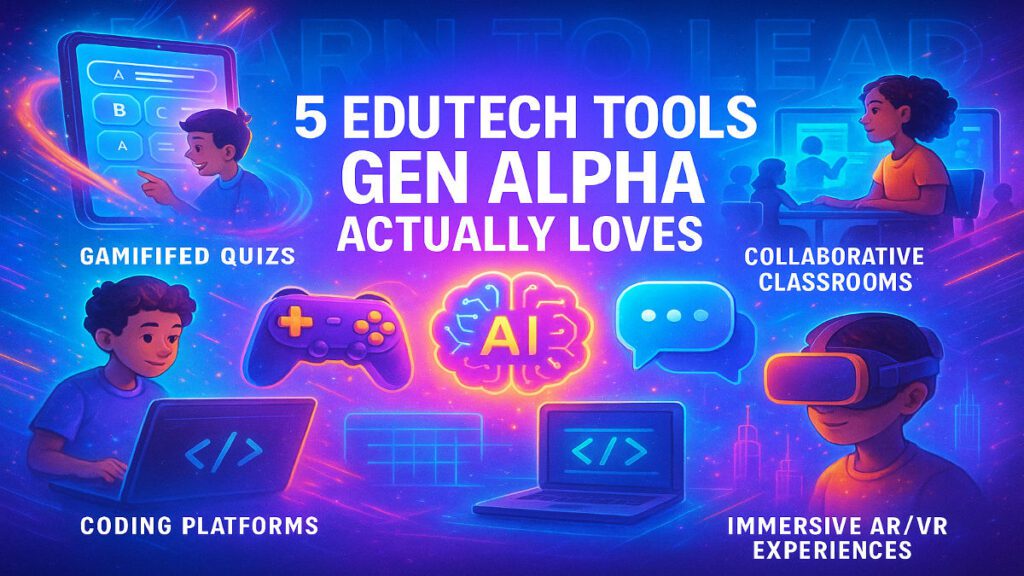
Here’s a look at five powerful edutech tools that are working for Gen Alpha in classrooms and homes across India.
How does gamified learning make study time feel like playtime?
Tools to watch: Kahoot!, Quizizz
Who said quizzes have to be boring? Platforms like Kahoot! and Quizizz turn assessments into fast-paced, game-show-style experiences. Colourful interfaces, leaderboards, and real-time scoring make learning thrilling, even addictive.
My niece Riya, a Class 5 student in Pune, spent an entire Sunday building quizzes for her friends using Kahoot!. “I didn’t even realize I was revising my chapters,” she laughed.
Research shows gamified learning can improve knowledge retention by up to 40% (Yu-kai Chou, Octalysis Group, 2023).
Key highlights
- Real-time feedback keeps kids engaged.
- Customizable content helps teachers align it with curricula.
- Friendly competition boosts motivation and confidence.
Why does personalized learning work for Gen Alpha?
Tools to watch: BYJU’S, Khan Academy
Gen Alpha doesn’t learn in straight lines. Some grasp concepts visually, others need repeated practice. AI-powered platforms like BYJU’S and Khan Academy tailor lessons to each learner’s pace, performance, and preferences.
Picture a teacher who never gets tired, remembers your weak points, and explains a concept five different ways until it clicks. That’s adaptive learning.
A 2024 study by India Today found students using adaptive learning tools improved their test scores by an average of 32% over one academic year.
Key highlights
- Tracks learning progress with precision.
- Offers instant remediation on difficult topics.
- Interactive video lessons enhance understanding.
How do collaborative platforms help kids learn from peers?
Tools to watch: Google Classroom, Microsoft Teams, Flipgrid
Gen Alpha thrives on social interaction, even in learning. Tools like Google Classroom and Flipgrid let students work on group projects, share opinions, and give video feedback. Learning turns communal instead of solitary.
Think of Flipgrid as Snapchat with a purpose. Students post short videos responding to class prompts, which helps even the shyest voices get heard.
When my cousin Aryan used Flipgrid for a history presentation, his video explanation of Ashoka’s empire got over 50 comments from classmates and sparked a lively discussion. He hasn’t looked at history the same way since.
Key highlights
- Real-time file sharing for group assignments.
- Video-based responses foster creative expression.
- Builds communication and teamwork skills.
What coding and STEM platforms suit Gen Alpha?
Tools to watch: Scratch, Tynker, Codecademy
Coding is the new literacy, and Gen Alpha kids are already fluent. Scratch and Tynker make learning code feel like playing a game. They teach logic, structure, and problem-solving in a visual, drag-and-drop format that even 7-year-olds can master.
Tynker offers over 3,700 coding modules, from game design to drone programming. It doesn’t only teach code; it cultivates inventors.
“I built my own space-themed video game in Scratch,” beams 9-year-old Saisha from Bengaluru. “I even made the aliens say things in Kannada!”
Key highlights
- Encourages creativity through storytelling and design.
- Builds foundational STEM skills early.
- Scales from beginner to advanced levels.
How do AR and VR tools turn classrooms into virtual worlds?
Tools to watch: Google Expeditions, Merge Cube, DevDen VR Labs
Why read about volcanoes when you can walk inside one in virtual reality? With AR/VR tools, Gen Alpha students experience lessons in 360-degree environments. From dissecting a frog in a virtual lab to travelling back in time to ancient Egypt, the range is wide.
Google Expeditions offers curated field trips, while Merge Cube lets students manipulate 3D objects using their smartphones.
According to EdTech Review India (2024), immersive tech increased science concept clarity by 55% in middle school students.
Key highlights
- Makes abstract or complex subjects easier to grasp.
- Engages multiple senses, improving retention.
- Sparks wonder and excitement around learning.
It’s not only about tech, it’s about how it’s used
The edutech tools that resonate with Gen Alpha do more than digitize textbooks. They tap into how this generation thinks, feels, and learns: through play, personalization, collaboration, creation, and immersion.
Technology alone isn’t a magic wand. It works best when blended with meaningful mentorship, emotional support, and human connection. Parents and educators have to guide kids to use these tools for academic excellence and for lifelong learning and well-being.
As we navigate education in 2025, ask this: are we giving Gen Alpha the tools to memorize facts, or the tools to imagine, innovate, and lead?
FAQs about edutech tools for Gen Alpha
What are the best edutech tools for Gen Alpha in India?
The top picks are Kahoot! and Quizizz for gamified learning, BYJU’S and Khan Academy for adaptive lessons, Google Classroom and Flipgrid for collaboration, Scratch and Tynker for coding, and Google Expeditions, Merge Cube and DevDen VR Labs for immersive AR/VR.
Does gamified learning actually improve retention?
Yes. Research by Yu-kai Chou and Octalysis Group (2023) shows gamified learning can lift knowledge retention by up to 40%, thanks to real-time feedback, leaderboards, and friendly competition.
How effective is adaptive learning for school students?
A 2024 India Today study found students using adaptive learning tools like BYJU’S and Khan Academy improved their test scores by an average of 32% over one academic year.
Is coding useful for primary school kids?
Yes. Platforms like Scratch and Tynker use drag-and-drop formats that kids as young as 7 can handle, building logic, structure, and problem-solving. Tynker alone offers over 3,700 modules, from game design to drone programming.
Do AR and VR tools really help students learn faster?
According to EdTech Review India (2024), immersive AR/VR tech increased science concept clarity by 55% in middle school students. Tools like Google Expeditions and Merge Cube make abstract topics easier to grasp and improve retention.