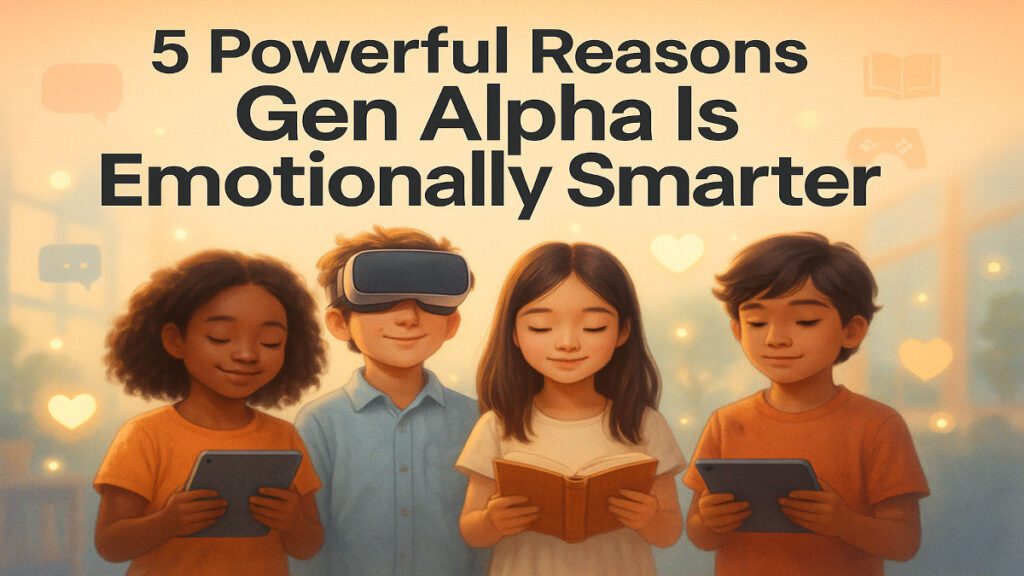
Short answer: Gen Alpha, born after 2013, is growing up more emotionally intelligent thanks to Millennial parents who normalise feelings, schools that teach Social-Emotional Learning (SEL), and games and stories that build empathy. A 2023 Pew Research study found 67% of Millennial parents prioritise emotional literacy at home, and a 2024 CASEL report linked SEL programs to an 11% boost in academic performance.
Global conflict, digital complexity, constant change. You’d expect the youngest generation to buckle. Instead, Generation Alpha is growing up emotionally aware, resilient, and empathetic.
Born after 2013, these digital natives aren’t just tech-savvy. They’re emotionally fluent in ways older generations never were at their age. From open conversations about mental health to empathy learned through immersive stories, Gen Alpha is quietly building a more emotionally intelligent future.
Here are five reasons why Gen Alpha is the most emotionally aware generation yet, and what that means for the rest of us.
Why is mental health a dinner table conversation for Gen Alpha?
Unlike earlier generations who swept emotions under the rug, many Gen Alpha kids grow up in homes where feelings get acknowledged, named, and discussed openly.
Millennial parents, more likely to have attended therapy themselves, are breaking cycles of emotional suppression. They encourage their kids to say things like “I feel anxious” or “That made me upset” without shame.
A 2023 Pew Research study found that 67% of Millennial parents prioritise emotional literacy at home. Gen Alpha is learning from a young age that it’s okay to cry, okay to ask for help, and okay to talk about it.
I remember my niece, barely 6 years old, gently telling her friend during playtime, “It’s okay to be sad. Do you want a hug or to talk about it?” That moment said it all. This generation is wired differently.
How are schools teaching emotional intelligence to Gen Alpha?
In classrooms across the globe, Social-Emotional Learning (SEL) is now as essential as reading and math. Schools recognise that emotional skills matter as much as academic ones.
Through structured lessons on self-awareness, empathy, conflict resolution, and mindfulness, children build the tools to manage their emotions. Mindfulness exercises, like deep breathing when overwhelmed or recognising emotional triggers, have become part of the school day.
According to a 2024 CASEL report, students engaged in SEL programs saw an 11% boost in academic performance along with improved behaviour and emotional regulation.
Picture a 9-year-old who calms themselves before lashing out, or checks in with a friend who looks down. Those are real-world superpowers.
Why does Gen Alpha embrace diversity so naturally?
Gen Alpha is the most diverse generation in history, racially, culturally, and in terms of gender identity and family structure. What sets them apart isn’t just that diversity. They’re growing up celebrating it.
From their favourite shows to classroom discussions, inclusion isn’t a buzzword. It’s the backdrop of their lives.
Kids today hear conversations about gender fluidity, neurodiversity, racism, and climate justice as part of everyday learning, not in hushed tones. This constant exposure to difference fosters tolerance and a deeper emotional understanding of others’ experiences.
A 2024 UNICEF report highlights that Gen Alpha kids are 40% more likely than Gen Z to express concern for social justice issues by age 10. That empathy is only growing stronger.
How do games and stories teach Gen Alpha empathy?
Who said screens were the enemy? For Gen Alpha, digital tools aren’t just entertaining. They’re emotionally enriching.
Through story-rich games like Life Is Strange or interactive experiences on VRChat, children navigate emotions, moral decisions, and consequences in real time. They role-play as characters facing tough dilemmas and build perspective along the way.
Literature, both printed and digital, is shaping their inner world too. Books with characters from various cultures, families, and emotional backgrounds help kids learn that feelings are universal.
Whether it’s a story about a girl saving a forest or a boy coping with loss, these narratives give them emotional blueprints to navigate their own lives.
Why is Gen Alpha more honest about feelings?
Gen Alpha doesn’t view emotional expression as weakness. Vulnerability is cool. Authenticity is valued. They’re growing up in an era where “how are you really feeling?” is more than small talk. It’s a sign of connection.
They reach out when overwhelmed, whether to a parent, a teacher, or a peer. When they don’t have the words, they’re learning to paint it, write it, or act it out.
This openness is already influencing older generations. One teacher from Bangalore recently shared how her 10-year-old student taught her to use a “feelings wheel” to describe her stress after class. “They’re helping us grow emotionally too,” she smiled.
What does Gen Alpha’s emotional intelligence mean for the future?
In 2025, the world is chaotic. If there’s one reason to feel hopeful, it’s Generation Alpha.
They’re growing up emotionally fluent not in spite of the digital age, but because of it. With support from emotionally intelligent parents, inclusive environments, progressive education, and powerful storytelling, they’re learning how to feel, how to care, and how to connect.
Maybe it’s time we follow their lead. Ask questions. Show feelings. Celebrate vulnerability. If emotional intelligence is the currency of the future, Gen Alpha is already rich.
FAQs about Gen Alpha emotional intelligence
When was Gen Alpha born?
Gen Alpha includes children born after 2013. They’re the first generation to grow up fully in a digital-first world, with Millennial parents and AI tools shaping their daily lives.
What is Social-Emotional Learning (SEL)?
SEL is a school curriculum covering self-awareness, empathy, conflict resolution, and mindfulness. A 2024 CASEL report found students in SEL programs saw an 11% boost in academic performance along with better emotional regulation.
Are Millennial parents really more emotionally open with their kids?
Yes. A 2023 Pew Research study found 67% of Millennial parents prioritise emotional literacy at home. Many have attended therapy themselves and actively break cycles of emotional suppression.
How does Gen Alpha compare to Gen Z on social issues?
A 2024 UNICEF report found Gen Alpha kids are 40% more likely than Gen Z to express concern for social justice issues by age 10. They’re growing up with inclusion as a default, not a debate.
Can video games actually build empathy?
Story-driven games like Life Is Strange and social spaces like VRChat let kids role-play moral dilemmas and see consequences of their choices, which builds perspective-taking, a core component of empathy.