

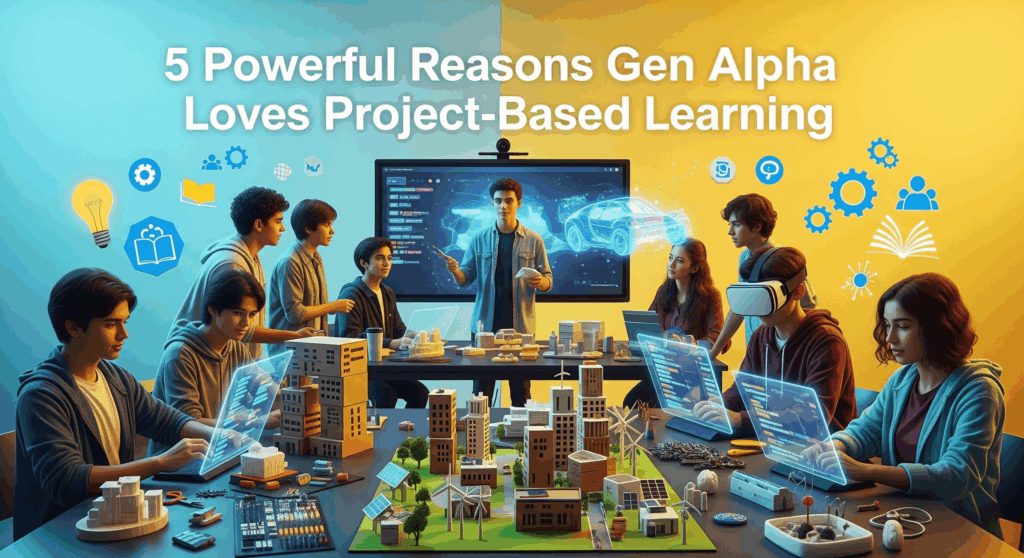
Short answer: Gen Alpha loves project-based learning (PBL) because it gives them real-world purpose, builds future-ready skills like problem-solving and collaboration, feels more like play than pressure, teaches self-management, and blends their visual, tech-savvy world with hands-on work. Indian classrooms in Pune, Bengaluru, Chennai and Noida show how PBL drives deeper engagement than textbooks.
Why is traditional teaching no longer enough?
Walk into any forward-thinking classroom in 2025 and something stands out. Desks are not in rigid rows. Students are not quietly scribbling notes. Groups brainstorm ideas, kids film presentations, others test prototypes. This is Project-Based Learning (PBL), and it is winning over Generation Alpha.
Born into a world of YouTube tutorials, climate activism and AI tools, Gen Alpha (children born after 2013) wants more than textbook knowledge. They want purpose, creativity and real-world connection, all of which PBL delivers.
Here are five reasons project-based learning fits Gen Alpha’s mindset and what it means for the future of education.
1. Why does Gen Alpha crave real-world purpose?
Gen Alpha isn’t just curious — they’re conscious.
This generation wants to know why something matters. They want to see how learning impacts the world around them. That is where PBL shines. Whether they are designing an eco-friendly bus stop for their community or launching a campaign on water conservation, students get to tackle real problems close to home.
At a school in Pune, for example, 11-year-old Tanishka and her classmates created a low-cost water filtration prototype using recyclable materials. “We saw how many kids in nearby villages didn’t have clean water,” she said. “So we wanted to help.” That level of emotional investment is hard to achieve through worksheets and lectures.
When learning becomes purpose-driven, motivation goes up and students start seeing themselves as changemakers.
2. How does PBL build future-ready skills?
Today’s kids will enter a workforce we can barely imagine. PBL is preparing them for it.
Through meaningful projects, students sharpen critical thinking, problem-solving, communication and collaboration, the core of 21st-century skills. They brainstorm, debate, build, revise and present, often using tools like Canva, Google Slides or basic coding platforms.
According to the World Economic Forum, problem-solving, creativity and emotional intelligence are among the top skills needed in the next decade. Project-based learning embeds these into everyday schoolwork.
One teacher from Bengaluru noted, “In a PBL unit on sustainable cities, my fifth graders weren’t just drawing green spaces — they were designing with empathy, asking how people of all ages could benefit. That’s real-world thinking.”
3. Why does PBL feel more like play than pressure?
Gen Alpha thrives on hands-on exploration and creative freedom. Unlike rote memorisation, PBL lets them explore ideas that matter to them in formats they enjoy.
Students often choose their own topics, decide how to present their work (a video, a podcast, a model, etc.), and evaluate their own progress. This autonomy fuels intrinsic motivation, the kind of drive that lasts beyond test scores.
Instead of “studying electricity,” imagine a group of 9-year-olds building a cardboard city powered by mini solar panels. That’s not just engaging — it’s unforgettable.
4. How does PBL teach kids how to learn?
One of the most underrated benefits of PBL is how it nurtures independence and self-management.
Students have to plan their projects, manage timelines, troubleshoot setbacks and reflect on what worked and what did not. It teaches resilience, accountability and the ability to adapt, life skills that go beyond academics.
A study by the Buck Institute for Education found that students in high-quality project-based learning showed higher levels of self-regulation and long-term retention than peers in traditional classrooms.
For many teachers, this is the most transformative part. “They’re not just absorbing facts,” said a Chennai-based educator. “They’re learning how to figure things out on their own — and that’s the ultimate goal.”
5. How does PBL fit Gen Alpha’s tech-savvy, visual world?
Gen Alpha is visual, digital, and interactive — and PBL meets them where they are.
Whether it is using iPads to film a documentary, creating a virtual art exhibit or coding a simple app, PBL integrates technology in meaningful ways. It also ensures students work together in person, blending screen time with human interaction for a healthier balance.
PBL often includes multimedia presentations and visual storytelling, which help Gen Alpha learners grasp complex concepts more effectively.
“Reading about deforestation didn’t hit home,” shared a student from Noida. “But when we created a stop-motion video showing a forest being cut down and animals losing their homes, it made me feel something. That’s how I really learned.”
Let’s teach for the future, not the past
Project-Based Learning is not another educational trend. It reflects how learning should feel in 2025 and beyond: authentic, student-driven and connected to the world outside the classroom.
As Gen Alpha keeps challenging old norms and bringing fresh perspectives, it is time for educators, parents and policymakers to lean into learning that empowers.
Because when we give kids problems to solve — not just answers to memorize — they don’t just learn. They lead.
FAQs about project-based learning for Gen Alpha
What is project-based learning?
Project-based learning (PBL) is a teaching approach where students work on real-world projects, like designing an eco-friendly bus stop or building a water filtration prototype, instead of only memorising textbook content. It builds critical thinking, problem-solving and collaboration.
Why is project-based learning good for Gen Alpha?
Gen Alpha (children born after 2013) wants purpose, creativity and real-world connection. PBL lets them tackle problems that matter, choose how to present their work, and use tools like Canva, Google Slides and basic coding platforms, which keeps motivation high.
What skills does project-based learning develop?
The World Economic Forum lists problem-solving, creativity and emotional intelligence among the top skills for the next decade. PBL builds these along with critical thinking, communication, collaboration, self-regulation and resilience.
What are examples of project-based learning in Indian schools?
In Pune, 11-year-old Tanishka and her classmates built a low-cost water filtration prototype from recyclable materials. In Bengaluru, fifth graders designed sustainable cities with empathy. In Noida, students created a stop-motion video on deforestation.
Is project-based learning backed by research?
Yes. A study by the Buck Institute for Education found that students in high-quality project-based learning showed higher levels of self-regulation and long-term retention than peers in traditional classrooms.