Short answer: AI is giving Gen Alpha (born 2010–2025) the power to self-learn through personalized platforms like Khanmigo, Duolingo Max, and Socratic by Google, gamified lessons that boost retention by 40% (WEF, 2024), and inclusive tools that break language and ability barriers. UNESCO (2024) found over 60% of learners aged 10–14 use AI tools weekly. Still, AI works best alongside teachers, parents, and mentors.
Toddlers swipe before they scribble. Generation Alpha, born between 2010 and 2025, is reshaping how learning happens. These kids live in a hyper-digital world where artificial intelligence isn’t a distant idea but a daily companion.
The striking part: Gen Alpha isn’t only consuming content. They’re teaching themselves, and AI is a big part of that.
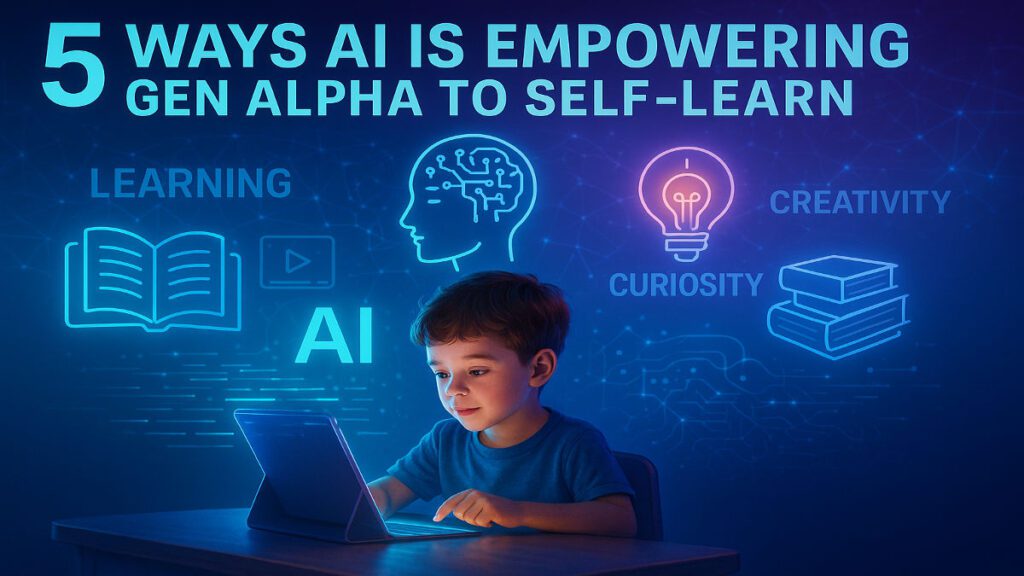
Here are five reasons AI is letting Gen Alpha take learning into their own hands in 2025.
1. How does AI make learning feel personal?
Forget one-size-fits-all classrooms. AI-powered learning platforms like Khanmigo, Duolingo Max, and Socratic by Google tailor lessons in real time. They adapt to how fast a child grasps a topic and to how they prefer to learn, whether through visuals, games, or storytelling.
A child struggling with division might get a visual game. Another might zip ahead with story-based math problems. The personalized path keeps students engaged and in control of their own progress.
“My daughter uses an AI reading tutor that changes stories based on her mood. She doesn’t even realize she’s learning—she thinks she’s just having fun,” says Neha, a parent from Mumbai.
2. Why do gamified AI lessons keep curiosity alive?
Ask any 9-year-old what makes a game fun and you’ll hear: challenges, levels, and rewards. Now imagine turning algebra or history into that kind of experience.
AI-driven platforms use gamification to grab and hold attention, which works well for Gen Alpha. Badges, unlockable modules, and interactive simulations give learning the same dopamine pull as gaming, making it effective and, in the best way, addictive.
Research by the World Economic Forum (2024) found that students who use gamified learning tools show 40% better knowledge retention compared to traditional methods.
3. How does AI help kids build real-world skills?
AI doesn’t only quiz facts. It pushes application. In project-based learning environments, children use AI to design apps, simulate business ideas, or build games.
These tools help Gen Alpha develop critical thinking, creativity, and digital fluency. Platforms like Tynker and Minecraft Education Edition use AI to guide students through coding while pushing them to problem-solve and iterate.
“My 11-year-old used ChatGPT to co-write a script for a robot play—and then used an AI voice generator to bring it to life. It was brilliant,” shares a Bengaluru-based schoolteacher.
4. Why does Gen Alpha navigate tech so fluently?
Gen Alpha doesn’t learn to use tech. They grow up using it. This generation speaks to Alexa like a sibling, swipes fluently before they can write, and explores new apps without a tutorial.
That native digital fluency means they can independently explore AI tutors, search engines, and creative tools. Learning isn’t confined to the classroom. It lives on YouTube, inside apps, and in every tap and scroll.
UNESCO (2024) reported that over 60% of learners aged 10–14 globally use AI tools at least once a week for homework or skill-building.
5. How does AI break boundaries and biases?
AI tools have become inclusive champions, breaking barriers that once limited access to education. Real-time translation and speech-to-text help children overcome language gaps, learning disabilities, and geographic limits.
Students in remote villages can now reach world-class tutors through AI interfaces. Kids with dyslexia use voice-enabled learning tools that read and explain difficult texts aloud.
Inclusive, democratized learning was once a dream. For Gen Alpha it is the norm.
But is AI self-learning enough?
AI puts immense power at Gen Alpha’s fingertips, but it isn’t a replacement for human connection.
Children still need teachers, mentors, and parents to guide, question, and give context. They need to be taught how to verify sources, spot bias, and use AI ethically. Social skills, empathy, and teamwork aren’t downloaded from an app.
A blended approach, where AI complements human interaction, seems to be the working formula.
Nurture the guide, not just the gadget
Gen Alpha is on track to become the most self-sufficient learning generation yet. With AI as their compass they can find their own paths, discover passions, and solve real problems before they reach high school.
Even the smartest compass needs a thoughtful guide. We should empower this generation to learn with AI, but also to learn responsibly, ethically, and creatively.
The future isn’t only automated. It’s inspired.
FAQs about AI and Gen Alpha self-learning
Who is Gen Alpha?
Generation Alpha are children born between 2010 and 2025. They are the first generation to grow up with AI as a daily companion rather than a new technology.
What are the best AI tools for kids in 2025?
Popular options include Khanmigo for tutoring, Duolingo Max for languages, Socratic by Google for homework help, Tynker for coding, and Minecraft Education Edition for project-based learning.
Does AI really improve learning outcomes?
Yes. The World Economic Forum (2024) found that students using gamified AI learning tools show 40% better knowledge retention than those using traditional methods.
How many Gen Alpha kids use AI for school?
UNESCO (2024) reported that over 60% of learners aged 10–14 globally use AI tools at least once a week for homework or skill-building.
Can AI replace teachers for Gen Alpha?
No. AI is a strong supplement but not a replacement. Kids still need teachers, mentors, and parents to build social skills, empathy, critical thinking, and ethical use of technology.