Short answer: Minecraft: Education Edition is making geography fun for Gen Alpha by letting students build landscapes and biomes, simulate erosion and tectonic shifts, design city maps, collaborate in multiplayer challenges, and learn through immersive play. Teachers in India, including in Delhi and Bangalore, report stronger engagement, sharper spatial skills and better retention than traditional textbooks deliver.
The game reshaping classrooms and young minds
In 2025, it is no longer unusual to see students mapping mountains, simulating erosion or designing cities — all inside a video game. Minecraft: Education Edition is changing how schools teach geography, especially to Gen Alpha, the first generation of true digital natives.
For a generation that grew up swiping, tapping and streaming before they could spell, traditional textbooks don’t cut it. Minecraft, a game they already love, is helping teachers open up a new world of interactive, meaningful learning.
How does Minecraft help students build geography from the ground up?
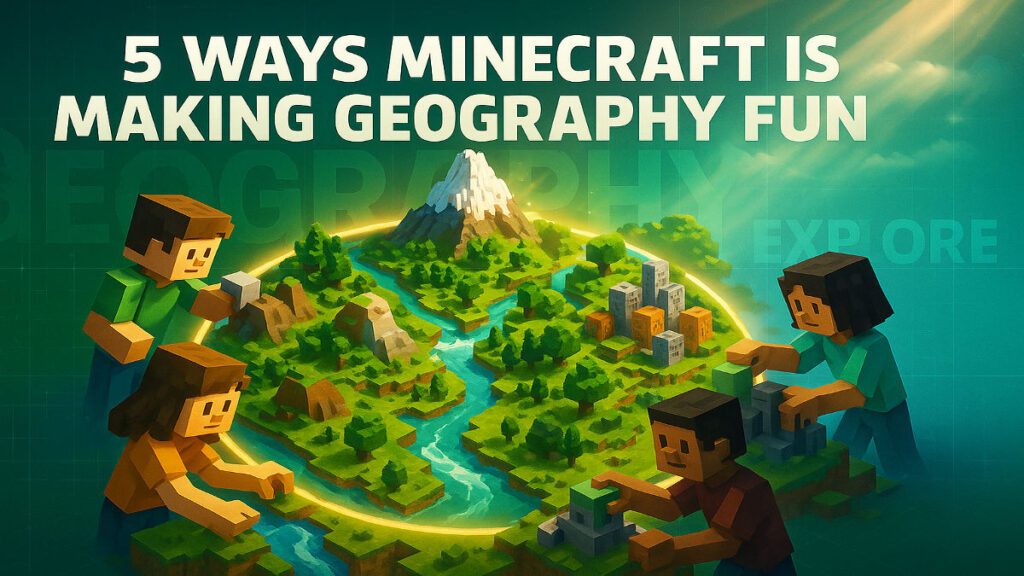
Forget 2D diagrams. Students are now creating entire virtual worlds to understand geographical features. Using Minecraft’s block-based design, kids can construct everything from snow-capped mountains to flowing rivers and wide plateaus.
In my niece’s fifth-grade classroom, students recreated the Himalayan mountain range block by block. “I didn’t just see Everest — I built it,” she told me, beaming with pride.
Beyond landscapes, Minecraft supports simulations of natural processes. Teachers guide students through virtual erosion, tectonic shifts and weathering, turning complex concepts tangible through gameplay.
Students also construct entire biomes, mimicking forests, deserts and wetlands in detail. This hands-on experience teaches geography and builds empathy for the environment, showing how climate, terrain, flora and fauna connect.
How does Minecraft show our role in shaping the planet?
Minecraft doesn’t only showcase nature. It reveals how humans interact with it. Students explore scenarios where people adapt to their environments, such as building homes near volcanoes or farming in river basins.
They also tackle urban expansion and deforestation. In one Delhi school, students built two versions of the same forest: one untouched and one transformed by development. They debated the consequences of pollution and land misuse, which pushed critical thinking and environmental awareness.
Through projects like virtual dam construction or city planning, students see how every road, bridge or farmland reshapes the earth’s surface. They aren’t only learning geography; they are learning to think like responsible citizens.
How does Minecraft improve mapping and spatial skills?
One of Minecraft’s strongest educational uses is in spatial reasoning and cartography. Students create digital maps of their surroundings — from their school campus to entire cities — complete with legends, coordinates and thematic elements.
In a Bangalore classroom, eighth graders used Minecraft to design a sustainable version of their city, carefully marking out industrial zones, green belts and transport hubs. “It felt like SimCity, but I was the planner,” said 13-year-old Vedika.
They also navigate and interpret existing terrain, then translate their explorations into physical maps, which sharpens both virtual and real-world navigation. These activities deepen understanding of topography, scale and direction while sparking creativity.
How does Minecraft build collaboration through team challenges?
Minecraft is more than solo play. It is a hub for collaborative learning. In multiplayer mode, students work in groups to build cities, solve geographical dilemmas or recreate historical landmarks.
Teachers often design problem-solving scenarios, such as creating a sustainable settlement in a desert or managing a town’s water resources in a rainforest. These challenges build knowledge alongside communication, teamwork and empathy.
As 21K School notes, “[Minecraft] offers a safe space to fail, try again, and learn by doing,” which makes it ideal for real-world simulations and decision-making exercises.
Why does gamified, immersive learning stick?
Students are more likely to remember what they do than what they read. Minecraft turns geography into a hands-on experience that keeps students engaged and curious.
Teachers using the platform report higher retention and comprehension through interactive gameplay. When you are actively shaping a world, understanding follows.
Games like Minecraft also allow non-linear exploration, letting students follow their curiosity. That learner-driven approach lines up with Gen Alpha’s need for agency and instant feedback.
A game-changer for geography education
In 2025, Minecraft is no longer only a game. It is a classroom tool. By merging creativity, collaboration and immersive learning, it is helping students not only learn geography, but experience it.
In a world grappling with climate change, resource challenges and urban growth, geography education has never been more important. Thanks to Minecraft, it has also never been more exciting.
Here is the thought to leave with: if students can build the Earth block by block, maybe they will be the ones to rebuild it — smarter, greener and more connected than ever.
FAQs about Minecraft and geography
How does Minecraft teach geography?
Minecraft: Education Edition lets students build landscapes, biomes and city maps, simulate natural processes like erosion and tectonic shifts, and explore how humans shape the environment. Teachers use it to turn abstract geography concepts into hands-on, interactive projects.
Is Minecraft Education Edition good for schools?
Yes. Teachers using Minecraft: Education Edition report higher student engagement, stronger spatial reasoning and better retention of geography concepts. It works well for collaborative learning, mapping exercises and real-world scenario simulations.
What geography skills can students learn in Minecraft?
Students build cartography and spatial reasoning skills by designing maps with legends and coordinates, understand topography and scale, learn how human activity affects land use, and practise urban planning through city and settlement projects.
Can Minecraft be used for collaborative learning?
Yes. Multiplayer mode lets students work in groups to build cities, recreate historical landmarks or solve problems like creating a sustainable desert settlement or managing water in a rainforest town. It builds communication, teamwork and empathy alongside subject knowledge.
Why does Minecraft work so well for Gen Alpha learners?
Gen Alpha grew up digital-first and expect agency, instant feedback and non-linear exploration. Minecraft provides all three, which is why hands-on gameplay lands harder than static textbook reading for this generation.