Short answer: Indian kids are learning Python at age 7 because coding is now seen as a core literacy under NEP 2020, Python’s clean English-like syntax suits young learners, and platforms like JetLearn and WhiteHat Jr make early coding fun. It builds future-ready skills, boosts math confidence and helps bridge India’s digital divide.
The coding craze sweeping India’s youngest minds
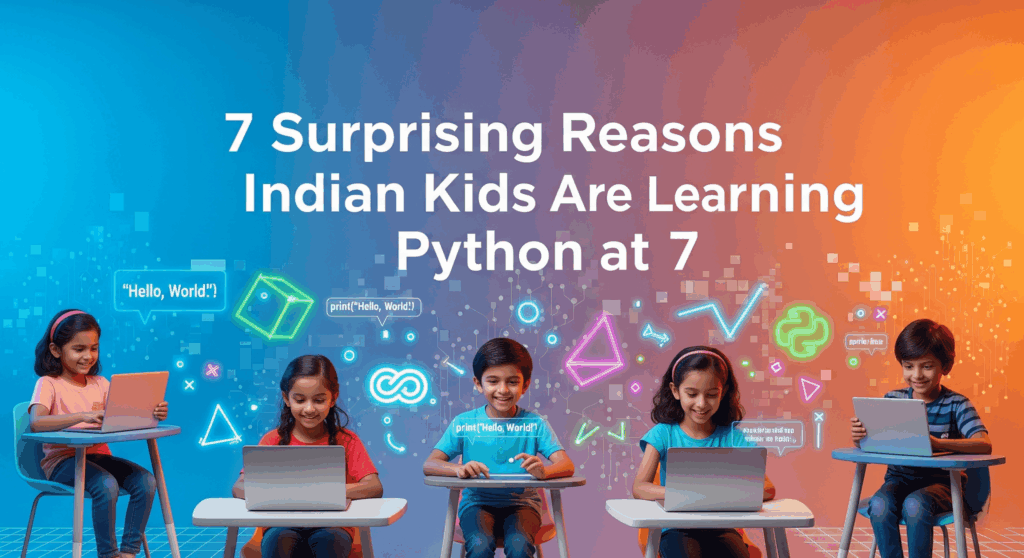
It is 2025, and in homes and classrooms across India something remarkable is happening. Children as young as seven are learning to code. Their parents may still be wrapping their heads around Excel spreadsheets while these young minds are writing Python scripts, building games and creating animations.
Coding is no longer a niche skill for computer science graduates. It is becoming as fundamental as reading, writing or arithmetic. In India, a country fuelling one of the world’s fastest-growing tech sectors, this shift is happening at lightning speed.
But why Python? Why now? And why are seven-year-olds, who have only started multiplying numbers, being introduced to something once considered college-level material?
Why is coding the new literacy for Indian kids?
In a digital-first world, coding is increasingly seen as a core literacy, much like reading or math. The National Education Policy (NEP) 2020 reflects this, recommending that students be introduced to coding as early as Grade 6. Parents and educators are not waiting.
They are turning to after-school coding classes, YouTube tutorials and platforms like JetLearn and WhiteHat Jr. to help kids start earlier, sometimes as young as first grade. The reason is simple: future-readiness.
From AI to robotics, the jobs of tomorrow ask for more than textbook knowledge. They need digital fluency and computational thinking. Learning to code early gives kids a head start.
Why is Python the perfect first language for young kids?
You might expect young kids to start with playful drag-and-drop tools like Scratch or Blockly, and many do. Python is now making inroads with kids as young as seven though, and it is not as wild as it sounds.
Unlike other programming languages filled with confusing brackets and symbols, Python’s syntax is clean and readable, almost like English. A simple line like print(“Hello, world!”) can instantly light up a child’s face.
Thanks to “Python for Kids” courses, simplified IDEs and visual aids, Python is taught in age-appropriate, gamified ways that are fun and understandable, even for children who have just mastered cursive writing.
How does coding help kids create and build?
Children are not learning Python only for job prep. They do it because it is fun.
With a few lines of code, they can build storytelling bots, digital flashcards, mini-games or interactive quizzes. Seeing their code come alive gives them a sense of control, confidence and joy that traditional rote learning often misses.
One Bengaluru-based mom shared, “My daughter wrote a Python program that changes colors on the screen when you press a button. She ran around the house calling herself an inventor!”
When learning feels like play, the possibilities are endless.
How does Python build resilience and problem-solving?
Coding is not only about typing commands. It is about thinking logically, spotting errors and fixing bugs, often after several failed attempts.
This process builds resilience, patience and systematic problem-solving, all vital in life and not only in tech careers. Every time a child figures out why a program did not work, they learn to break problems into parts and try again. That is a powerful lesson in perseverance.
Coding teaches kids how to think, not what to think.
Does coding improve math and academic confidence?
Many parents are surprised to find that coding often improves their child’s performance in math and science. The reason is that coding turns abstract concepts into real applications.
When a child writes a loop or a conditional statement, they apply logic, pattern recognition and algorithmic thinking, all core to mathematics. It brings dry textbook problems to life.
As a coding instructor from Delhi put it, “We had a student who hated math. But once she started coding simple Python games that required numbers and logic, math suddenly became meaningful to her.”
How is India’s tech economy driving parental ambition?
Indian parents have always sought an academic edge for their children. In a country where technology powers dreams, coding is the latest frontier.
With India producing over 1.5 million engineering graduates annually and companies like Google, Infosys and TCS hiring for AI, data science and machine learning roles, early coding skills look like an investment in future success.
For many parents, coding represents a skill and a gateway to stability, innovation and upward mobility.
How is early coding bridging India’s digital divide?
The rise of coding for kids is helping bridge the digital divide.
Affordable smartphones, low-cost internet and ed-tech platforms are making coding more accessible than ever, not only for kids in metro cities but in Tier 2 and Tier 3 towns. Free coding bootcamps and government-led initiatives are widening access further.
Experts still stress that Python or any coding language should be introduced based on a child’s interest and readiness, not pressure. Visual languages like Scratch suit many 5–7-year-olds and offer a smooth transition to text-based coding when the child is ready.
Let curiosity lead the code
In a world where technology touches every part of our lives, teaching kids to code is not about turning them into programmers. It is about equipping them to think critically, solve problems creatively and engage with their digital world meaningfully.
So if your seven-year-old wants to learn Python, let them play, explore and experiment. If they prefer building Lego robots or animating stories in Scratch, that is fine too. The key is to nurture curiosity, the real engine behind every great innovation.
Because when children learn to code, they are not only learning a language. They are learning to shape the future.
FAQs about Indian kids learning Python
Why are Indian kids learning Python at age 7?
NEP 2020 recommends coding from Grade 6, and parents want kids future-ready for AI and robotics. Platforms like JetLearn and WhiteHat Jr., YouTube tutorials and “Python for Kids” courses make it possible to start even earlier, sometimes in first grade.
Is Python a good first programming language for kids?
Yes. Python’s syntax is clean and almost like English, so a line like print(“Hello, world!”) works without confusing brackets or symbols. Simplified IDEs and gamified lessons make it accessible to seven-year-olds.
Can learning Python help kids do better in math?
Often yes. Writing loops and conditionals uses logic, pattern recognition and algorithmic thinking. A Delhi coding instructor shared that a student who hated math started enjoying it after building Python games that needed numbers and logic.
At what age should a child start coding in India?
There is no single right age. Many 5–7-year-olds start with visual languages like Scratch or Blockly, then move to Python when they are ready. Experts stress that interest and readiness should lead, not pressure.
Which platforms teach Python to kids in India?
Popular options include JetLearn and WhiteHat Jr., along with “Python for Kids” courses, YouTube tutorials, free coding bootcamps and government-led initiatives that are widening access in Tier 2 and Tier 3 towns.