
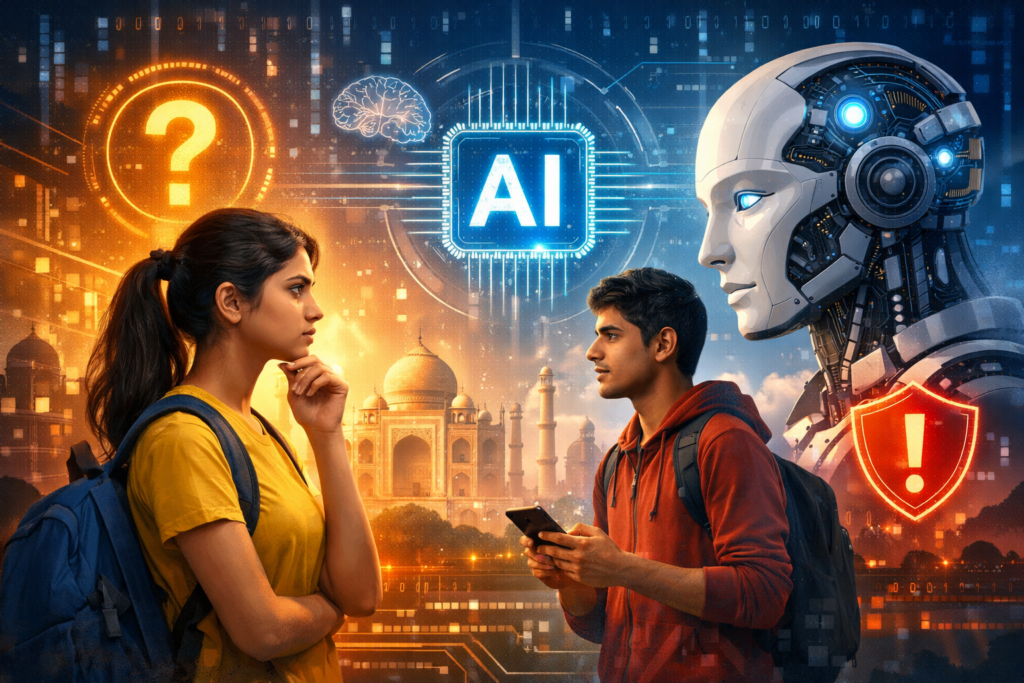
Short answer: Indian Gen Z is using AI every day for studies, careers, and side hustles, but with guarded optimism. A Gallup, Walton Family Foundation and GSV Ventures survey shows only 18% of Gen Z feel hopeful about AI, down from 27% a year earlier. In India, the picture is curiosity balanced with caution over jobs, authenticity, and overdependence.
If there is one generation that has not only watched AI rise but grown up inside it, it is Gen Z. From asking AI to summarise lecture notes at midnight to using it for interview prep, resumes, coding help, and even relationship advice, young Indians are taking to this tech at a pace no generation has matched.
The adoption is high, but the emotion underneath is more mixed. A recent global survey by Gallup, the Walton Family Foundation, and GSV Ventures found that while more than half of Gen Z uses generative AI regularly, optimism is falling. Only 18% said they feel hopeful about AI, down from 27% the previous year. Close to a third reported negative emotions like anxiety or anger.
For the YouthTalks community, this duality feels familiar. Indian Gen Z is not blindly pro-AI. The approach is a mix of curiosity and caution, shaped by the socio-economic and cultural realities of young India.
Why is AI seen as a gateway to opportunity in India?
In India, AI is more than a new toy. It is a gateway to opportunity. In a country where access to good teachers and career guidance is uneven, AI tools are flattening the playing field.
I recall a YouthTalks campus interaction in Indore, where a student from a modest background called AI his “personal mentor.” Without money for expensive coaching institutes, he used AI to prepare for competitive exams and sharpen his English. His story is not rare. It repeats across Tier 2 and Tier 3 cities.
How is Indian Gen Z using AI?
- Academic support: Breaking down complex concepts, generating notes, and helping with research.
- Career preparation: Resume building, interview simulations, and portfolio reviews.
- Entrepreneurship: Launching side hustles, validating ideas, and creating marketing content.
- Creative expression: Writing, designing, coding, and making digital media.
- Everyday problem-solving: Financial literacy, travel planning, and language translation.

According to a NASSCOM report, India is on track to host one of the world’s largest AI talent pools, with demand for AI-related skills rising sharply. For many young Indians, AI represents possibility and empowerment, a way to compete globally regardless of background.
Why do young Indians feel job anxiety around AI?
AI opens doors, but it also casts a shadow. India adds millions of young workers to the labour force every year, and competition for entry-level roles is already brutal. The fear that automation could wipe out those jobs sits close to the surface.
The World Economic Forum’s Future of Jobs Report says AI will create new roles but will also transform or eliminate others, pushing a serious need for reskilling. That fuels urgency among young professionals.
“AI helps me work faster and smarter, but I sometimes wonder if it will eventually replace the very role I’m preparing for.”
— Rahul, 23, Engineering Student, Pune
This tension between opportunity and insecurity defines much of Indian Gen Z’s relationship with AI. It is not pessimism. It is a pragmatic read on a fast-shifting job market.
Why does authenticity still matter when using AI?
One defining trait of AI adoption among Indian youth is the focus on authenticity. Young Indians are fine using AI for productivity and learning, but pull back when the task is emotional.
“I use AI to refine my ideas, but when it comes to writing personal messages or making important life decisions, I prefer doing it myself. Some things should remain human.”
— Aditi, 21, Media Student, Delhi
That view is rooted in Indian cultural values that hold human relationships, empathy, and emotional connection at a premium. AI, for this group, is not a replacement for human interaction but a tool that extends human capability.

A Pew Research Center study also shows that while young people value AI’s speed, many worry about its impact on creativity and critical thinking. Those concerns hit hard among Indian Gen Z, who want tech progress without losing emotional texture.
How is AI becoming an educational equaliser?
India’s diversity brings both challenges and openings. Urban youth often use AI for productivity and innovation. Those in smaller towns use it as a bridge to quality education and resources they were earlier locked out of.
Urban India vs. Bharat
| Dimension | Urban India | Tier 2/3 cities |
| Primary use | Productivity and innovation | Education and skill development |
| Access to resources | High | Increasing |
| Job displacement concerns | Significant | Moderate |
| Optimism about AI | Balanced | Generally higher |
For students in smaller towns, AI acts as a 24/7 tutor, career counsellor, and language translator, cutting down barriers to opportunity. This democratising effect is one of the most transformative parts of the technology.
Is digital dependence a real concern for Indian youth?
Alongside the benefits sits a growing worry about overdependence. Many young people fear that heavy AI use could dull their creativity, patience, and problem-solving.
At a YouthTalks workshop in Jaipur, a participant said, “AI gives me answers instantly, but I sometimes wonder if I’m losing the patience to think things through on my own.” That line summed up an anxiety many in the community share.

A DataReportal study shows Indians spend more than six hours online daily, which tells you how deep digital tools sit in everyday life. The question is not only whether to adopt AI, but how to use it responsibly and mindfully.
What emotion defines Indian Gen Z’s view of AI?
Even with scepticism and anxiety around, the strongest emotion shaping Indian Gen Z’s view of AI is curiosity. Young Indians know AI fluency will matter for future careers, so they experiment with it even while questioning its implications.
“AI feels like the internet did in its early days. We don’t fully understand it yet, but we know it’s going to shape our future.”
— Karan, 24, Startup Enthusiast, Bengaluru
That curiosity places Indian Gen Z as thoughtful adopters, people who are not just consuming the tech but shaping how it evolves.
What does this mean for the YouthTalks ecosystem?
Educators: build AI literacy
Schools and colleges must build AI literacy into the curriculum so students learn to use these tools ethically and effectively.
Employers: prioritise human skills
As automation reshapes the workplace, human skills like creativity, emotional intelligence, adaptability, and critical thinking will carry more weight, not less.
Policymakers: ensure inclusive access
Bridging the digital divide matters. Without it, AI’s benefits will not reach rural and underserved parts of India.
Brands and communities: build trust
Organisations that engage with Gen Z have to lead with transparency, ethical AI practices, and honest communication. Trust is the currency here.
A personal reflection: watching the shift
Having met thousands of students on campuses through YouthTalks, I have seen the shift up close. From students in small towns launching digital startups to young professionals using AI to pivot careers, the tech is clearly rewriting ambitions.
What stands out is not blind enthusiasm but thoughtful engagement. Indian Gen Z is asking real questions: Will AI enhance my creativity? Will it take away my job? How can I use it responsibly? These are the questions of a generation actively shaping change, not just reacting to it.
How is the human and technology relationship being redefined?
The mixed feelings around AI reflect a wider social shift. Indian Gen Z is trying to balance technological progress with human authenticity. AI, for them, is not a replacement for human capability but a collaborator guided by ethics and emotional intelligence.
That view cuts through the lazy binary of a generation either embracing or rejecting AI. What you actually see is conscious, responsible adoption.
Consciously connected, not cautiously detached
Indian Gen Z sits at the intersection of aspiration and apprehension. They are using AI to unlock opportunities while staying alert to its risks. This balance of curiosity and caution is not confusion. It is a sign of maturity and foresight.
For the YouthTalks community, the message is clear. AI is not just a technology shift. It is a cultural and societal shift. The responsibility sits with everyone, educators, employers, policymakers, and young people themselves, to keep the transition inclusive, ethical, and human-centric.
The more important question is not whether AI will shape the future, but how we, as a generation, will shape AI.
At YouthTalks, we believe young voices should lead this conversation. The future of AI in India will not be defined only by algorithms. It will be defined by the values, aspirations, and choices of its youth.
FAQs on Indian Gen Z and AI
How many Gen Z use generative AI regularly?
A global survey by Gallup, the Walton Family Foundation, and GSV Ventures found that more than half of Gen Z uses generative AI regularly, though optimism about it has fallen from 27% to 18% year on year.
What do Indian Gen Z use AI for the most?
Indian Gen Z use AI mainly for academic support, career preparation like resumes and interview prep, entrepreneurship and side hustles, creative work, and everyday tasks like translation and financial literacy.
Why is Indian Gen Z both curious and cautious about AI?
They see clear benefits in education, jobs, and creativity, but they are also worried about job displacement, loss of authenticity in emotional tasks, and overdependence that could dull critical thinking.
How is AI helping students in Tier 2 and Tier 3 cities?
For students outside metro cities, AI acts as a 24/7 tutor, career counsellor, and language translator. It lowers the cost of good guidance and helps them compete despite limited access to coaching institutes.
Will AI take away jobs from Indian youth?
The World Economic Forum’s Future of Jobs Report says AI will create new roles while transforming or eliminating others, which means reskilling is essential. Indian Gen Z see both the risk and the new opportunities this shift will bring.