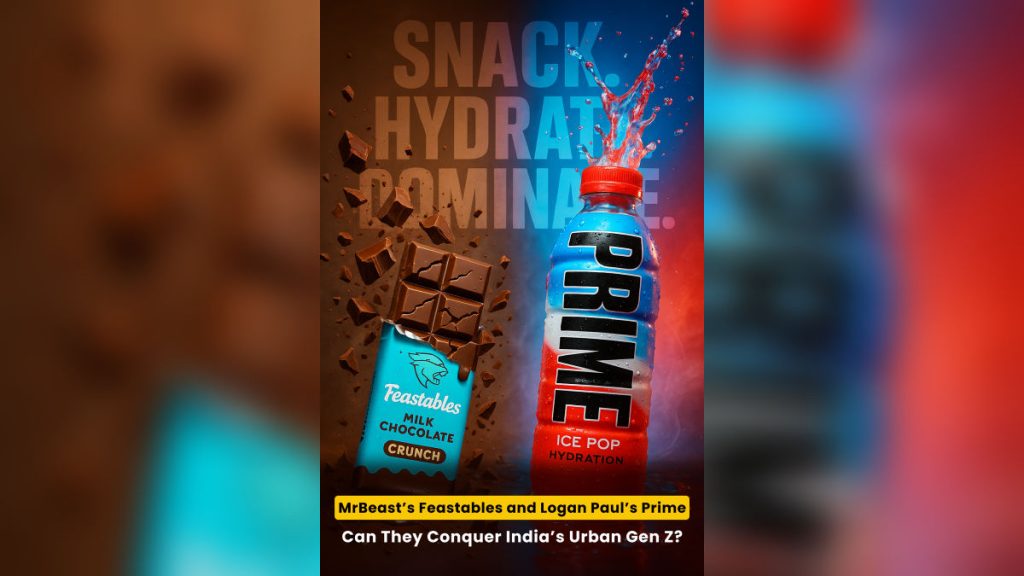
Short answer: The launch was huge but lasting success in India isn’t guaranteed. Feastables retails at ₹499 for 60 grams and Prime at ₹399 a bottle, both far above mass-market price points. To convert hype into habit, MrBeast’s and Logan Paul’s brands will need smaller SKUs, local collabs, deeper distribution and India-specific flavours.
When two of the internet’s biggest celebrities, MrBeast and Logan Paul, touched down in Mumbai, India witnessed a different kind of frenzy. At the plush Jio World Drive mall, fans jostled, screamed and thronged the venue just to glimpse their favourite YouTubers. The reason? The launch of their much-hyped brands: Feastables, a chocolate snack line by MrBeast, and Prime, a hydration drink by Logan Paul and KSI. The excitement was real. But as the crowds surged and security struggled to contain the madness, organisers were forced to shut the event down early.
A dramatic start. The real question, though, hangs in the air, can these creator-led brands truly make it in India?
Why are influencer-led brands so powerful right now?
In a world where attention is currency, MrBeast and Logan Paul hold enormous power. With 329 million YouTube subscribers and a brand identity built on challenges, philanthropy and viral content, MrBeast (real name: Jimmy Donaldson) has cultivated a loyal global following. Logan Paul and KSI, with their combined 40+ million subscribers, have done the same, mixing fitness, entertainment and entrepreneurship into a heady cocktail Gen Z finds hard to resist.
Their brands, Feastables and Prime, ride the wave of this popularity. These aren’t just snacks and drinks. They’re extensions of a digital lifestyle, aspirational purchases that blur the line between consumption and fandom.
What is Feastables, and why does Gen Z care?
Brand at a glance
Feastables positions itself as a premium snack brand offering chocolate bars in flavours like Milk Chocolate, Almond Chocolate, Sea Salt and Quinoa Crunch. The packaging is playful, colourful, instantly recognisable, a nod to MrBeast’s over-the-top YouTube style.
What Gen Z loves
- Influencer credibility: MrBeast’s association is a huge magnet.
- Quality and experience: Clean ingredients and unique textures.
- Interactive marketing: Challenges, giveaways and mystery prizes.
Take my 16-year-old cousin Aarav, for instance. He saved up his pocket money to buy a Feastables bar not just to eat it, but to post an unboxing video on Instagram. Half about clout. Half about cocoa.

The catch
Feastables retails at a steep ₹499 for 60 grams. That’s almost ten times the price of a basic Cadbury bar. And in India, where mass-market affordability rules, this pricing puts it out of reach for the average consumer.
Why are Gen Z drinking Prime?
What’s inside the bottle?
Prime is marketed as a hydration and energy drink, enriched with electrolytes, vitamins and antioxidants, ticking off Gen Z’s growing interest in wellness. Flavours like Ice Pop, Blue Raspberry and Tropical Punch are designed to appeal to a younger, flavour-craving audience.
Why Gen Z bites
- Trendiness: The packaging is bold, the influencers bolder.
- Health halo: Low sugar and high-performance positioning.
- Scarcity & exclusivity: Limited drops and influencer collabs (like IShowSpeed) drive demand.

But is it worth it?
At ₹399 a bottle, Prime is competing with tried-and-tested players like Red Bull and Gatorade. And while it may have a cooler label, it doesn’t yet have the distribution or the affordability of its rivals.
Will the buzz translate to business in India?
India isn’t an easy market to crack. It’s price-sensitive, loyalty-driven and already saturated with strong local players. Cadbury, Amul, Parle, Coca-Cola and Bisleri dominate the FMCG landscape here. Even global brands struggle to win over Indian consumers without adapting to local tastes and price points.

As Sachin Bobade from Daulat Capital pointed out, “The Indian chocolate market is sizeable and can absorb new players. But in the premium category, dark chocolates perform better. Feastables, being milk-based, might not find easy acceptance.” That’s an important distinction. Indian consumers may be open to new brands, but only if those brands match the context.
Is the urban Gen Z obsession real or just niche?
India’s Gen Z, especially in urban metros, is global in its tastes. They know who MrBeast is. They follow Logan Paul. They get hyped about creator brands. But they’re also pocket-conscious. Spending ₹499 on a chocolate bar might happen once, for the gram, for the hype, but it’s unlikely to become a habit.
And that’s where the challenge sits. According to Mohsin Mansoori, store manager at Freshpik (the launch venue), “Even though they are expensive, we are anticipating the first lot to get sold very quickly.” But he also added that this might be a “one-time buy” product unless pricing and accessibility improve.
What can India learn from the U.S. success story?
In the U.S., both brands have performed phenomenally well:
- Feastables sold $10 million worth in just three months and now has a valuation close to $200 million.
- Prime clocked $250 million in global sales in 2023 and inked high-profile deals like its partnership with the UFC.
Their success was built on massive retail expansion (Walmart, 7-Eleven, Target), relentless influencer marketing, and the ability to tap into a culture that pays for hype and health alike. But India isn’t the U.S. And that’s the part these brands must remember.
So what needs to change?
For Feastables and Prime to move beyond launch-day excitement and enter Indian homes regularly, they’ll need to:
1. Rethink pricing
Launching smaller, affordable SKUs could help them reach more consumers. A ₹49 or ₹99 price point could work wonders.
2. Local collaborations
Tapping Indian influencers like CarryMinati (who’s already collaborated with MrBeast) or Bhuvan Bam could build deeper resonance.
3. Expand distribution
Right now, availability is limited to high-end stores and online platforms. Expanding to tier-2 cities and general retail would be critical for scale.
4. Customise for Indian tastes
Flavours like “Mango Punch” or “Masala Crunch” might just do the trick. Cultural customisation often separates winners from one-hit wonders in India.

What does this say about India’s creator economy?
Regardless of how these two brands perform, their arrival marks a real moment for India’s booming creator economy. With projections suggesting the Indian creator market could grow to ₹34 billion by 2026, these launches are inspirational playbooks for local influencers.
As Meet Gala from SuperClan puts it, “Prime and Feastables show that when creators build authentic brands, they resonate deeply with their audience and disrupt traditional markets.”
From homegrown ventures like “Peach by Vishnu” to “Awra” travel wear, Indian creators are waking up to the potential of influence-as-capital.
Will hype convert to habit?
Maybe. Not yet. Feastables and Prime have cracked the formula for initial buzz, but to win in India they’ll have to localise, adapt and price competitively. India rewards consistency over virality. If these brands can match their global flair with Indian relevance, they might just write the next big chapter in creator commerce.
Until then, we’ll watch the story unfold, one expensive chocolate bar at a time.
FAQs about Feastables, Prime and India’s Gen Z
How much does Feastables cost in India?
Feastables retails at around ₹499 for a 60 gram bar. That’s roughly ten times the price of a basic Cadbury bar, which puts it firmly in the premium-import bracket and out of reach for most everyday Indian consumers.
How much does Prime hydration drink cost in India?
Prime is priced at about ₹399 a bottle in India, putting it in direct competition with established players like Red Bull and Gatorade. The label and influencer pull are stronger, but the pricing and distribution still trail those rivals.
Can MrBeast’s Feastables actually succeed in India?
It can, but not without changes. Sachin Bobade of Daulat Capital notes the Indian chocolate market is sizeable and open to new players, but premium dark chocolates do better than milk-based ones. Smaller SKUs, lower price points and local flavour adaptations are the obvious next steps.
How big are Feastables and Prime globally?
Feastables sold $10 million worth in just three months and now carries a valuation close to $200 million. Prime clocked $250 million in global sales in 2023 and partnered with the UFC. Both brands lean heavily on retail expansion (Walmart, 7-Eleven, Target) and creator marketing.
What’s the size of India’s creator economy?
Projections suggest the Indian creator market could reach ₹34 billion by 2026. The Feastables and Prime launches act as a playbook for local influencers, showing how creator equity can scale into FMCG, hydration and lifestyle products if priced and distributed right.