

Short answer: DINK (Double Income, No Kids) households are rising in urban India, but not for the reason headlines suggest. Gen Z isn’t rejecting parenthood, they’re rescheduling it. Around 40% of Gen Z women plan to start trying for kids between ages 28-32 (NDTV), and 51% are interested in fertility testing. The pattern is delay with intention, not dismissal.
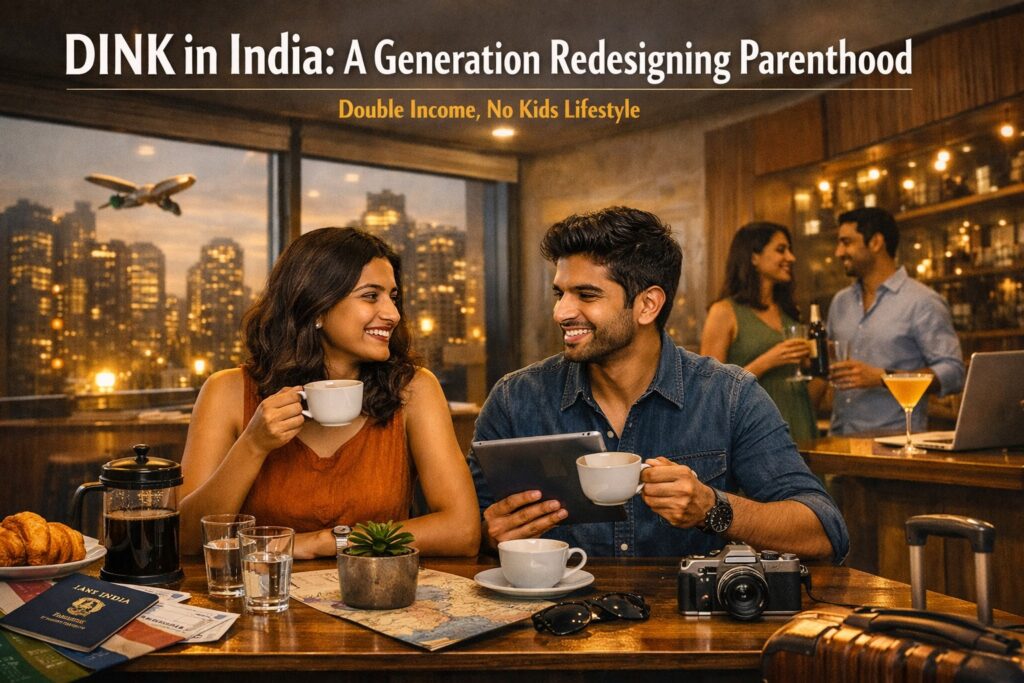
Walk into any urban cafe in Mumbai, Bangalore, or Delhi, and you’ll catch a familiar conversation. Two young professionals, both earning well, talking about travel plans, career moves and, every so often, the looming question: “Do we even want kids?”
A decade ago that question would have sounded almost rebellious. Today, it feels… normal.
This shift captures the essence of a growing phenomenon in India — the rise of DINK (Double Income, No Kids) households. But here’s the catch: it isn’t a story about rejection. It’s a story about redefinition.
What does the data actually say about Gen Z and kids?
Let’s address the elephant in the room. Is Gen Z in India truly walking away from having children?
Not exactly.
Research suggests that around 40% of Gen Z women in India plan to start trying for kids between ages 28-32, significantly later than previous generations (NDTV). That’s a delay, not a dismissal. At the same time, 51% of Gen Z women express interest in fertility testing as part of routine health checks. That isn’t indifference. That’s intentionality.
Broader surveys highlight that Gen Z places strong emphasis on career growth, work-life balance, and personal well-being. Add the fact that interest in marriage and children sits lower compared to Millennials, and a pattern starts to emerge.
The honest read? Gen Z isn’t opting out of parenthood — they’re opting out of doing it blindly.
Is DINK a passing trend or a real transition?
The DINK lifestyle is gaining visibility, particularly in urban India. Studies indicate that DINK households are steadily increasing, with many newly married couples choosing to delay children initially. There’s nuance here, though.
For many couples, “no kids” doesn’t mean “never.” It often starts as “not now.”
I remember a conversation with a friend working in consulting. He and his partner both earn well, travel often, and live what many would call an aspirational life. When I asked about kids, he paused, looked at his coffee, and said:
“We’re not against it. We just don’t want to rush into something we’re not ready for — financially or mentally.”
That hesitation isn’t fear. It’s awareness.
The economics of parenthood
Let’s be honest. Raising a child in India today is expensive. Education costs alone can feel overwhelming. Add healthcare, extracurriculars, lifestyle expectations, and the opportunity cost of time, and the equation gets complex fast.
As highlighted in multiple reports — including coverage by The Times of India — parenthood is increasingly viewed as a financial project, not just an emotional milestone. That’s a real shift.
For previous generations, having children was almost automatic — a natural next step after marriage. For Gen Z, it’s a calculated decision. A cost-benefit analysis, if you will. Kids are no longer just a “heart decision.” They’re a rupee decision too.
Career, identity, and the DINK equation
Another powerful driver of the DINK trend is the changing role of work. For Gen Z, careers aren’t only about survival — they’re about identity. Growth, purpose, independence. These weigh heavily.
Both partners in a relationship often have ambitions. Both want to build something meaningful. And that creates a dilemma. Children, while fulfilling, demand time, energy, and often career compromises — especially in a society where support systems are evolving but not always reliable.
This doesn’t mean Gen Z values careers over family. It just means they aren’t willing to sacrifice one entirely for the other.
How global influence meets local reality
India doesn’t exist in isolation. Through social media and global exposure, Gen Z is constantly interacting with alternative lifestyles — DINK, child-free living, delayed parenthood.
Globally, studies suggest that around 25% of young people are uncertain about having children, often citing financial and lifestyle concerns. Yet most remain open to the idea — just later in life. India mirrors this trend, albeit at a slower pace.
What’s interesting is how the global mindset blends with local realities. In India, family expectations still carry weight. Cultural norms still matter. And that creates tension.
The cultural tug-of-war
On one side, there’s traditional India:
- Marriage leads to children
- Children represent legacy and continuity
- Parenthood is seen as a duty
On the other, there’s modern Gen Z:
- Marriage is optional
- Kids are optional
- Life is customisable
This clash doesn’t always result in conflict, but it does create negotiation. Many DINK couples in India operate inside this tension. They delay decisions, manage expectations, and sometimes face subtle (or not-so-subtle) pressure from families. The result? DINK in India is rising, quietly.
Not one story, but many
It would be a mistake to see this trend as uniform across the country.
Urban India
Here, the DINK lifestyle is more visible. Career-driven individuals, global exposure, and higher living costs contribute to delayed or reconsidered parenthood. Conversations happen openly, in cafes, on dating apps, in WhatsApp groups.
Tier 2 and Tier 3 India
Family structures remain stronger. Marriage and children still follow a more traditional timeline.
This diversity is crucial. There is no single “Gen Z India.” There are multiple Indias, each moving at its own pace.
The biggest misinterpretation
Let’s address a common narrative: “Gen Z doesn’t care about kids.” It’s catchy. It’s provocative. And it’s largely inaccurate.
A more truthful statement would be: “Gen Z refuses to have kids under pressure, uncertainty, or compromise.”
That’s not apathy. That’s agency.
The three faces of DINK in India
To understand this trend better, it helps to break it down.
Temporary DINK
The largest segment. Couples delay kids until they feel ready — financially, emotionally, professionally. The decision is on, just not yet.
Conditional DINK
Open to children, but only under specific conditions. Stable income. Reliable support system. Mental readiness. Without those boxes ticked, the answer stays no.
Conscious child-free
A smaller but growing group choosing not to have children at all.
Each of these reflects a different mindset. Together, they form the broader DINK narrative.
What does this mean for the future?
The rise of DINK in India signals something deeper than a lifestyle choice. It represents a shift in how young people approach life decisions:
- More intentional
- More informed
- More individualised
For brands, creators, and platforms like Theyouthtalks, this is an opportunity. Not to take sides. But to create conversations.
A personal reflection
I’ve noticed this shift even in casual conversations. Friends who once spoke about “settling down” now talk about “figuring things out.” The timeline has stretched. Priorities have shifted.
And honestly, it makes sense. When the world becomes more complex, decisions become more thoughtful.
The real story
DINK in India isn’t about rejecting children. It’s about reclaiming choice. It’s about saying:
- “Not yet.”
- “Not like this.”
- “Not unless we’re ready.”
The real takeaway? Gen Z in India isn’t anti-kids — they’re anti-compromise.
They will have children. But later. Fewer. And on their own terms.
FAQs about DINK in India
What does DINK stand for and how is it being used in India?
DINK stands for Double Income, No Kids. In India, it describes married or partnered urban couples — usually in cities like Mumbai, Bangalore and Delhi — who both earn and have chosen to delay or skip having children, often to focus on career, travel, or financial stability.
Is Gen Z in India actually rejecting parenthood?
Not really. Around 40% of Gen Z women in India plan to start trying for kids between ages 28-32, according to NDTV. Roughly 51% express interest in fertility testing. The trend is delay and intentionality, not rejection.
Why are urban Indian couples delaying having kids?
Three big reasons. Education and lifestyle costs make parenthood feel like a financial project. Both partners often have careers tied to identity, not just income. And global exposure has normalised alternative life paths like child-free living and delayed parenthood.
What are the three types of DINK couples in India?
Temporary DINKs delay kids until they feel ready. Conditional DINKs are open to children but only under specific conditions like financial stability or emotional readiness. Conscious child-free couples — a smaller but growing group — have decided against having children entirely.
Is the DINK trend the same across all of India?
No. The trend is far more visible in urban India, where career, cost, and global exposure shape decisions. In Tier 2 and Tier 3 India, family structures remain stronger and marriage and children still tend to follow a more traditional timeline.