
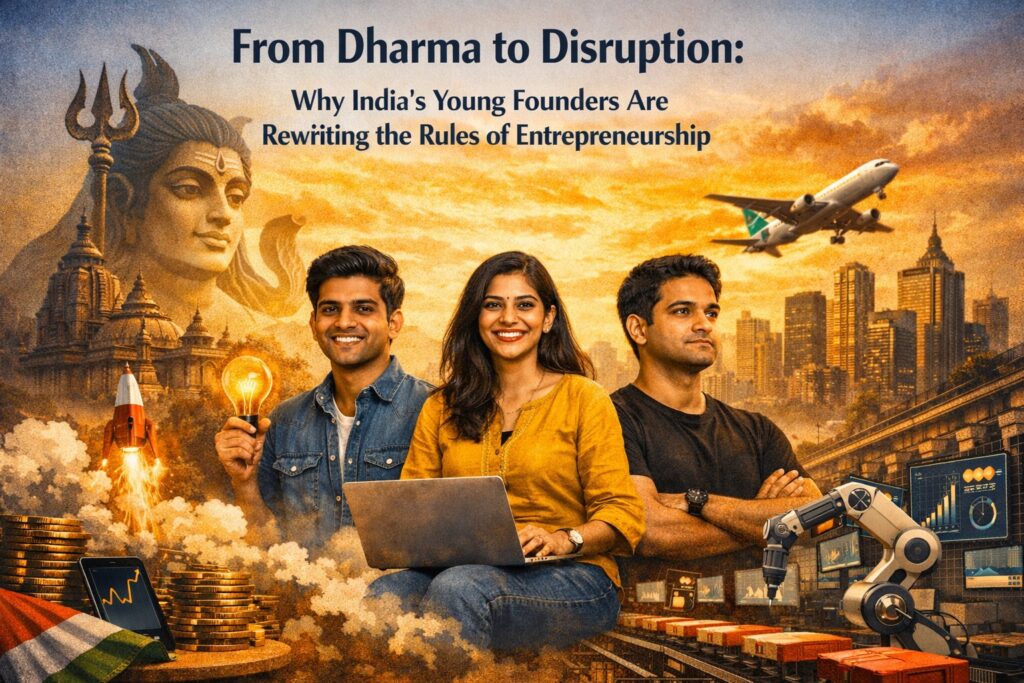
Short answer: India’s young founders aren’t rejecting ambition, they’re reframing it. New research from the Adam Smith Business School at the University of Glasgow and IIM Calcutta calls this “Hindu Religious Entrepreneurial Intention”, a model where Dharma, Karma and Artha sit beside profit. The shift matters because India is now the third-largest startup ecosystem with over 100 unicorns (NASSCOM, 2024).
Rethinking what success even means
For decades, the global startup script read the same way. Build fast. Scale faster. Maximise profit before the next person does.
It’s a model that produced some of the most valuable companies on the planet, and also a culture defined by relentless hustle, burnout, and a near-obsessive focus on valuation over actual value. Something is shifting now, quietly, inside India’s startup landscape.
A growing number of young founders are questioning the inherited definition of success. They aren’t rejecting ambition. They’re reframing it. Instead of asking “How big can this get?”, they’re asking something far more fundamental: “What is worth building in the first place?”
And the shift isn’t only philosophical. It’s structural, it’s measurable, and it’s being validated by research.
What does “Hindu Religious Entrepreneurial Intention” actually mean?
A recent study by the Adam Smith Business School at the University of Glasgow, in collaboration with the Indian Institute of Management Calcutta, put a name to a phenomenon many Indian entrepreneurs had felt but never articulated. The research drew on in-depth interviews with founders working at the intersection of culture, technology, and entrepreneurship, and it introduced the idea of “Hindu Religious Entrepreneurial Intention.”
In plainer language: for a certain cohort of Indian founders, building a company isn’t only an economic decision. It’s a cultural one, sometimes a civilisational one.
Professor Sreevas Sahasranamam, one of the study’s co-authors, frames it this way. Aligning concepts like Dharma (duty), Karma (action), and Artha (prosperity) creates “a different interpretation of success — one that foregrounds purpose alongside performance” (Sahasranamam & Kondayya, 2026).
This isn’t spirituality bolted onto a brand deck. It’s about rethinking the foundation a business is built on.
The quiet shift beneath the unicorn boom
India is now the third-largest startup ecosystem in the world, home to over 100 unicorns and thousands of emerging ventures (NASSCOM, 2024). On the surface it mirrors global trends — funding rounds, rapid scaling, aggressive competition.
Beneath that surface, though, something quieter is happening. Many young founders are moving away from borrowed, Western-centric frameworks. They’re designing businesses that reflect their own context, their lived experience, and their value systems.
You can see the shift in the questions they ask:
- What responsibility does this product fulfil?
- How does this venture contribute to society?
- Can growth and meaning coexist?
Not your typical pitch-deck questions. And yet, more and more, they’re becoming the central ones.
Entrepreneurship as a form of Dharma
One of the most compelling threads in the study is the idea of entrepreneurship itself as Dharma. Traditionally, Dharma points to duty or responsibility — something deeper than personal ambition. It’s about alignment with a larger purpose.
For many founders interviewed in the research, building a company wasn’t only about opportunity. It was about responsibility — towards culture, community, and continuity.
I remember speaking to a young founder at a student-led startup event in Delhi a couple of years ago. His product was a regional language learning platform. When asked about revenue models, he gave a fairly standard answer. But when asked why he had started it, his response stood out.
He said, “If we don’t build for our own languages now, we’ll lose them in a generation.”
That wasn’t a pitch. That was conviction.
This is what entrepreneurship as Dharma looks like in practice. Profit still matters, but it becomes one part of a larger equation, not the entire goal.
The rise of the “translator founder”
Another fascinating pattern emerging from the research is the idea of founders as translators. Today’s entrepreneurs aren’t only creating new products. They’re reinterpreting old knowledge.
They take ideas that once lived in scriptures, traditions, or cultural practices, and make them accessible, relevant and usable in a digital-first world. Consider the growing number of startups working on:
- AI models trained on ancient Indian texts
- Meditation and wellness apps grounded in indigenous practices
- Digital platforms that recreate cultural or spiritual experiences
This isn’t nostalgia. It’s transformation. These founders are bridging time. They’re pulling knowledge out of what the study calls “temporal silos” and placing it into modern contexts where it can evolve and scale.
Solving the “two lives” problem
For many young Indians, there’s always been a subtle tension between two identities. On one side: the professional self — shaped by global education, corporate culture, and modern aspirations. On the other: the personal self — rooted in tradition, family values, and cultural heritage.
For years these two worlds coexisted, but rarely overlapped. You could be modern at work and traditional at home, but blending the two often felt awkward, sometimes even discouraged.
What’s changing now is that founders are building ventures where this separation no longer exists. They’re creating spaces where cultural identity isn’t something to compartmentalise, it’s something to integrate and build on. The shift is subtle, but powerful. It lets people operate with greater authenticity, which in turn shapes the kind of products and companies they create.
A different kind of startup culture
This new wave is also challenging some of the most ingrained assumptions of startup culture. For years the dominant narrative ran like this:
- Own everything
- Scale aggressively
- Monetise at every stage
But many of these emerging ventures are experimenting with alternatives:
- Community-first growth models
- Open knowledge systems
- Value creation that extends beyond immediate monetisation
And here’s the thing — these ideas aren’t entirely new. They echo older traditions where knowledge was shared rather than hoarded, and value was measured in collective benefit rather than individual gain. In that sense, what looks like innovation is also, in part, rediscovery.
Why this shift matters right now
This transformation isn’t happening in isolation. It’s part of a larger global mood. Across the world, there’s growing fatigue with hustle culture and burnout-driven growth. According to a 2023 Deloitte survey, nearly 46% of Gen Z professionals report feeling stressed or anxious most of the time, often because of work pressure.
At the same time, demand for purpose-driven work keeps rising. People are no longer satisfied building or working for companies that print profit but lack meaning. In that context, what’s emerging from India feels particularly relevant. It offers an alternative — not to ambition itself, but to how ambition is defined.
Beyond scale: meaning and alignment
If Silicon Valley popularised the model of speed and scale, India may be shaping a model centred on meaning and alignment. This doesn’t mean Indian startups will stop chasing growth or profitability. It suggests those goals will increasingly coexist with deeper considerations of purpose, identity, and impact.
The real shift isn’t in what founders are building, but in why they’re building it. And that “why” is becoming harder to ignore.
The question that will define the next decade
For years the central question in entrepreneurship was straightforward: can purpose-driven companies succeed?
Today, that question is evolving. A more relevant one might be: can companies succeed in the long run without purpose at all?
As India’s young founders keep experimenting with new ways of building — blending Dharma with disruption, scripture with software, tradition with tech, and yes, the whole nine yards of cultural inheritance with venture-style ambition — they aren’t just creating startups. They’re quietly redefining the rules of the game.
FAQs about India’s young founders and Dharma-led entrepreneurship
What is Hindu Religious Entrepreneurial Intention?
It’s a concept introduced in research by Sreevas Sahasranamam and Kondayya (2026), conducted at the Adam Smith Business School (University of Glasgow) with IIM Calcutta. It describes how some Indian founders align Dharma, Karma and Artha to define success as purpose plus performance, not profit alone.
How is Dharma changing how Indian startups operate?
Dharma reframes a company as a duty, not just an opportunity. Founders influenced by it think about responsibility to culture, community and continuity alongside revenue. Profit still matters, but it sits inside a larger equation rather than dominating it.
Is this just a Silicon Valley copy with Indian branding?
No. The research argues the opposite. Where Silicon Valley emphasises speed and scale, this emerging Indian model emphasises meaning and alignment. Founders are designing ventures from cultural context outward, rather than importing a template.
How big is India’s startup ecosystem right now?
India is the third-largest startup ecosystem globally, with over 100 unicorns and thousands of emerging ventures, according to NASSCOM (2024). The Dharma-led shift is happening inside that boom, not outside it.
Why does this trend matter for Gen Z professionals worldwide?
A 2023 Deloitte survey found nearly 46% of Gen Z professionals feel stressed or anxious most of the time, often due to work pressure. The Indian model offers an alternative framing of ambition that may resonate well beyond India as purpose-driven work continues to rise.