
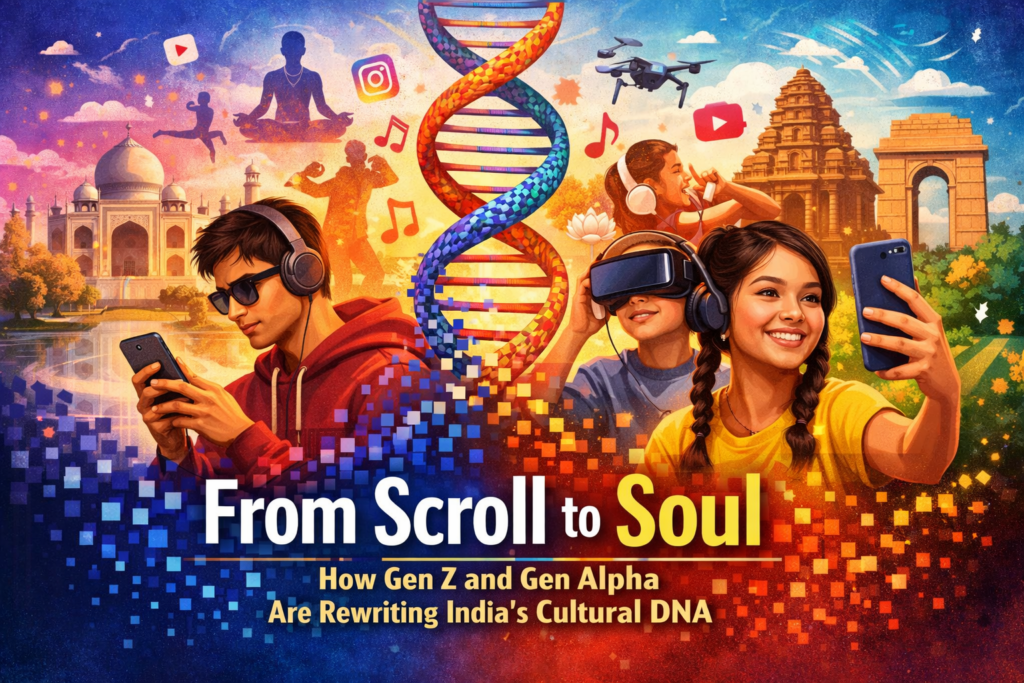
Short answer: Gen Z and Gen Alpha are reshaping Indian culture by shifting from passive consumption to active participation. Nearly 40% of 12–15 year olds now take intentional screen breaks (GWI), 59% of Gen Z use AI for career decisions (Mastercard), and 65% identify as creators. Gen Z is projected to command $33 trillion in global income by 2030.
A culture in transition
There was a time, not too long ago, when culture in India felt collective. Families gathered around televisions on Sunday mornings. Bollywood songs became national anthems overnight. Cricket matches paused cities and united strangers.
It was shared. Predictable. Familiar.
Step into India today, into a Delhi metro, a Jaipur café, or a college campus in Indore, and you’ll notice something different. Everyone is connected. Yet everyone is experiencing a different world.
Welcome to the age of Gen Z and Gen Alpha, two generations that are not just consuming culture but actively redefining it.
According to a study by Mastercard, these generations represent the “next growth generation.” Beyond economics, they represent something deeper: a shift from passive consumption to active participation. Put plainly, agency.
How is the doomscrolling paradox playing out?
Let’s begin with a habit we all recognise: doomscrolling. The endless swipe. The mindless consumption. One reel blending into another.

For years, the narrative was clear: younger generations would become increasingly addicted to screens. And to an extent, that prediction came true.
But here’s where things take an unexpected turn. They’re pushing back.
Globally, nearly 40% of young users (ages 12–15) now take intentional breaks from screen time, according to GWI research. This isn’t a rejection of technology. It’s a recalibration.
I remember speaking to a 17-year-old student in Jaipur who said, “I still use Instagram, but I’ve stopped letting it control my time. I log out sometimes. It feels freeing.”
That word, freeing, is telling. What we’re seeing is not digital fatigue alone. It’s digital consciousness.
Why is mental health driving cultural change?
Behind this shift lies a growing awareness of mental health. Books like The Anxious Generation have sparked global conversations about the psychological impact of social media. In India too, these discussions are gaining ground, especially among young people.
A college student in Indore shared, “We’ve seen what overuse does. Anxiety, comparison, burnout, it’s real.”
Behaviours are evolving. Screen time tracking is becoming common. Social media detoxes are normal. Online spaces are curated with more intention.
This generation understands something the ones before didn’t take seriously:
Access does not equal obligation.
Just because you can be online all the time doesn’t mean you should. That realisation is quietly reshaping culture.
How is AI becoming a co-pilot for young Indians?
If Gen Z grew up with the internet, Gen Alpha is growing up with something else entirely: Artificial Intelligence.
AI is no longer a futuristic concept. It’s embedded in daily life.

From generating ideas to making decisions, young people treat AI as a collaborator rather than a tool. According to Mastercard’s findings, 59% of Gen Z are comfortable using AI for career-related decisions.
A 20-year-old from Delhi told me, “Sometimes I ask AI for clarity before I ask anyone else. It helps me think.”
That statement might seem simple, but it signals a shift. Decision-making is no longer linear or purely social. It’s now augmented.
As Gen Alpha grows up fully immersed in this environment, their approach to learning, working, and creating will be different.
What happens when “mainstream” culture ends?
Once, culture was centralised. Everyone watched the same shows, listened to the same songs, followed the same trends. That era is fading.
Today, culture is fragmented into countless micro-worlds.
A student from Indore captured it: “My Instagram feed is nothing like my friend’s. We’re living in different realities.” And he’s right.
Algorithms have personalised content to such an extent that no two users experience the same internet. Trends are niche, not universal. Communities are hyper-specific.
This has led to the rise of micro-cultures. From indie music fandoms to niche meme communities, culture is no longer a monolith. It’s a mosaic.
Why does everyone now think like a creator?
Perhaps the most defining trait of these generations is this: they don’t just watch content. They create it.
Research suggests that 65% of Gen Z identify as creators. That doesn’t mean everyone is an influencer. It means everyone thinks like one.
A Jaipur-based creator once told me, “Even if I post once a week, I think about how it looks, how people feel, how it represents me.”
That mindset transforms individuals from consumers into participants. Culture is no longer dictated by a few voices. It is co-created by millions.
How does co-creation reshape how brands talk to youth?
The old model was simple: Brands create → Consumers consume. That model is now obsolete.
Today’s reality looks like this: Brands create → Consumers remix → Culture evolves.
One example from the Mastercard study stands out. A young creator made a short jingle for a beverage brand. Weeks later, that same jingle appeared in a national advertisement.
This isn’t marketing. It’s collaboration.
A Delhi student summed it up: “We don’t want to be sold to. We want to be involved.”
This expectation is reshaping how brands communicate, innovate, and engage.
How much economic power do these generations hold?
Cultural influence is often dismissed as intangible. In this case, it is backed by hard numbers.
- Gen Z is expected to command $33 trillion in global income by 2030
- Gen Alpha could influence $5.5 trillion by 2029
These aren’t just statistics. They represent decision-making power. From fashion to fintech, entertainment to education, these generations are driving demand and redefining value. For businesses, ignoring them is not an option.
How is identity changing in the digital age?
Perhaps the most profound transformation lies in how identity is formed. Traditionally, identity was shaped by family, geography, and social environment. Those factors still matter, but they are no longer dominant.
A student in Jaipur shared something striking: “I feel more understood by people in my online community than in my college sometimes.”
This isn’t isolation. It’s evolution. Identity today is multi-layered, fluid, and digitally influenced. Young people are no longer confined to a single narrative. They are curating their own.
What does technology with intention look like?
Despite deep integration with technology, Gen Z and Gen Alpha are not blindly dependent on it. They are learning balance.
- They use AI but question its outputs
- They engage online but take breaks
- They create content but prioritise mental well-being
This balance isn’t perfect. It’s still evolving. But it reflects intentionality, and intentionality is shaping not just behaviour but culture itself.
The bigger picture: culture as participation
If we zoom out, one thing becomes clear. Culture is no longer something you passively absorb. It is something you actively shape.
Gen Z and Gen Alpha are co-creating narratives, influencing trends in real time, and building communities across borders. They are not waiting for culture to be defined. They are defining it.
A personal reflection
I remember sitting in a café recently, watching a group of teenagers. They weren’t just using their phones. They were filming. Editing. Posting. Laughing.
Within minutes, they had created something that could reach hundreds, maybe thousands.
It struck me then: what used to require studios, producers, and budgets now requires a smartphone and an idea. That isn’t just technological progress. That’s cultural democratisation.
The generation that took control
For years, young people were seen as passive recipients of culture. They watched. Listened. Followed. That narrative no longer holds.
Today’s youth question what they consume, shape what they see, and influence what becomes relevant. They are not just participants in culture. They are architects of it.
FAQs about Gen Z, Gen Alpha and Indian culture
How are Gen Z and Gen Alpha different from earlier generations in India?
Gen Z grew up with the internet and smartphones; Gen Alpha is growing up with AI as a default. Both treat culture as something to shape, not just consume. They are more likely to take screen breaks, question content, and co-create with brands than older generations who grew up with television and Bollywood as fixed cultural centres.
What percentage of Gen Z use AI for career decisions?
According to Mastercard’s research cited in this piece, 59% of Gen Z are comfortable using AI for career-related decisions, treating tools like ChatGPT as a first-pass advisor before turning to family or mentors.
Are young Indians really taking breaks from social media?
Yes. GWI research cited here shows that globally, nearly 40% of users aged 12 to 15 now take intentional breaks from screen time. This trend is showing up in Indian cities like Jaipur and Indore, where students talk openly about logging out, screen time tracking, and social media detoxes.
How much economic influence will Gen Z and Gen Alpha hold?
Gen Z is expected to command $33 trillion in global income by 2030, and Gen Alpha could influence $5.5 trillion by 2029. That spending power is already shifting how brands in fashion, fintech, entertainment, and education build and market products.
What do Indian Gen Z and Gen Alpha expect from brands?
They expect involvement, not advertising. As one Delhi student put it, “We don’t want to be sold to. We want to be involved.” Brands that invite remixing, creator collaborations, and community input perform better than those running one-way campaigns.