

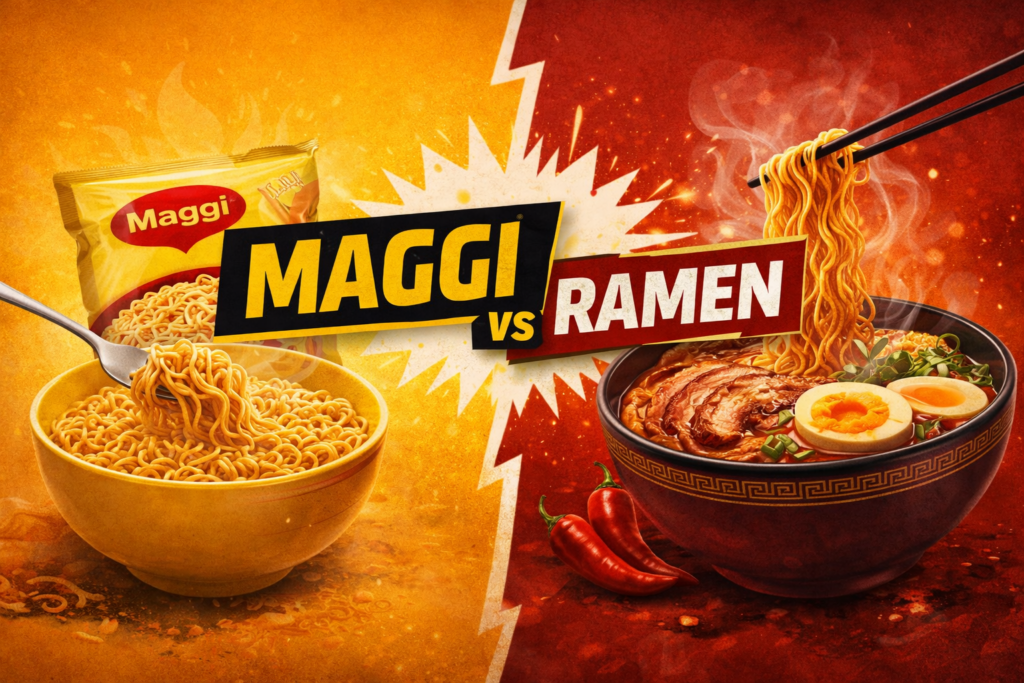
Short answer: Indian Gen Z still treats Maggi as the default comfort meal, while ramen, particularly Korean and Japanese variants, has become an occasional event tied to K-dramas and social media. In conversations with 100 Gen Z students and young professionals across Delhi, Mumbai, Bangalore and Pune, The Youth Talks found that Maggi stays routine (₹15–₹20 a packet) while ramen (₹100–₹300) remains an experience.
One thing binds Indian Gen Z across metros, hostels and college campuses: a steaming bowl of noodles. Quick, cheap and comforting, noodles have gone past food into something closer to a feeling.
But the plate is changing. Maggi still dominates as the everyday comfort meal, while ramen, especially the Korean and Japanese variants, is pulling attention. Flashy, global and very clearly trendy.
So is Gen Z shifting loyalties, or just widening its palate?
What did 100 Gen Z voices say about Maggi and ramen?
To look past trend pieces, The Youth Talks ran informal conversations with 100 Gen Z students and young professionals across India, covering cities like Delhi, Mumbai, Bangalore and Pune.
Nearly every participant had a personal Maggi story. Late-night hostel cravings. Quick meals in exam week. A Delhi student said, “Maggi got me through my entire first year. It’s not just food—it’s survival.”
Ramen, by contrast, pulled a different tone. Curiosity, excitement, a sense of novelty. A 21-year-old from Mumbai put it this way: “Ramen feels like an event. I don’t eat it daily, but when I do, it’s intentional—like watching a K-drama and making a whole vibe out of it.”
One line kept coming back: Maggi is routine. Ramen is experience.
Why does Maggi still win Gen Z hearts?
Maggi sits at the emotional centre of Gen Z’s food habits.
For many, it was the first thing they learned to cook. For others, it became a companion during stressful or lonely stretches. That familiarity is hard to beat.
Affordable, accessible and consistent, Maggi has embedded itself into daily Indian life. Market reports continue to place instant noodles among the most consumed ready-to-eat categories in India, especially among younger buyers.
Maggi isn’t exciting. It doesn’t need to be. It’s dependable.
How did ramen become a Gen Z favourite?
Ramen’s rise in India is tied to how globally connected Gen Z has become. K-dramas, anime and food trends from Instagram and YouTube have given ramen its moment.
From spicy Korean fire noodles to cheese-loaded bowls, ramen is closer to an experience than a quick meal. It feels immersive, almost cinematic.
A student in Bangalore described her weekend ritual: preparing ramen while watching her favourite K-drama. “It just feels more authentic,” she said, “like I’m part of something global.”
Ramen is not eaten so much as performed.
How does social media drive the ramen hype?
Ramen’s rise is inseparable from social media. Instagram and YouTube have turned food into content. Dishes are no longer consumed, they are filmed and shared.
Search for ramen online and you’ll find:
- Spicy noodle challenges
- Recipe hacks with cheese and butter
- Aesthetic plating videos
Ramen thrives in that environment because it looks dramatic. It tells a visual story. Maggi stays understated. It’s rarely about plating, it’s about comfort.
That’s the split: Maggi is private. Ramen is performative.
What makes ramen so appealing to Gen Z?
The pull of ramen sits on a few layers.
It carries novelty. In a world where Gen Z keeps chasing new experiences, ramen offers something different.
It aligns with global culture. Eating ramen feels like stepping into an international trend.
It allows customisation. Eggs, vegetables, sauces, cheese, ramen becomes a creative outlet.
It has social currency. A ramen bowl feels more share-worthy online than a plate of plain Maggi.
Together these make ramen attractive, but not essential.
How much does ramen cost compared to Maggi in India?
Price is ramen’s biggest barrier in India.
A packet of Maggi costs as little as ₹15–₹20. Imported or premium ramen variants can run anywhere between ₹100 and ₹300, sometimes more.
For students and young professionals on tight budgets, that difference matters. Maggi is available in almost every kirana store, roadside stall and campus canteen. Ramen is mostly limited to urban supermarkets or online platforms.
Result: ramen stays an occasional indulgence, not a daily staple.
Why is this really a story about identity?
At its core, this isn’t about noodles. It’s about identity.
Indian Gen Z lives at the meeting point of tradition and global culture. Rooted locally, but exposed to everything worldwide.
Maggi stands for familiarity, simplicity and home. Ramen stands for exploration, aspiration and a wider worldview. When Gen Z picks between the two, they’re saying something about who they are in that moment.
Are Maggi and ramen actually competing?
It’s easy to frame this as a rivalry. Maggi vs ramen. Old vs new. The truth is more layered.
The two aren’t competing, they’re coexisting. Maggi dominates daily consumption. Ramen occupies a different space: occasional, experimental and social. Many Gen Z consumers are blending both worlds.
What is the “upgraded Maggi” remix culture?
One of the sharpest trends is the rise of “upgraded Maggi.” Instead of abandoning the old favourite, Gen Z is reinventing it:
- Adding cheese and butter
- Mixing in Schezwan sauces
- Experimenting with Korean-style spices
This fusion mirrors a wider cultural pattern: take something familiar, layer global influences on top. Creative, personal and very Gen Z.
Is Gen Z moving towards healthier noodles?
Another layer is a growing awareness around health. Many young consumers are questioning ingredients, nutrition and long-term impact. That has nudged interest towards whole wheat noodles, millet-based options and low-oil variants.
The shift is still early, but it hints that the noodle aisle of the future may look quite different.
So, does Gen Z actually love ramen?
Yes, but not in the way they love Maggi. Maggi is emotional. Ramen is experiential. Maggi is routine. Ramen is occasional. Maggi is home. Ramen is exploration.
The bigger insight
Gen Z doesn’t replace. They layer. They hold on to what they love while embracing what excites them. That ability to balance comfort with curiosity shows up in food, and in almost everything else they do.
More than just noodles
The story of Maggi and ramen is really a story about a generation in transition. One that values nostalgia and seeks novelty. Respects tradition and embraces change. Finds comfort in the familiar, then keeps exploring anyway.
So next time you see someone filming ramen for Instagram and quietly making Maggi the same night, don’t see it as a contradiction. See it for what it is: a generation choosing both.
FAQs about Gen Z, Maggi and ramen in India
Why do Indian Gen Z prefer Maggi over ramen for daily meals?
Maggi is cheaper, familiar and easier to buy. A packet costs around ₹15–₹20 and is stocked in almost every kirana store, hostel mess and campus canteen. For Gen Z students and young professionals on tight budgets, it is the default comfort meal, tied to late-night cravings and exam-week memories.
How expensive is ramen compared to Maggi in India?
Imported or premium ramen variants sell for anywhere between ₹100 and ₹300, sometimes more, depending on the brand and city. That is roughly 5 to 15 times the price of a Maggi packet, which is why most Indian Gen Z consumers treat ramen as an occasional indulgence rather than a daily staple.
Why is ramen trending among Gen Z in India?
Ramen’s rise is linked to global content: K-dramas, anime, Instagram Reels and YouTube food videos. Spicy Korean fire noodles, cheese-loaded bowls and aesthetic plating make ramen look dramatic on camera. Students describe pairing ramen with K-drama marathons as a weekend ritual.
What is upgraded Maggi and why is it popular with Gen Z?
Upgraded Maggi is the trend of remixing regular Maggi with extras like cheese, butter, Schezwan sauces or Korean-style spices. Instead of choosing between Maggi and ramen, Gen Z takes a familiar comfort food and layers global flavours on top. It captures their habit of blending nostalgia with experimentation.
Is Gen Z moving towards healthier noodle options?
Slowly, yes. Many young Indians are starting to question ingredients and nutrition, and are showing interest in whole wheat noodles, millet-based options and low-oil variants. The shift is still emerging, but it suggests the noodle category in India may diversify well beyond Maggi and ramen.