In the summer of 2023, during a counseling session with NGO Arpan, a 16-year-old boy shared, “Ours was a consensual relationship. I believed that because my partner said she loved me, it meant she was comfortable with everything I did. Since she didn’t say no, I assumed she was fine with it.” Their relationship had resulted in a pregnancy. In later sessions, the boys’ reflections changed: “I used to think staying quiet was the same as saying yes; now I know silence is not consent.”
This story illustrates how lack of understanding consent leads to unsafe choices and relationships, which can have lasting consequences.
So, What Is Consent?
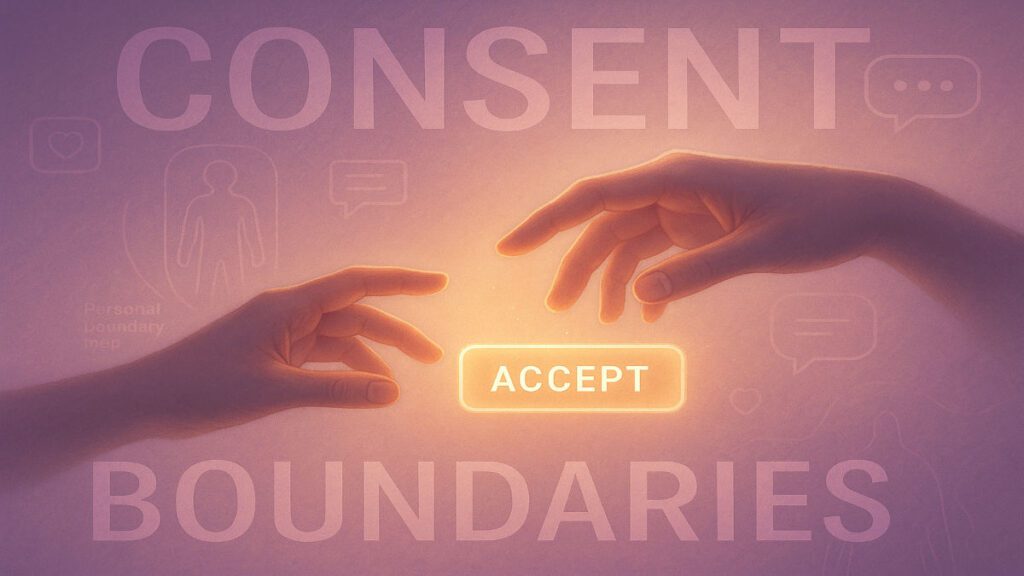
Imagine consent like the IRL ‘Accept’ button – just like clicking ‘accept’ for a trade on a gaming app or a friend request on a social media account – nothing starts until both people say ‘yes’. It’s like a mutual vibe check – everyone involved should feel comfortable and on the same wavelength. Consent is not a one-time activity, but an ongoing process.

Personal Boundaries = Consent’s Best Friend
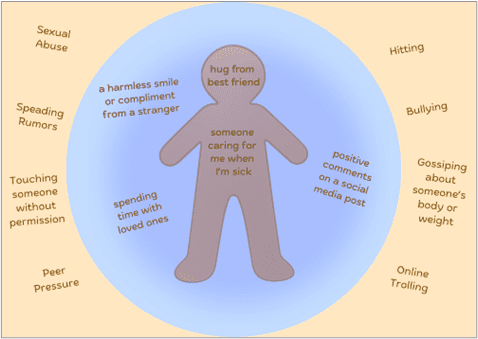
Personal boundaries are the limits and rules we set for ourselves, and consent involves all our decisions based on these boundaries. Think of personal boundaries as a map of your comfort zone. In Spider-Man: Into the Spider-Verse, when Gwen tells Miles, “Let’s just be friends,” – she is setting a boundary. In Frozen, Anna frequently respects Elsa’s wish for space, even when she desperately wants closeness. When Elsa says, “No, I can’t,” – she is setting a boundary, and Anna is learning to listen and show respect for consent, even between siblings.
Imagine this body diagram as someone’s ‘Personal Boundary Map’ – acceptable behaviors are listed within the body outline, while unacceptable behaviors are written outside the body outline. Try creating your own map!
The foundation of safe relationships is simple:
✔ Communicate your boundaries.
✔ Respect others’ boundaries.
Consent 101 For Safe and Unsafe Relationships
Personal boundaries are nuanced, individualistic, and evolving. Recognising them is an ongoing process that leads to a deeper understanding of consent, safe choices, and healthier relationships. Let’s understand this better with a situation – say, an adolescent couple is in a relationship. What would consent mean for them?
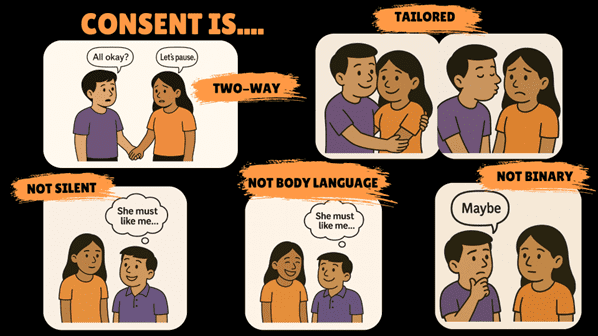
- Consent is Full Disclosure – One partner invites the other home after school, but doesn’t mention that no one else will be home – true consent demands full disclosure. We can only truly agree to something when we know everything about it.
- Consent Is Situational – One partner may be comfortable holding hands around friends, but not in a crowded place.
- Consent Is A Tailored Process – Agreeing to watch a movie together doesn’t automatically mean consent to sit very close if it feels uncomfortable. One partner may be fine with a hug but not with a kiss.
- Consent Is Not Time-Bound – One partner asks if the other is okay with a kiss. The response is, “I’ll think about it.” Consent can happen in a jiffy, or can take forever, or never.
- Consent Is Revocable – At 8:05 pm, one partner agrees to a coffee date over text, but at 8:07 pm, they text back, “Sorry, not feeling like it.” Consent can be withdrawn anytime.
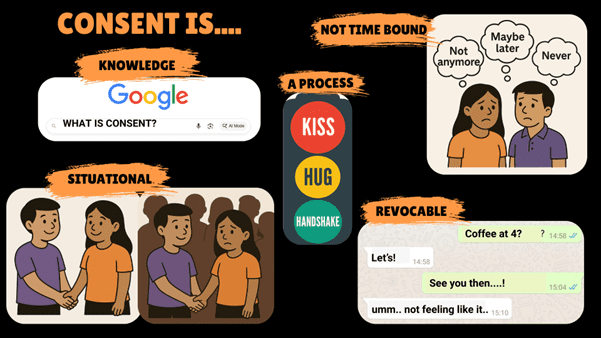
- Consent Is Not Binary – One partner asks the other out for a coffee date, and the reply is, “Hmm, I’m not sure yet.” Consent can sit in the ‘maybe’ space between a ‘yes’ and ‘no’.
- Consent is a Two-Way Street – As partners, asking for consent – Are you comfy with this? Can I? – and giving consent – I’m not into this. Can we pause? Another time. – shows mutual respect.
- Consent Is Not Silent – One partner leans in, thinking the other might want a kiss, but the other just goes quiet – silence doesn’t mean ‘yes’. While Bollywood and media often romanticise silence, in reality, silence can mean going into ‘freeze mode’ for some people.
- Consent Is Not Cryptic – One partner leans in, thinking the other might want a kiss, but the other refuses. Society often glamorizes a ‘no’ as a secret ‘yes’, especially for girls – but consent is not a puzzle. No means no.
- Consent Doesn’t Follow Body-Language – One partner tries to hug the other, and the other laughs nervously. This nervous reaction may not be an encouragement but discomfort. Body language can be misleading — always ask, never assume.
- Consent is Not Mixed – One partner may text flirty emojis but seem distant in person. Rom-coms sold us the ‘hard to get’ trope, but unclear gestures may actually be a shift in comfort level. Gen Z dating trends like ‘slow dating’ and ‘vibe checks’ are proof – people want clarity, not guessing games. The partner should check in, “Hey, are you okay?”
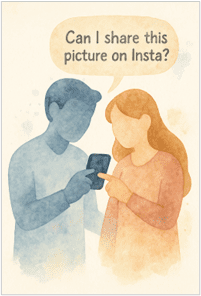
- Digital Consent – One partner shares a private selfie over chat. Later, the other partner threatens to leak the photo if they discontinue the relationship. This is sextortion – a form of Digital Sexual Abuse which also includes trolling, catfishing, doxxing, revenge porn, online grooming, and deepfake abuse. That’s where Digital Consent kicks in – deciding what’s okay to post, share, or DM. Digital consent refers to obtaining, managing, and respecting permission electronically for various activities.
How Consent Is Violated
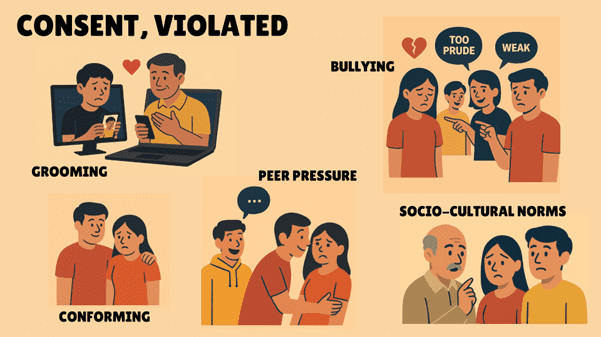
Online and offline, let’s better understand how consent is violated with a few examples –
- Grooming – An older person befriends a younger person online, constantly complimenting them and offering emotional support when they’re feeling low. Over time, they convince the younger person to share personal photos. This is grooming — a manipulative process of building trust to exploit someone, override their ability to give informed consent, and eventually sexually abuse them.
- Peer Pressure – Friends tease someone: “You’ve been dating for months — why haven’t you kissed them yet?” Feeling pressured, the person leans in for a kiss even though their partner hasn’t shown they’re ready. Peer influence can push someone to cross a boundary or act against their will.
- Bullying – Some classmates spread rumors that someone is ‘too prude’ because they didn’t want to hold hands in public, while others call another person ‘weak’ for respecting their partner’s choice. This is bullying — and it can be physical, verbal, social, sexual, or take the form of cyberbullying.
- Socio-Cultural Norms – From a young age, girls are often taught, “Be careful about saying no to boys — it might seem disrespectful.” Meanwhile, boys are often taught that, “A girl’s no really means yes.” Consequently, young adults struggle to understand and assert boundaries. Unquestioned respect for elders even when uncomfortable, rigid gender roles, and patriarchal beliefs often discourage people from challenging authority or asserting boundaries.
- Pressure To Conform – These often stem from deep-rooted socio-cultural norms. At a party, one partner puts their arm around the other. The person feels uncomfortable but doesn’t say anything because they’re scared of hurting their partner’s feelings or being judged by friends. Fear, awkwardness, or anxiety can silence individuals – and it is not their fault.
Building Your Personal Safety Universe
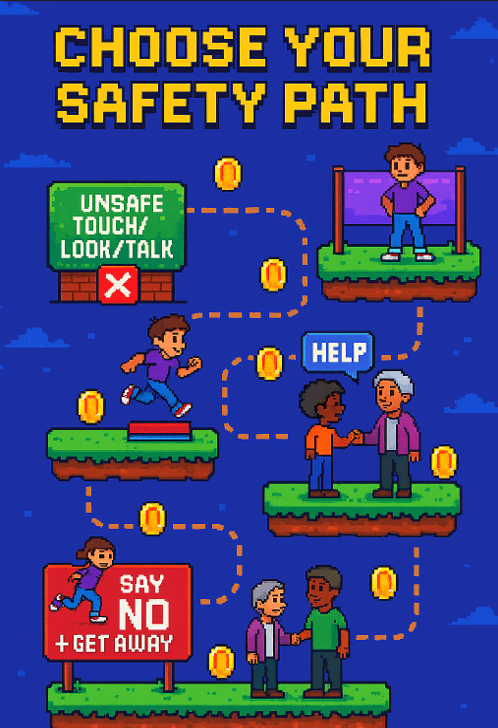
Understanding consent helps individuals identify and prevent unsafe situations. This is where Arpan’s Personal Safety Education (PSE) programme steps in, equipping individuals with practical tools, knowledge, and skills to recognise sexual abuse and unsafe relationships, set boundaries, and seek help when needed. PSE’s key safety messages reinforce this learning –
- Identify Sexual Abuse & Set Boundaries – Sexual abuse can happen to children or adolescents by touching, looking at or talking about their Private Parts or other parts of the body with sexual intent. Understanding sexual abuse helps us set boundaries.
- Refuse Assertively – If someone makes you feel unsafe, say no and get away.
- Seek Help – After getting away from the unsafe person and situation, inform a helpful adult.
- Keep Seeking Help – Keep reaching out to a helpful adult until you find help.
- It is not your fault – If someone makes you feel unsafe, it is not your fault.
Boundaries are not barriers; they are bridges to healthier connections. When consent guides our choices, our relationships become safer, stronger, and kinder.
You can better understand how consent shapes safe and unsafe relationships in Arpan’s FAQ for Adolescents. Arpan offers more child safety resources for children, parents, teachers, and stakeholders at arpanelearn.com.
Note: The Protection of Children from Sexual Offences (POCSO) Act is an Indian law that aims to protect individuals under 18 years old from sexual assault, sexual harassment, and the use of children in pornography. Under POCSO, consent is not accepted legally