
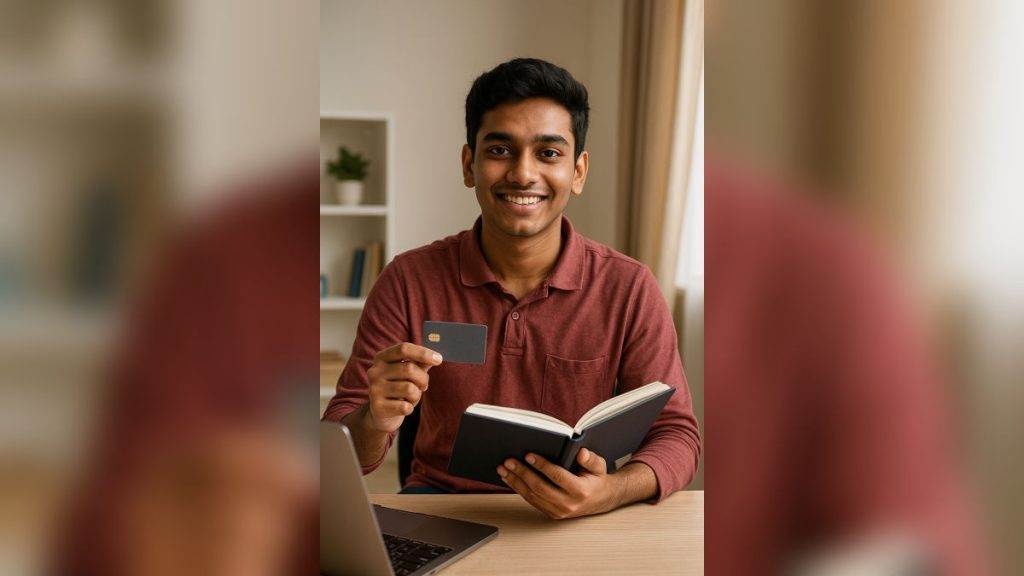
Short answer: To build credit as a college student in India, start with a student or secured credit card backed by an FD, pay every bill on time, keep usage under 30% of your limit, and let your education-loan EMIs do quiet work in the background. Check your CIBIL, Experian, Equifax, or CRIF report once a year and dispute anything that looks off.
Picture this. You graduate, line up a flat in Bandra, and the landlord asks for your CIBIL score. You have none. Your ATM card is the entirety of your financial footprint, and that’s a problem the moment any lender, employer, or broker wants proof you’re good for the money.
Credit isn’t taught in most Indian classrooms. It probably should be. Your score sits between you and the EMI on your first bike, the personal loan that bridges a gap year, sometimes even the BFSI job you’re chasing. Here’s how to build it while you’re still in college.
Why does building credit early matter for Indian students?
A credit score in India runs from 300 to 900. It tells a bank, NBFC, or fintech how reliable you’ve been with borrowed money. Lenders pull it from CIBIL, Experian, Equifax, or CRIF High Mark. No score, no easy approvals.
Starting at 19 instead of 29 buys you a decade of compounding good behaviour. And honestly, in a country where rejection rates for first-time borrowers are brutal, that head start matters more than most students realise.
Step 1: Get a credit card designed for students
Student credit cards
Several Indian banks issue student cards that don’t demand income proof. Limits are small, usually Rs 10,000 to Rs 20,000, which is exactly the point. You learn the muscle memory of swiping, billing, and repaying without staring down a Rs 2 lakh limit you can’t clear. A few banks tie these cards to a fixed deposit; others issue them to students with an active education loan. Hunt for cashback, no annual fee, or fuel rewards.
Secured credit cards
If a student card is out of reach, the secured card is your friend. You park an FD, the bank issues a card against it, and your deposit becomes your limit. Easy. Use it like any other card, but pay the full bill on time, every time. Personal anecdote. I started with a secured card against my Rs 20,000 FD. Groceries, the phone bill, the odd Swiggy order, all on the card, all cleared in full each month. Within a year my CIBIL was past 730. Pre-approved offers started landing in my inbox.
Step 2: Become an authorised user
Borrow trusted credit behaviour
If a parent or sibling has a credit card with a clean repayment record, they can add you as an authorised user. Their on-time payments and low balances start showing up on your report. The catch is real: if they slip up, that hits your file too. Pick someone responsible.
Step 3: Use your education loan wisely
For a lot of Indian students, the education loan is the first credit line they ever touch. If you’ve taken one, you’re already mid-build. You just don’t know it yet.
Pay EMIs on time
Once repayment kicks in, set up an auto-debit from your salary account. One missed EMI can knock 50-80 points off your score. Brutal, but that’s the reality.
Contribute to your credit mix
An education loan is installment credit, very different from the revolving credit on a card. Bureaus like seeing both kinds on your file. It signals you can handle different repayment structures, not just one.
Quick fact. According to TransUnion CIBIL, consistent repayment of education loans significantly improves credit scores by age 25.
Step 4: Practice good credit habits
Tools matter. Behaviour matters more. Some habits worth burning into your routine from day one:
Pay your bills on time, always
Mobile bill, OTT subscription, credit card statement, postpaid Jio, anything with a due date. Payment history is over 35% of your score. It’s the single biggest lever you’ve got.
Keep credit utilisation low
If your card limit is Rs 20,000, don’t push beyond Rs 6,000-7,000 in a billing cycle. Stay under 30% and lenders read you as someone who doesn’t depend on credit. Stay above 80% and they read you as stretched. Same person, different signal.
Don’t apply for too many loans or cards
Every application triggers a hard inquiry. Three or four in a quarter and your score takes a visible hit. Space them out. Be picky.
Step 5: Check your credit report regularly
Monitor your progress
You’re entitled to one free report per year from each bureau. Use them. Reading your report tells you what’s actually moving your score, and what isn’t.
The four official sources:
Dispute errors promptly
Reports get things wrong. A late payment that wasn’t yours, a closed loan still showing open, a duplicate account. Raise a dispute the moment you spot one. Cleaning up a single error can bump scores by 30-50 points.
Bonus tip: start with small EMIs
Want to push the score harder? Buy something modest on a no-cost EMI through Amazon, Flipkart, or a BNPL like LazyPay. Small amount, real credit signal. Pay every installment on time.
Final thoughts: credit is a responsibility, not just a number
Building credit in college isn’t really about chasing 800. It’s about giving your future self options. The flat that doesn’t need a guarantor. The job in BFSI that finds nothing alarming. Small decisions today compound into big ones later. Start small. Stay consistent.
“Credit is like a reputation: hard to build, easy to lose.”
FAQs about building credit as a college student in India
Can a college student get a credit card in India without income proof?
Yes. Most major Indian banks offer student credit cards with no income requirement, and almost all banks offer secured credit cards backed by a fixed deposit of Rs 10,000 or more. The deposit becomes your credit limit, and your repayment history starts building from day one.
What is a good CIBIL score for a college student?
Anything above 700 is considered solid for a student, and 750+ unlocks pre-approved personal loans and better credit-card upgrades. New borrowers usually start around 650-680 and grow from there with on-time payments over 6 to 12 months.
Does paying an education loan EMI on time improve your CIBIL score?
Yes. Education-loan EMIs are reported to all four bureaus, and consistent on-time payments add positive installment-credit history to your file. TransUnion CIBIL data shows steady loan repayment significantly lifts scores by age 25.
How long does it take a college student to build a usable credit score in India?
You typically need 6 months of credit activity for a bureau to generate a score, and around 12-18 months of clean repayment to reach the 720-750 range. Pay every bill on time, keep usage under 30%, and don’t open too many lines at once.
What’s the safest first credit product for an Indian student?
A secured credit card against a fixed deposit. Risk is contained because the bank holds your FD as collateral, the limit is small, and on-time repayment builds the same credit history as any unsecured card.