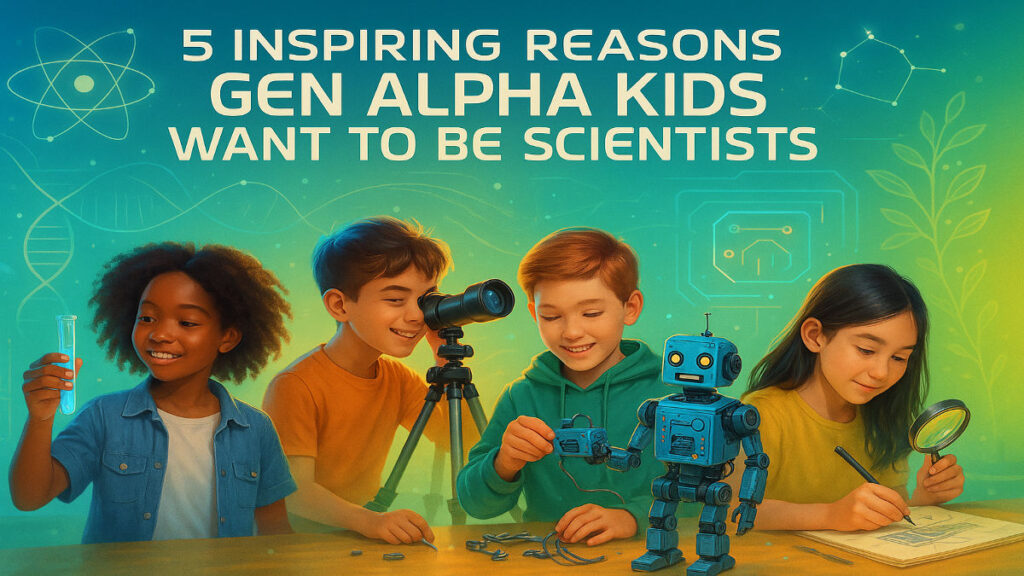
Short answer: Gen Alpha kids in India want to be scientists because science surrounds their daily life, hands-on learning apps make it fun, they see it as a way to fix real problems like climate change, and role models from Dr. A.P.J. Abdul Kalam to Sonam Wangchuk show what’s possible. Science feels like a superpower they can use.
In an age dominated by influencers, viral content, and the creator economy, it might surprise some to hear that many Gen Alpha kids, those born after 2010, are dreaming not of followers and fame but of formulas, experiments, and solving the world’s biggest problems.
The scientist is back in style. In 2025, across Indian classrooms, science fairs, and YouTube channels, a new generation of thinkers is emerging, driven by curiosity and a wish to change the planet.
Why does science still hold magic for Gen Alpha?
Unlike earlier generations who first engaged with science through textbooks and chalkboards, Gen Alpha’s relationship with science is immersive, interactive, and personal.
1. They’re surrounded by science and they know it
From voice-activated devices to AI-powered games and school chatbots, Gen Alpha has grown up in a world where science and technology are part of everyday life. For them, science isn’t a subject. It’s the engine behind their world.
“Alexa tells me jokes, plays songs, and answers homework questions. I wanted to know how she knows so much,” says 9-year-old Vanya from Jaipur, who recently created her first basic voice bot through a school coding workshop.
This constant exposure builds a natural sense of wonder: How do things work? Can I build something too?
2. Hands-on learning makes science fun
With apps like Byju’s, interactive STEM toys, and school programs pushing project-based learning, Gen Alpha isn’t reading about science. They’re doing it.
Gamified platforms like Tynker and coding classes from WhiteHat Jr. let Indian children simulate real scenarios, from space exploration to urban pollution. Science starts to feel relevant and exciting.
At a recent school event in Bengaluru, a group of Class 5 students demonstrated a homemade water purification model powered by solar energy. Their message? “We want to help villages where people don’t get clean water.”
3. They see science as a way to change the world
This generation is deeply aware of the world’s challenges. Climate change, pandemics, deforestation, and ocean plastic aren’t abstract issues. Gen Alpha sees them on social media, discusses them in classrooms, and watches documentaries about them on Netflix.
According to a 2024 report by Exploding Topics, there’s a growing global trend of kids linking science with activism. They see it as a tool for change, not knowledge alone.
In India, young voices are rising. Take 13-year-old Ridhima Pandey from Uttarakhand, who filed a petition in the National Green Tribunal against the government for not doing enough on climate change. Her scientific understanding fuels her activism.
4. There are more role models than ever
Science is no longer hidden in labs. It’s on YouTube, in TED Talks, and on Instagram. From iconic legends to modern-day heroes, Gen Alpha has a wide mix of scientific role models to look up to.
Key inspirations for Indian kids include:
- Dr. A.P.J. Abdul Kalam – The former President and ISRO scientist remains a national icon for innovation, humility, and education.
- Sonam Wangchuk – An engineer and education reformist who made real-world science accessible through the Ice Stupa project in Ladakh.
- Greta Thunberg and Jane Goodall – While not conventional lab scientists, their scientific advocacy resonates with young environmentalists.
- Marie Curie and Albert Einstein – Their historical achievements still fascinate today’s kids and show up in animated science explainer videos.
Even digital science communicators like Bill Nye and India’s own Dr. Binocs (from the YouTube channel Peekaboo Kidz) have become household names, turning complex concepts into engaging stories.
5. Science feels like a superpower
In an era where even 8-year-olds can code, launch a mini weather balloon, or 3D print a school project, science has become something thrilling, not just logical.
It gives kids the tools to invent, explore, and solve. Unlike rote learning, it celebrates trial and error. That fits well with Gen Alpha’s preference for hands-on learning, real-world relevance, and a problem-solving mindset.
As 11-year-old Aarav from Noida shares, “In science, it’s okay to fail. That’s how we learn. One day I want to invent something that can clean Delhi’s air.”
The future looks bright and brilliant
While digital fame dominates headlines, a quiet revolution is brewing in science classrooms across India. It’s a story of resilience, intelligence, and real-world curiosity.
Gen Alpha isn’t only dreaming about a better world. They’re preparing to build it, one equation, one invention, and one breakthrough at a time.
For parents, educators, and mentors, the job isn’t only to teach formulas. It’s to nurture wonder, champion ideas, and support ambitions, whether that means raising the next Marie Curie or helping someone build solar-powered water purifiers for rural India.
Because in the hands of this generation, science isn’t only knowledge. It’s hope.
FAQs about Gen Alpha and science
Who are Gen Alpha?
Gen Alpha are kids born after 2010. They are the first generation raised fully with AI assistants, smart devices, and gamified digital learning from early childhood.
Why are more Gen Alpha kids in India interested in science?
Gen Alpha kids in India are drawn to science because of everyday exposure to AI and smart devices, hands-on STEM apps like Byju’s and Tynker, project-based school learning, and a sense that science can solve problems like climate change and water scarcity.
Who are scientific role models for Indian kids today?
Popular role models include Dr. A.P.J. Abdul Kalam, Sonam Wangchuk, Greta Thunberg, Jane Goodall, Marie Curie, Albert Einstein, Bill Nye, and Dr. Binocs from Peekaboo Kidz.
How do Indian schools make science hands-on?
Schools use project-based learning, STEM toys, coding workshops, and events like the Bengaluru Class 5 demonstration of a solar-powered water purification model. Apps like Byju’s and Tynker simulate real-world problems.
Can kids really do science activism?
Yes. Ridhima Pandey from Uttarakhand, for example, filed a petition in the National Green Tribunal at age 9 against the government for inadequate climate action, showing that scientific understanding can drive real activism in kids.