
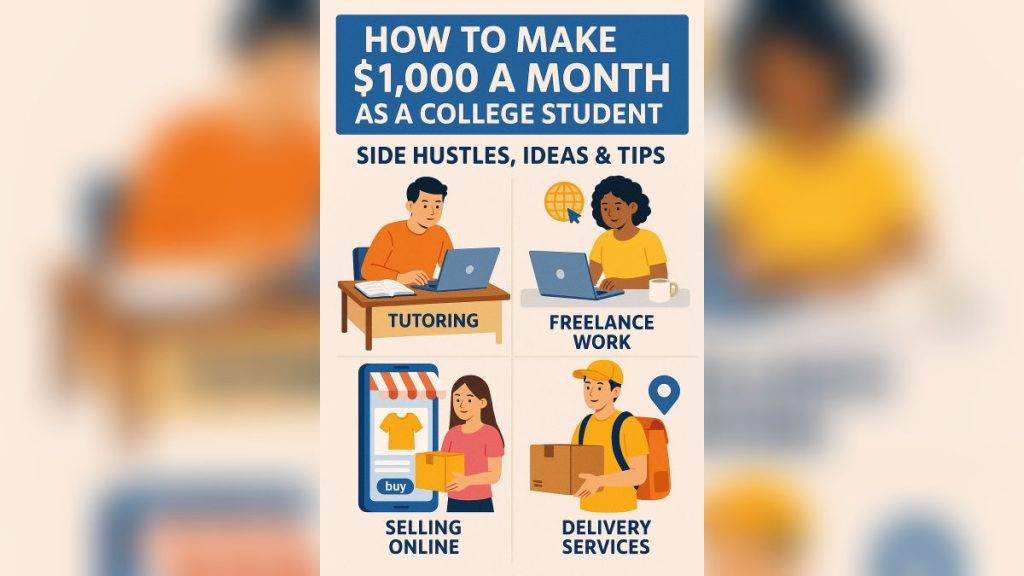
Short answer: Earning $1,000 a month as a college student is achievable through a mix of tutoring ($25/hour), freelance writing or design ($30 to $100 per piece), social media management ($200 to $500 per client) and gig platforms like Wyzant, Upwork, Chegg, Rev and TaskRabbit. The fastest path is stacking two or three smaller gigs, not chasing one big one.
Making an extra $1,000 a month as a college student sounds ambitious. It’s also entirely doable, with the right mix of skills, consistency and a bit of creativity. In an era where flexibility is everything, students aren’t stuck with on-campus jobs and babysitting gigs anymore. From freelancing to launching a micro-business, the income options are everywhere if you know where to look.
Here’s a realistic, student-friendly playbook for stacking up that extra income while keeping your GPA intact.
How can you turn academic skills into income?
You’re already spending hours mastering academic subjects. Why not turn that knowledge into cash?
Tutoring: Turn Class Notes into Cash
If you’re acing calculus or fluent in French, tutoring can be a goldmine. High school students (and even fellow college peers) will pay for academic help. I once helped a junior with economics over Zoom and earned $25/hour. After four students, I was bringing in nearly $400 a month. Platforms like Wyzant or even your campus notice boards are great places to start. Bonus: you reinforce your own learning while earning.
Freelance Writing and Editing
Good with words? Put that essay-writing prowess to work. Students who write well can contribute articles, edit website content or ghostwrite blogs. Sites like ProBlogger or Contently list freelance gigs regularly. I began writing short articles on student life for $30 a piece and worked my way up to editing for a travel blog at $60 per article. Slow start, real income.
Be a Subject Matter Expert
Got niche knowledge in computer science, chemistry or finance? Platforms like Chegg Study or Studypool pay you to answer academic questions. It’s on-demand work that fits any student schedule. Some top contributors make over $1,000 monthly just through Q&A.
Which digital gigs pay college students the most?
If you’re more tech-savvy than textbook-oriented, there’s a digital gig waiting.
Social Media Management
Most small businesses struggle with Instagram, TikTok or LinkedIn. If you’re already good at content creation, captions or trend-watching, turn that into a side hustle. Offer to manage accounts for local shops or freelancers for $200 to $500 a month. I once managed a local artist’s Instagram and Pinterest pages and made $300/month, all from my dorm room.
Virtual Assistant Work
VA roles are in demand, especially for startups and solopreneurs. Tasks range from managing emails to scheduling meetings or basic data entry. Websites like Belay and Fancy Hands list these roles, which can pay $10 to $25/hour.
Graphic Design and Web Development
Have a knack for Photoshop or Canva? Can you code in HTML or build a WordPress site? Freelance design and development are incredibly profitable. Start small with logo designs or simple websites on Fiverr or Upwork, then gradually raise your rates. One design student I know charges $100 per logo and averages 10 orders a month. Easy math.
Blogging or Vlogging
Creating content online takes time, but it pays off. Start a YouTube channel or a blog on something you love: gaming, college life, fitness, anything. Monetise through affiliate marketing, Google AdSense or sponsored posts. It took me six months of consistent blogging before my site started earning $100/month through ads. A year in, it crossed $500.
What about quick-cash micro gigs?
Not all side hustles require specialised skills. Sometimes all you need is consistency and a bit of hustle.
Freelance Marketplaces
Websites like Upwork, Fiverr and Freelancer.com are loaded with gigs: copywriting, resume building, virtual assistant work, translation. New freelancers might start small, but $20 to $30/hour gigs aren’t out of reach with time.
Online Surveys and Testing
Not a full income stream, but paid surveys on Swagbucks or Survey Junkie can supplement your income. Similarly, user testing sites like UserTesting.com pay $10 to $60 for reviewing websites or apps.
Transcription Services
If you’re a fast typer, try transcription. Sites like Rev, GoTranscript and TranscribeMe offer jobs that pay per audio minute. Experienced transcribers can earn up to $1,500/month with regular work.
What real-world and creative gigs still work?
Let’s not forget some good old-fashioned (and creative) hustle.
Sell Crafts or Art
If you love creating, whether it’s jewelry, pottery, digital prints or crochet, you can sell on Etsy, Amazon Handmade or even Instagram. A friend of mine sells custom keychains and stickers, making $200 to $400 every month.
Gig Economy Jobs
Ride-share driving, food delivery (via Zomato, Swiggy or Uber Eats) and helping people move furniture through TaskRabbit are flexible ways to earn. Just track your hours and fuel costs to stay profitable.
Part-Time Campus Jobs
Universities often have student roles in libraries, labs or admin departments. They’re usually low-stress, close to your classes, and designed to fit around your academic schedule.
How do you actually maximise side hustle earnings?
Build Your Brand
As you freelance or sell online, build a simple portfolio or Instagram page showcasing your work. Over time, clients start coming to you.
Diversify Income Streams
Don’t rely on one gig. Combine two or three that complement each other. Tutor during the week, design logos over the weekend, run surveys in your downtime. Stacking is the strategy.
Stay Patient and Consistent
The truth? It won’t happen overnight. But with consistency and gradual improvement, what starts as an extra $200/month can turn into $1,000 or more, give or take.
Final thoughts: hustle smart, not just hard
College is a unique time. You’ve got freedom, flexibility, and a ton of learning opportunities. Making $1,000 a month isn’t about working yourself to burnout. It’s about choosing smart, sustainable gigs that align with your strengths and lifestyle. Whether you’re tutoring three nights a week or editing videos between classes, you’re building skills (and possibly even your future career) along the way.
Start small. Stay consistent. And hustle smart.
FAQs about making $1,000 a month in college
How long does it take to make $1,000 a month from a side hustle as a student?
Most students hit $1,000/month within three to six months of consistent effort, depending on the gig. Tutoring at $25/hour gets you there fastest (about 40 hours of paid sessions). Blogging and YouTube usually take six months to a year before they cross $500/month.
What is the easiest side hustle for a college student with no experience?
Tutoring in a subject you already know well is the lowest-friction starting point. After that, transcription on Rev or TranscribeMe and survey sites like Swagbucks or Survey Junkie need no prior experience and pay quickly.
Can I make $1,000 a month freelancing without a portfolio?
You can start without a portfolio, but expect lower rates ($5 to $15 per gig) for the first month or two on Fiverr or Upwork. Once you’ve delivered five to ten quality jobs and collected reviews, raising rates to $20 to $30/hour becomes realistic.
Which platforms pay students the most for academic Q&A?
Chegg Study and Studypool both pay for answering academic questions, with top contributors earning over $1,000 monthly. Subjects in computer science, chemistry, finance and advanced math typically pay the highest per-question rates.
Is social media management a real income source for students?
Yes. Local shops, artists and small freelancers often pay $200 to $500 per month per account for someone to handle Instagram, TikTok or Pinterest. Two or three clients can comfortably take you to $1,000/month.