
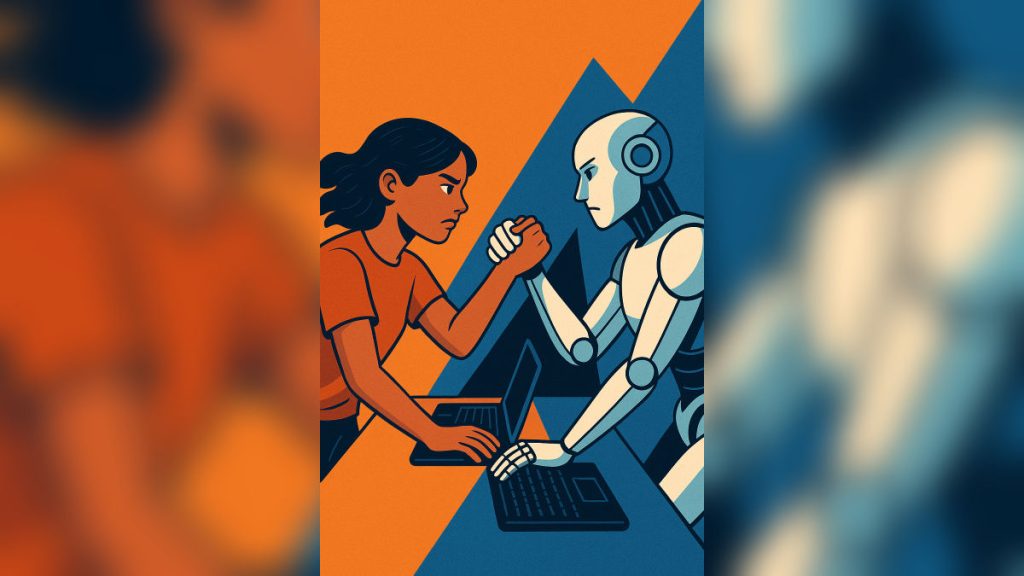
Short answer: A survey of over 1,000 Indian Gen Z aged 13-26 found 65% see AI as a collaborator, not a threat, and only about 10% view it as competition. Nearly 80% said their AI use grew significantly in the past year, with ChatGPT, Grammarly, Midjourney, Duolingo, Canva and Notion topping the list. They trust AI for productivity, but they want transparency, human-centred design, and teachers, not screens, in classrooms.
A quiet revolution is underway. It doesn’t march on the streets. It unfolds in the small interactions between humans and machines, in late-night scrolling sessions, productivity apps, and group chats about which AI tool finishes essays best. For Gen Z, artificial intelligence isn’t a distant marvel. It’s their reality. As AI embeds itself deeper into our lives, one question gets louder: is this partnership between humanity and AI actually a collaboration, or is it slowly turning into a contest?
To explore this generational crossroads, we delved into the minds of over 1,000 Gen Z individuals across India, ages 13 to 26. What emerged wasn’t fear or fantasy. It was a nuanced blend of admiration, wariness and expectation. This article captures that essence.
Who exactly is the first AI-native generation?
Born between 1997 and 2012, Gen Z has never known a world without the internet. They grew up talking to Siri, swiping on screens, and watching YouTube tutorials instead of asking older siblings for help. And now they’re casually chatting with ChatGPT to finish essays, using Canva for class presentations, and automating to-do lists with Notion. In our survey, 78% were still in school or college, digital natives in their formative years, while the rest were young professionals navigating early careers.
This group doesn’t just interact with tech. They embody it. For them, AI isn’t a “breakthrough.” It’s background noise. Routine. Like electricity or Google. The better question isn’t “What do they think of AI?” but “What do they expect from it?”
How does Gen Z actually use AI day to day?
When asked about familiarity with AI, 45% of respondents described themselves as very familiar, and another 35% had a moderate grasp. Only a fraction admitted to knowing little. But here’s where it gets interesting. The tools they mentioned weren’t just chatbots or robots. They listed real, everyday software: ChatGPT, Grammarly, Midjourney, Duolingo, Canva and Notion.
These aren’t just tools. They’re companions. AI is helping Gen Z brainstorm YouTube titles, write cleaner code, translate languages and organise personal schedules. For this generation, artificial intelligence isn’t a “wave” on the horizon. It’s the water they’re already swimming in.
Is AI a toy, or a productivity engine?
One of the most striking insights? Over 60% of Gen Z participants said they use AI for productivity, not just play. They lean on it for summarising notes, generating creative ideas, refining resumes, or organising their week. For a generation juggling academic stress, career uncertainty and content creation ambitions, AI feels like a secret weapon.
And it’s not a one-off experiment either. Nearly 80% said their use of AI had increased significantly over the past year. The trend reveals an important shift, from occasional use to habitual reliance. From novelty to necessity.
One 19-year-old college student shared: “I started using ChatGPT just for fun. Now I literally use it to revise my notes before exams. It’s like a smart friend who doesn’t judge.”
What worries Gen Z about AI?
Gen Z isn’t blind. Alongside the appreciation sits a layer of concern, soft, cautious, deeply thoughtful. Several respondents voiced fears about losing originality. One common worry: “What if AI is making us lazy thinkers?” Another chimed in, “If I rely too much on it, will I forget how to write by myself?”
Others raised ethical red flags. From deepfake content to biased data, from surveillance concerns to misinformation, these young minds are watching closely. They know the technology they’re excited about is also reshaping society in unpredictable ways.
A 22-year-old content creator noted: “I love AI, but I hate when I can’t tell what’s real anymore.”
Trust, for them, isn’t automatic. It has to be earned.
Should AI replace teachers in classrooms?
Perhaps the most insightful response came when participants were asked about AI in education. Does it help or harm learning?
A clear consensus emerged. AI is brilliant at personalisation. It can adapt, explain and simplify. But it can’t replace human mentorship. The teacher-student bond, with its emotion, nuance and unpredictability, remains sacred.
AI might be great at identifying weak areas in a test. It can’t read a student’s face to sense burnout. Or inspire with a personal story.
A 16-year-old put it beautifully: “My math teacher helped me believe I could solve problems. AI helps me actually solve them. I need both.”
Is AI a partner or competition?
So where does Gen Z stand on the headline dilemma?
When asked directly whether they view AI as competition or a partner, more than 65% voted for collaboration. They want to build with AI, not against it. Only about 10% saw AI as something that might “replace” or “threaten” them.
And when asked whether AI would surpass humans entirely, most responded with confident scepticism. Their reasoning wasn’t scientific. It was philosophical.
“AI can write poems,” said one respondent, “but it can’t feel heartbreak.”
Another added: “AI knows logic. Humans know meaning.”
This isn’t naivety. It’s clarity. Gen Z understands what AI can do. They also deeply understand what it cannot: feel, empathise, imagine, forgive.
What should brands and educators take away?
This survey isn’t only a reflection. It’s a roadmap.
Three big takeaways for anyone building AI-powered tools, products or communities.
1. Trust is non-negotiable
AI must be transparent. Gen Z won’t buy into platforms that feel manipulative, extractive or opaque. They need clarity on what data is being used, how it’s stored, and what’s being done with it.
2. Human-centred design wins
Even the smartest AI won’t matter if it alienates users. Tools that prioritise intuitive design, emotional intelligence and cultural relevance will always win over those that just flaunt technical sophistication.
3. Education must be reimagined, not replaced
AI should be an extension of good teaching, not a substitute. Gen Z doesn’t want screens instead of people. They want screens that help people teach better.
The heart of the matter
What makes this story so compelling is that it isn’t really about AI. It’s about us. About how humans, young, curious and deeply reflective, are navigating the unknown with surprising grace.
They aren’t running from AI. Nor are they idolising it.
They’re learning to live alongside it.
They’re asking hard questions, building new tools, adapting their thinking, and refusing to let machines dictate meaning.
A 17-year-old summed it up best: “AI is smart. But I’m human. That’s not the same thing.”
Final thoughts: a story still being written
This generation isn’t preparing for the arrival of AI. They’re already shaping its evolution. As creators, students, employees and entrepreneurs, Gen Z is showing us a new way to engage with technology, grounded in ethics, powered by purpose, and framed by humanity.
The future of AI isn’t a solo act.
It’s a duet.
The question isn’t whether humans and AI will collaborate, but how well we’ll learn to harmonise.
So as we rush to build smarter machines, let’s not forget to raise wiser humans.
Because AI may write our emails. Only we can write the story of our lives.
FAQs about Gen Z and AI in India
Do Gen Z see AI as a competitor or a partner?
In a survey of over 1,000 Indian Gen Z aged 13-26, more than 65% described AI as a collaborator they want to build with, while only about 10% viewed it as a threat or replacement. The dominant attitude is partnership, not rivalry.
Which AI tools do Gen Z use most often?
Respondents named ChatGPT, Grammarly, Midjourney, Duolingo, Canva and Notion as their daily AI companions. Over 60% use AI primarily for productivity, summarising notes, generating ideas, refining resumes, and nearly 80% said their use grew significantly in the past year.
What worries Gen Z about AI?
Concerns cluster around losing originality (“will I forget how to write by myself?”), deepfake content, biased data, surveillance and misinformation. Trust isn’t given automatically, it has to be earned through transparency.
Should AI replace teachers?
No, according to the survey. Gen Z values AI for personalisation and explaining concepts, but they want human mentorship for emotion, nuance and inspiration. As one 16-year-old put it, “My math teacher helped me believe I could solve problems. AI helps me actually solve them. I need both.”
What do Gen Z expect from AI brands and platforms?
They expect transparency about data, human-centred design that respects emotional intelligence and cultural relevance, and education tools that augment teachers rather than replace them. Brands that feel manipulative or opaque get rejected fast.