

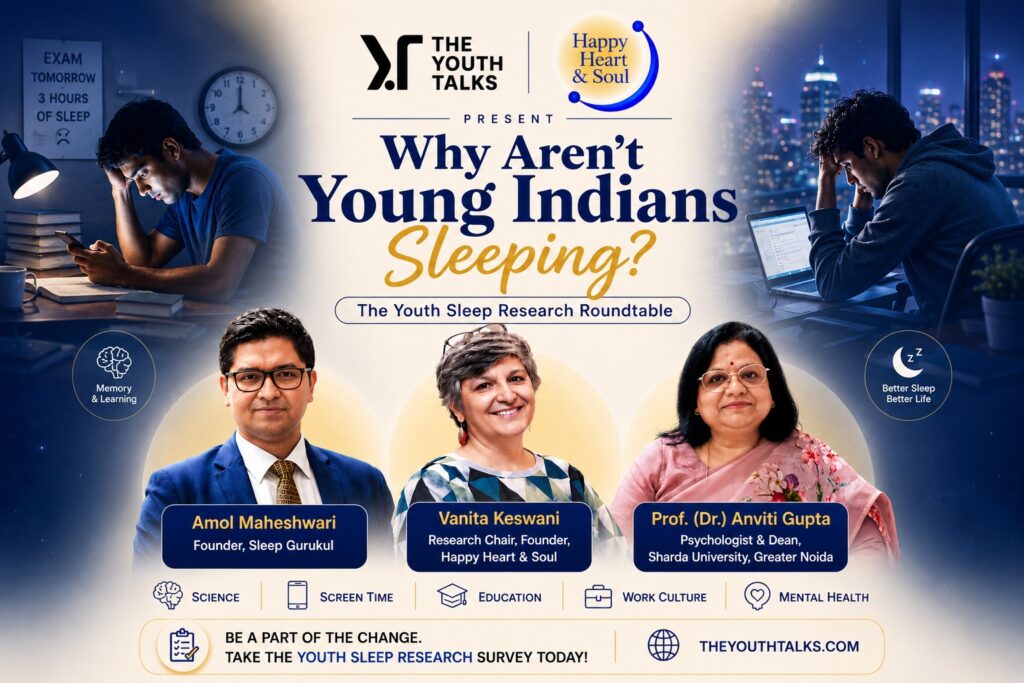
Sleep Has Become a Silent Crisis for India’s Youth
Every generation faces a defining challenge. For today’s young Indians, alongside concerns about careers, mental health, and an increasingly digital lifestyle, another issue is quietly emerging—sleep.
Late-night study sessions, demanding work schedules, endless scrolling on social media, and the pressure to remain constantly productive have fundamentally changed how young people approach rest. Sleeping less has almost become a badge of ambition. Phrases like “I only slept three hours” are often spoken with pride rather than concern.
But what does this culture of sleep deprivation mean for the health, productivity, and future of an entire generation?
To explore this important question, TheYouthTalks hosted The Youth Sleep Research Roundtable, bringing together three leading sleep experts—Vanita Keswani, Amol Maheshwari, and Dr. Anviti Gupta—alongside students and young professionals to discuss why young Indians aren’t sleeping and what can be done about it.
Watch the complete discussion here:
A Simple Question That Opened a Bigger Conversation
The discussion began with a question that everyone could relate to:
“What time did you go to bed last night? How many hours did you sleep? And how rested do you feel today on a scale of one to ten?”
The responses revealed a striking pattern. Students spoke about preparing for examinations until the early hours of the morning. Young professionals described balancing long workdays, international meetings, and constant notifications. Several participants admitted that checking their phones before bed had become second nature, while others confessed to feeling guilty whenever they slept for eight hours, believing they could have spent that time working instead.
What appeared to be individual habits quickly reflected a much larger cultural shift.
When Being Tired Becomes a Status Symbol
One of the most thought-provoking discussions centred on an uncomfortable reality: why has sleeping less become something to celebrate?
For many students and professionals, exhaustion is increasingly viewed as evidence of commitment and hard work. Society often praises busyness while overlooking recovery. Instead of asking whether someone slept well, conversations frequently revolve around how late they stayed awake or how much work they managed to complete.
The panel questioned whether educational institutions, workplaces, and even social media have unintentionally created an environment where burnout is normalised instead of prevented.
Sleep Is More Than Just Rest
Throughout the discussion, the experts emphasised that sleep is far more than simply switching off for the night.
Scientific research shows that during sleep, the brain consolidates memories, regulates emotions, supports learning, and repairs the body. According to the Centers for Disease Control and Prevention, adults generally require at least seven hours of sleep per night for optimal health, while the National Sleep Foundation recommends 7–9 hours for most young adults. Persistent sleep deprivation has been linked to poorer concentration, reduced academic performance, impaired decision-making, and increased risks to both physical and mental health.¹²
The panel’s message was clear: sleep is not a luxury. It is a biological necessity that underpins every aspect of daily life.
Can Weekend Sleep Make Up for Lost Time?
Another myth challenged during the roundtable was the belief that weekday sleep loss can simply be recovered by sleeping longer on weekends.
While additional rest may help reduce short-term fatigue, experts explained that it does not fully reverse the cumulative effects of chronic sleep deprivation. Consistently sacrificing sleep throughout the week eventually affects attention, mood, memory, and overall wellbeing.
Technology also emerged as a recurring theme. Rather than blaming smartphones outright, participants discussed how constant connectivity has reshaped bedtime routines. Endless scrolling, late-night messaging, and the expectation of always being available make it increasingly difficult for young people to truly disconnect before sleeping.
Should We Teach Sleep in Schools and Colleges?
Perhaps the most surprising conclusion from the discussion was that sleep education remains largely absent from formal education.
Students are taught mathematics, science, financial literacy, and even entrepreneurship, yet very few ever learn how sleep influences learning, emotional resilience, productivity, or long-term health.
The panel argued that introducing evidence-based sleep education in schools, colleges, and workplaces could become one of the simplest yet most impactful investments in youth wellbeing.
A National Conversation Starts Here
The roundtable marks the beginning of The Youth Sleep Research, an ongoing nationwide initiative by TheYouthTalks to understand the sleep habits, behaviours, and wellbeing of young Indians aged 16–30.
The objective extends beyond publishing research findings. By combining expert insights with the lived experiences of young people, the initiative aims to generate evidence that can support educators, employers, healthcare professionals, parents, and policymakers in creating healthier environments for the next generation.
If there is one takeaway from the discussion, it is this: improving youth wellbeing begins by understanding how young people actually live—and how they actually sleep.
If you are between 18 and 30 years of age, you can contribute to The Youth Sleep Research by sharing your experiences. Every response strengthens our understanding of youth wellbeing and helps shape future research, public conversations, and evidence-based recommendations.
Participate in the Survey: https://theyouthtalks.com/sleep-research/