

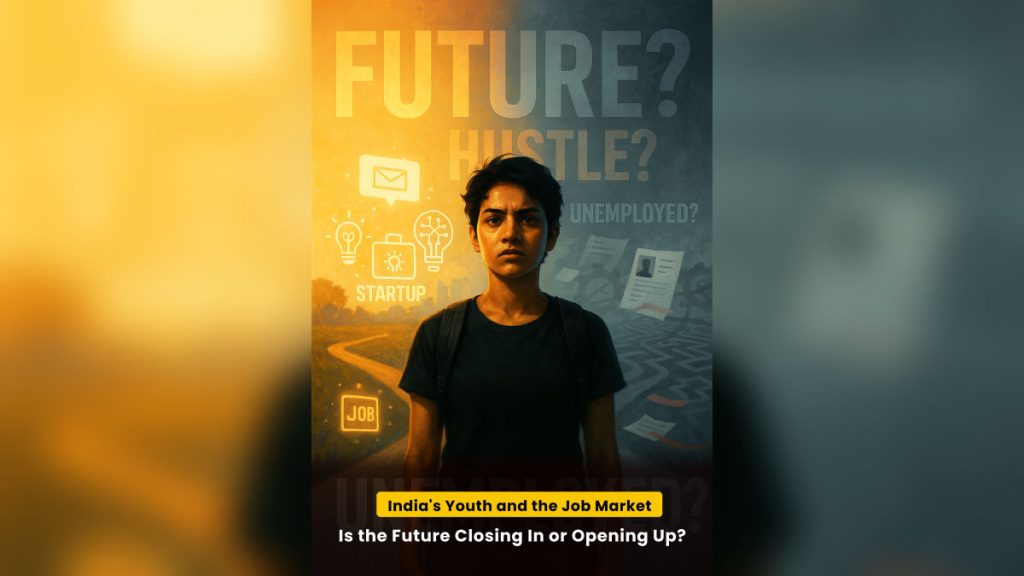
Short answer: India’s youth job market is in a rough patch, mass layoffs at Intel (24,000), TCS (12,000) and Microsoft (10,000), plus 13 lakh aspirants for just 602 UPSC posts in 2024. Only 42.6% of Indian graduates are considered employable per a 2025 study. But AI, blockchain, green jobs and the care economy are still hiring. The real fix needs better education, skill-building and grassroots entrepreneurship.
A tipping point for India’s youth
India stands at a crucial juncture. Its youth, ambitious, educated, full of energy, are staring into an uncertain future. Once hailed as the torchbearers of a rising economic power, they’re now navigating a job market in retreat. Mass layoffs at tech giants. Startup hiring on pause. Stalled momentum in the private sector. As over 1 crore aspirants vie for limited government positions, the promise of prosperity feels out of reach for many.
But is this really the end of India’s job growth story, or just a painful transition before a reset?

Let’s take a closer look at how today’s employment crisis is hitting young Indians, what’s structurally broken underneath it, and whether real opportunities still exist in the new sectors taking shape.
Layoffs, hiring freezes and a shrinking private sector
The headlines speak volumes:
- Intel to lay off 24,000 employees
- TCS to lay off 12,000
- Microsoft cuts 10,000 jobs
- Infosys freezes salary hikes
- Startups hit pause on hiring
These aren’t isolated events. They’re part of a wider trend that’s sending shockwaves through India’s aspiring workforce. Many fresh graduates, especially from Tier 2 and Tier 3 colleges, are finding themselves without offers, internships, even basic interviews. The rejection emails. The radio silence. The slow realisation that the rules they prepared for don’t quite apply anymore.
“I worked hard through college to land a tech job. Now, my offer is indefinitely delayed, and there’s zero communication,” says Riya, 22, a computer science graduate from Jaipur.
And it isn’t only the engineering grads. MBAs, liberal arts students, vocational diploma holders, all of them are running into the same wall, jobs disappearing faster than they can apply.

The stampede towards government jobs
With the private sector quiet, a mass migration is happening, not physically, but in aspiration. Young people are turning to the public sector. Government jobs offer what private gigs currently don’t: stability, benefits, and dignity.
More than 10 million youth are now preparing for competitive exams, from UPSC to SSC to state-level services. The supply-demand mismatch is stark, and a little frightening. In 2024, over 13 lakh candidates applied for just 602 positions in the UPSC Civil Services Examination. That’s a success rate of less than 0.05%.
“I’ve been preparing for three years. The stress is immense. There’s no Plan B,” says Suresh, 25, a UPSC aspirant from Bihar. That kind of pressure, layered on top of uncertainty, has fed a quiet epidemic of anxiety and burnout in coaching towns across the country.

Underemployment and the informal trap
Even when young people do find work, the quality of that work often disappoints. A large chunk of India’s youth ends up in low-paying, informal sector jobs, delivery riders, call-centre workers, data-entry operators. These roles rarely use their academic training, and they almost never offer job security, career progression, or social benefits.
According to the Periodic Labour Force Survey (PLFS), about 90% of India’s workforce remains in the informal sector. Many of these roles are temporary, unregulated, and exposed to exploitation. Underemployment, where you’re working below your qualification level, is now a defining feature of the youth labour market, or rather, more accurately, it’s been one for years and is finally getting noticed.
The bigger problem: skill gaps and mismatched training
One of the root causes of the employment crisis is a stubborn mismatch between education and employability. A 2025 study revealed that only 42.6% of Indian graduates are considered employable. That’s less than half.
It points to a deeper issue. Colleges are churning out degrees, not job-ready professionals. Communication. Problem-solving. Critical thinking. Domain-specific expertise. Employers find that even graduates with top marks often aren’t ready for the actual work.
It’s a sentiment recruiters echo. “We find that many candidates, even with top degrees, struggle with basic work ethics, collaborative thinking, or adaptability,” notes a hiring manager at a mid-size tech firm in Bengaluru.

Silver linings: where opportunities still exist
The picture looks grim, but it isn’t all dark. There are real glimmers of hope, especially in emerging sectors reshaping the global economy.
1. The tech-plus frontier: AI, blockchain, and more
Traditional IT roles are shrinking, but emerging technologies like artificial intelligence, blockchain, machine learning, and cybersecurity are still booming. These domains demand specialised skills, and they’re hiring, just selectively.
2. Green jobs and sustainability careers
The green economy is poised to be one of the major employment generators of the next decade. Renewable energy, electric mobility, sustainable agriculture, waste management, all projected to create millions of jobs in the coming years.
3. The care economy
Healthcare, education, and domestic services, collectively the care economy, hold real potential, especially for women. As India’s population ages and health awareness rises, the demand for care professionals will only grow.
Government initiatives: promises and gaps
Recognising the looming crisis, the Indian government has launched several initiatives:
- Skill India Mission and Pradhan Mantri Kaushal Vikas Yojana (PMKVY) aim to train youth in market-relevant skills.
- Startup India and Stand Up India offer support for entrepreneurship and MSMEs.
- Make in India and the PLI (Production Linked Incentive) Scheme target domestic manufacturing growth and job creation.
These are commendable efforts, the challenge is implementation. Many youth in rural or underserved areas don’t even know these programmes exist, or lack the access and resources to benefit. Better coordination between educational institutions, industries and government bodies is critical. Curriculum reform, internship pipelines, mentorship, all of it has to actually map to what employers want.
What needs to change?
To dodge a demographic disaster, India has to move quickly and strategically. Here’s what could shift the picture:
- Revamp education: Focus on practical, interdisciplinary learning. Blend technical with soft skills.
- Promote entrepreneurship at the grassroots: Build incubation hubs beyond the metros. Encourage youth-led micro-enterprises.
- Enhance digital access: Bridge the digital divide so every student has access to online learning and job platforms.
- Strengthen mental health support: Make psychological counselling and stress management part of mainstream education and exam prep.
- Celebrate diverse career paths: Move beyond the engineer-doctor-IAS narrative. Promote design, arts, sports, climate action, vocational trades.

Conclusion: a fork in the road
India’s youth is its greatest asset, or potentially, its greatest liability. What we’re witnessing today isn’t the collapse of dreams, it’s the clash between aspiration and opportunity. This moment demands clarity, compassion, and coordinated action.
The situation is serious, but not hopeless. Across the country, young people are adapting, upskilling, and hustling. They’re starting YouTube channels, freelancing online, building edtech apps, and growing D2C brands on Instagram, all while waiting for the formal economy to catch up.
They don’t lack ambition. They lack support systems. It’s time we matched their drive with the right infrastructure, educational, economic, and emotional.

Because if we fail them now, we risk losing more than jobs, we risk losing the very spirit that could define India’s next era.
FAQs about India’s youth job market
Why is India’s youth job market struggling in 2025?
Mass layoffs at Intel (24,000), TCS (12,000) and Microsoft (10,000), startup hiring freezes, and a private sector slowdown have reduced opportunities. At the same time, only 42.6% of Indian graduates are considered employable per a 2025 study, deepening the mismatch between supply and demand.
How many Indian graduates are actually employable?
A 2025 study found that only 42.6% of Indian graduates are considered employable. The gap is largely down to weak communication, problem-solving, critical thinking and domain-specific skills, not academic credentials.
What is the success rate of the UPSC Civil Services Exam?
In 2024, over 13 lakh candidates applied for just 602 positions in the UPSC Civil Services Examination, a success rate of under 0.05%. More than 10 million Indian youth are now preparing for various government exams.
Which sectors in India are still hiring?
Emerging sectors are still hiring selectively, including artificial intelligence, blockchain, machine learning, cybersecurity, the green economy (renewable energy, electric mobility, sustainable agriculture, waste management), and the care economy (healthcare, education, domestic services).
What government schemes support youth employment in India?
Skill India Mission, Pradhan Mantri Kaushal Vikas Yojana (PMKVY), Startup India, Stand Up India, Make in India and the Production Linked Incentive (PLI) Scheme are key initiatives. The schemes are well-designed but face uneven implementation, especially in rural and underserved areas.