
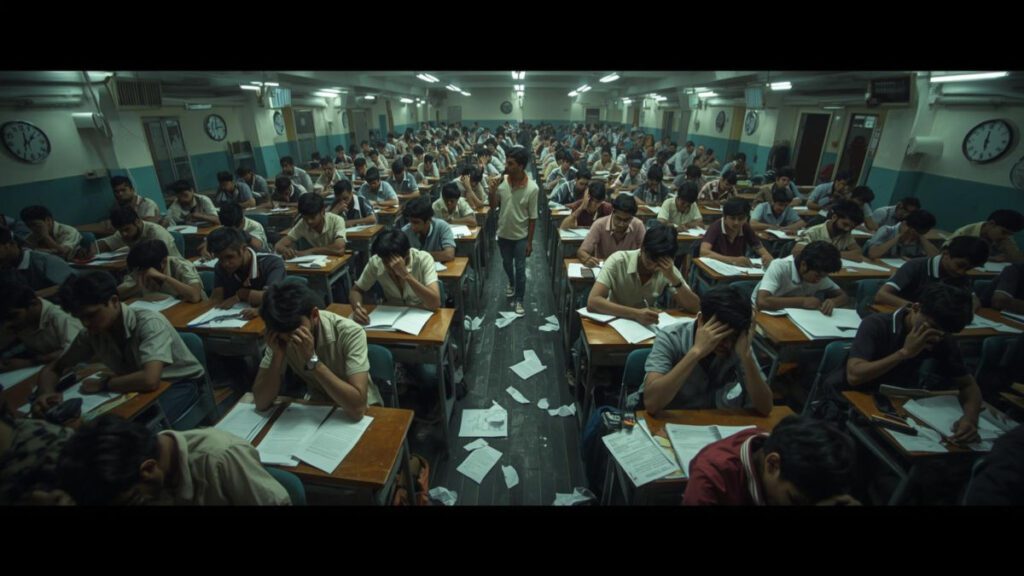
Short answer: India’s exam system is buckling under two forces: population pressure that turns tests like NEET, JEE and UPSC into survival contests, and systemic failures — paper leaks, far-flung centre allocations, delays — that have shaken trust in merit. The 2024 NEET-UG episode, with over 60 perfect scorers and a confirmed paper leak, made the crisis impossible to ignore.
In India, competition is no longer just tough. It has become industrialised, commercialised, and at times ethically fractured. Every year, millions of students fight for a few thousand seats in medicine, engineering or government service, because those seats often decide careers, social mobility and respect.
Two things have become painfully clear in recent years:
Overpopulation has turned competition into survival.
Systemic cracks, from paper leaks to logistical chaos, have shaken public trust in merit itself.
1. What happened in the NEET-UG 2024 paper leak?
In 2024, India’s biggest medical entrance test, NEET-UG, saw something never seen before: over 60 students scored a perfect 720/720, with multiple toppers emerging from the same exam centres. Soon after, reports of paper leaks surfaced from Bihar and other regions, triggering a nationwide outcry.
Investigations confirmed that the question paper had indeed been leaked before the exam in certain locations. The Supreme Court of India later noted that “at least 155 candidates” were found to have benefitted from unfair means, but ruled that there was insufficient evidence to cancel the entire exam.
(Source: Supreme Court hearings, July 2024; Ministry of Education statements; media reports from The Hindu, Indian Express, and NDTV.)
The result? A generation of students who did everything right — studied for years, followed the rules — were left doubting whether “merit” still means anything.

2. Why does reaching the exam hall feel like a battle?
Another layer of dysfunction lies in exam logistics themselves. In several government recruitment exams such as SSC, State PSCs, and even CUET-UG, candidates were allotted centres up to 500–800 kilometres away from their hometowns.
For many, especially students from lower-income families, that distance is not only inconvenient. It is a financial and emotional burden. Imagine travelling 8 hours by train to take a 2-hour test that could decide your future. Many arrive exhausted, late, or unable to appear at all.
What’s worse? The system often says nothing more than “technical allocation error.”
3. What are the numbers behind the madness?
NEET-UG 2024: 24 lakh candidates. Only around 1 lakh MBBS seats nationwide.
JEE (Main + Advanced): Over 12 lakh aspirants, roughly 16,000 IIT seats.
Government exams (SSC, UPSC, State PSCs): More than 3 crore applicants every year for fewer than 1 lakh total posts combined.
That is the math of hopelessness. When population growth collides with stagnant opportunity, “competition” becomes a polite word for systemic despair.
4. How is a whole generation being pressured by exams?
The ripple effects are visible everywhere: rising mental health concerns among students, burnout, and a growing number of tragic suicides in coaching hubs like Kota. Parents are mortgaging homes for coaching fees, while students measure their self-worth in ranks and cutoffs.
Every leak, every delay, every unfair centre allocation is not “an incident.” It is another crack in the nation’s collective faith in fairness.
5. The hard truth about India’s exam system
India’s youth are not short of talent or willpower. What is missing is a fair system — one that values integrity over volume, transparency over profit, and humanity over statistics.
Until that happens, even rank 1 will not feel like victory, because the system itself will remain the biggest loser.
FAQs about India’s exam system
How many students took NEET-UG 2024?
Around 24 lakh candidates appeared for NEET-UG 2024, competing for roughly 1 lakh MBBS seats nationwide.
Was the NEET-UG 2024 exam cancelled?
No. The Supreme Court noted that at least 155 candidates were found to have benefitted from unfair means, but ruled there was insufficient evidence to cancel the entire exam.
How competitive is JEE for IIT seats?
Over 12 lakh aspirants sit JEE Main and Advanced each year, chasing roughly 16,000 IIT seats — a ratio that makes the test one of the toughest in the world.
Why are candidates given exam centres hundreds of kilometres away?
Exams such as SSC, State PSCs and CUET-UG have allotted centres 500–800 km from candidates’ hometowns, with officials citing “technical allocation errors.” It creates a heavy financial and emotional burden, especially for lower-income families.
Why is Kota often mentioned in discussions about exam stress?
Kota is one of India’s largest coaching hubs, and it has seen a growing number of tragic student suicides, making it a symbol of the mental health toll of exam pressure on Indian youth.