
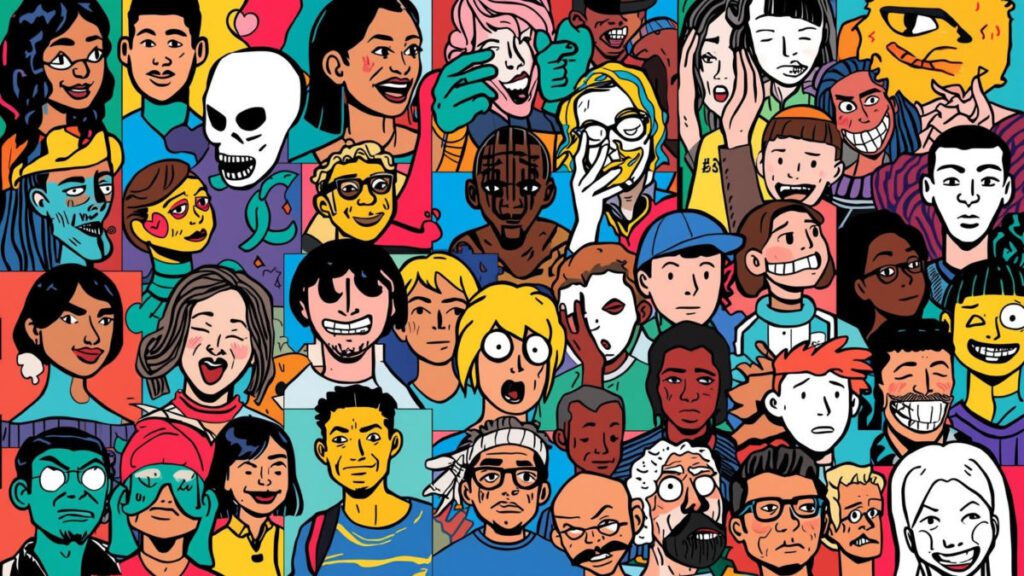
Short answer: Memes are a modern philosophy for online youth. Scholars like Limor Shifman, Ryan Milner, and Whitney Phillips show how formats such as “This Is Fine,” “Distracted Boyfriend,” “Galaxy Brain,” “Loss,” and “OK boomer” compress argument, critique, and ethics into shareable images, letting young people define problems and suggest how to respond.
When a teenager posts an image of a cartoon dog surrounded by flames and captions it “this is fine,” they are not only joking. They are making an argument about how to live, feel, and act in an unstable world. What looks like rapid-fire humour and shorthand is often a compressed, collectively authored philosophy: a way of naming a problem, diagnosing it, and suggesting, sometimes earnestly, sometimes ironically, how to respond.
Below is a sourced look at how memes have become a vernacular philosophy for young people: how they form ideas, how they circulate, why they matter, and what their power and peril look like.
What do we mean by “meme”?
Scholars use “meme” to describe culturally meaningful units, such as images, short videos, phrases, or formats, that are imitated, adapted, and circulated online. Limor Shifman’s influential account frames memes not as single objects but as social units that gain meaning through user variation, remix, and spread. They are multimodal (mixing image, text, sound), repeatable, and transformable. Memes are a grammar for rapid cultural thought.
Why are young people the main meme-makers?
Young people are the most active makers and adapters of memetic forms. They live on platforms like TikTok, Instagram, Snapchat, and YouTube that make remixing and circulation frictionless. Large-scale surveys show these platforms dominate teen attention and social life, which makes youth both consumers and the primary workforce behind meme creation. That ubiquity is how meme-ideas grow into shared, generational ways of thinking.
How does a meme “think”?
Memes compress argument into instantly recognisable moves. Ryan Milner and other memetics scholars describe memetic media as a set of communicative logics (multimodality, re-appropriation, resonance, collectivism, and spread) that let people turn jokes into critique and images into claims. A single stock photo or template, with labelled elements, repeated panels, or short sound loops, can carry a metaphor, a diagnosis, and an ethical stance at once. Memes don’t replace longform argument. They function like aphorisms and thought-bridges that invite rapid collective judgment.
What are five memetic moves that feel philosophical?
Parable compressed into a frame. Formats such as the “Distracted Boyfriend”, a stock-photo object-labelling template, let users map complex relational dynamics, like desire versus responsibility or old systems versus new hopes, in a single repeatable tableau. Re-use turns private insight into public analogy.
Irony-as-defence. “Galaxy Brain” and other expanding-brain formats let people perform meta-commentary about knowledge, ego, and self-deception. They show, in stages, an idea’s apparent brilliance and its possible stupidity. The form becomes a compact dialectic.
Existential coping made sharable. KC Green’s comic that became “This Is Fine” lets a single absurd image express resignation, denial, or gallows humour toward catastrophe, from climate breakdown to economic precarity and daily overwhelm. It is an emotional diagnosis that also doubles as a behavioural option: laugh, look away, persist.
Meta-commentary and self-critique. “Loss”, the minimalist remix of a comic strip about miscarriage, shows how communities turn a tonal mismatch into a whole genre of reflexive commentary, an extended meditation on sincerity, performative grief, and in-jokes.
Generational shorthand as political stance. Catchphrases like “OK boomer” moved from niche boards into parliamentary record and mass media. In a few syllables they summarise intergenerational frustration, political impatience, and moral condemnation all at once. The phrase’s rapid public circulation shows how youth use memetic forms to stake claims in civic life.
Why does this count as philosophy and not just jokes?
Philosophy’s basic moves are definition, critique, analogy, and prescription. Memes do all four:
Define — they name emotional states, structural ills, and identity moves with a single sign.
Critique — they lampoon status quos: institutions, norms, and pundits.
Analogise — a meme maps one domain onto another, producing emergent insight (for example, capitalism-as-distraction).
Prescribe — through irony, satire, or earnest exhortation, meme-communities suggest how to feel or act.
Because so many young people share and iterate these moves, memetic currency becomes a kind of collective syllogism. If a community accepts a meme’s labels and analogies, it implicitly accepts its claims about the world.
What are the power and peril of meme-thinking?
Memes are powerful rhetorically. They propagate quickly, cross platform boundaries, and shift mainstream discourse. Politicians and journalists quote memes; advertisers appropriate them. But memetic power is ambivalent. Scholars like Whitney Phillips show how the same cultural forms that empower playful critique can be weaponised for trolling, disinformation, or cynicism, and how anonymity and virality can amplify both insight and harm. Memes build solidarity. They can also flatten nuance, accelerate misinformation, and harden group identity into exclusion.
How should educators and readers interpret memes?
Read the format and not only the caption. A meme’s template often carries historical uses and shades of meaning.
Trace provenance when stakes are high. A single viral image can be repurposed for political ends, so origins matter.
Look for chains and not individual memes. Philosophical viewpoints often live across dozens of related memes.
Treat memetic claims as starting points, not final arguments. Memes invite conversation, and critical thinking is about continuing it.
A closing thought
Memes are not lightweight noise. For many young people they are the first place a feeling meets a public, a private diagnosis becomes shared wisdom, and a fleeting joke turns into an ethical posture. To read memes as “just jokes” is to miss that entire ways of seeing the world, sceptical, ironic, hopeful, and exhausted, are being sketched in shorthand, billions of times a day. If we want to understand the ideas, anxieties, and ethics of today’s youth, we need to learn this language well enough to translate its one-liners back into sustained conversation.
FAQs about memes and youth philosophy
Who defined the modern idea of a “meme”?
Limor Shifman’s work frames memes as social units that gain meaning through user variation, remix, and spread. They are multimodal, repeatable, and transformable, which makes them a grammar for rapid cultural thought.
Which memes act like philosophical statements?
“This Is Fine” (KC Green) expresses existential coping. “Distracted Boyfriend” compresses parable into a frame. “Galaxy Brain” performs irony-as-defence. “Loss” turns into meta-commentary. “OK boomer” functions as generational political shorthand.
Why is Gen Z so central to meme culture?
Gen Z lives on TikTok, Instagram, Snapchat, and YouTube, platforms built for remix and circulation. Surveys show these platforms dominate teen attention, so young people are both the biggest consumers and the primary makers of memes.
What are the dangers of meme-based thinking?
Whitney Phillips and other scholars show memes can flatten nuance, spread misinformation, harden group identity into exclusion, and be weaponised for trolling or cynicism. The same forms that enable critique can also enable harm.
How can teachers and journalists read memes responsibly?
Read the format and not only the caption, trace provenance when stakes are high, look at chains of related memes rather than one image in isolation, and treat memetic claims as conversation starters rather than final arguments.