
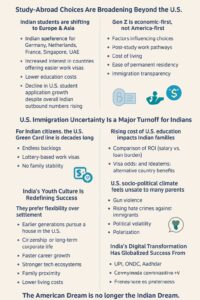
Short answer: The American Dream is not dying for India’s Gen Z; it is evolving. A Theyouthtalks survey of 1,000+ respondents in New Delhi and Hyderabad found young Indians no longer treat US settlement as the peak of ambition. Rising Indian salaries, long green card waits exceeding 50 years, and a booming domestic tech scene are pushing Gen Z toward a new mindset: build globally, live locally.
For decades, the “American Dream” sat at the heart of middle-class Indian ambition. It was more than a geographical move. It represented prestige, prosperity, and the promise of a predictable life. Parents told stories of cousins who “made it big” in California. Teenagers grew up watching English sitcoms and imagining a life framed by wide highways, suburban lawns, and endless opportunity.
But India in the 2020s, and more so its Gen Z, is rewriting that script. They have inherited a world where homegrown tech companies rival global giants, where creators from Tier-2 cities gather millions of followers, and where a laptop and steady Wi-Fi can bridge continents without anyone leaving home.
To understand this shift, Theyouthtalks surveyed over 1,000 Gen Z respondents across New Delhi and Hyderabad with one emotionally loaded question: Do you still want to settle in America? The answers reflect a generational re-examination of what success means in a rapidly changing India.
How is India’s economic confidence reshaping youth aspirations?
Walk through a co-working space in Bengaluru or Hyderabad today and you will see 19-year-old AI developers working alongside 25-year-old startup founders building products for global markets. India has moved from talent supplier to talent magnet.
A booming economy, a new mindset
India is now the world’s 5th largest economy, and the growth is visible in everyday life. Better infrastructure, improved education access, and rising disposable incomes have shifted the national psyche.
A respondent from Hyderabad put it aptly: “Why chase an American dream when India is becoming an opportunity hub?”
Sectors like fintech, EV manufacturing, cybersecurity, and AI are creating high-paying domestic roles, narrowing the wage gap that once pushed young Indians to the US.
Middle-class stability strengthens possibility
The Indian middle class today has:
- Wider access to private healthcare
- A growing network of international schools and colleges
- Financial cushions through savings, SIPs, and real estate
- Better access to global brands and lifestyle upgrades
Earlier generations saw the US as an escape from limitations. Gen Z sees it as one option among many, not the only route to upward mobility.
Why are Indian students picking Europe and Asia over the US?
India sends more students abroad than ever before, but the US share of that pie is shrinking.
Europe and Asia are the new rising stars
Germany, France, Singapore, the UAE, and the Netherlands are luring Indian talent with:
- Lower tuition fees
- Post-study work privileges
- Straightforward immigration systems
- Affordable living costs
This diversification signals a real pivot. Students are choosing value and stability, not the American brand.
Practicality over nostalgia
Gen Z’s study decisions are driven by ROI, immigration clarity, safety and quality of life, and long-term work opportunities.
A student from Delhi shared in the survey: “My parents still say America is the best, but I’d rather study where I get a job easily.”
This pragmatic approach marks a major ideological shift from previous generations that treated a US degree as a golden ticket.
Why is US immigration turning Gen Z away?
H-1B and green card lottery fatigue
Indian professionals face staggeringly long green card wait times, some exceeding 50 years. To a generation that values speed and clarity, this feels like an outdated system.
One respondent joked, “I’ll get a green card at 75. What will I do with it then, walk slowly into the American sunset?” Humour aside, the frustration is real.
Skyrocketing education costs
With US tuition ranging between $80,000 and $120,000, Indian families are reconsidering whether the return on investment still holds. Rising living costs and unpredictable job markets add further pressure.
Safety concerns and political polarisation
Indian parents now worry about mass shootings, racial incidents, political divisiveness, and security on campuses. These concerns are shared openly in family WhatsApp groups, shifting parental endorsement away from America.
How is Gen Z redefining success on their own terms?
One striking trend in the Theyouthtalks survey was how casually Gen Z dismissed traditional symbols of achievement.
Flexibility over fixation
For millennials, America was a finish line. For Gen Z, it is a stop on a global map. They aspire to remote-first careers, digital nomad lifestyles, freelance projects, building startups or creator brands, and working in cross-border teams. This focus on mobility, not migration, is a philosophical pivot.
Foreign no longer equals success
A Delhi respondent noted: “My cousin works in the US, but my friend in India earns more from her design studio. Things have changed.”
For Gen Z, prestige is not tied to geography. It is tied to impact, creativity, and personal brand.
Mental health and lifestyle matter more
Fast-paced US work culture, long hours, and job insecurity clash with Gen Z’s priorities: work-life harmony, mental well-being, community belonging, and time for hobbies and relationships. This generation wants a life, not a livelihood.
What is the reverse brain drain telling Gen Z?
Many respondents mentioned older cousins or acquaintances returning to India after years abroad. These returnees cite competitive Indian salaries, senior roles at younger ages, proximity to family, lower living costs, and booming startup opportunities.
For Gen Z, these stories offer a powerful counter-narrative: you don’t need to stay abroad to thrive.
How has India’s digital revolution made global work local?
One cannot overstate this shift:
- UPI and Aadhaar empowered millions digitally
- ONDC is reshaping commerce
- Global companies now hire Indian talent remotely
- Creators earn in dollars from Indian bedrooms
Success has become location-agnostic. As one respondent quipped, “If I can work for a US company from Gurugram, why would I move there?”
This merging of global markets into Indian homes is making the American Dream geographically irrelevant.
Dream transformed, not ended
So is the American Dream fading for Indian Gen Z? The Theyouthtalks survey and broader societal trends suggest a more nuanced answer: the American Dream is not dying. It is evolving.
What’s fading:
- Fixation on US settlement
- The idea that success equals going abroad
- The bragging rights of “my child is in America”
What’s enduring:
- Desire for global exposure
- Aspiration for quality education
- Hunger for international networks
What’s rising:
- Belief in India’s economic promise
- Confidence in domestic tech ecosystems
- Commitment to flexible, multi-country careers
- A new dream: build globally, live locally
India’s Gen Z is not rejecting the American Dream. They are rewriting it to fit a world where borders matter less, opportunity is distributed, and ambition has more than one destination.
FAQs about India’s Gen Z and the American Dream
Is the American Dream dead for India’s Gen Z?
No. The Theyouthtalks survey of 1,000+ respondents in Delhi and Hyderabad shows the dream is evolving, not dying. Gen Z still values global exposure but rejects US settlement as the default finish line.
Why are Indian students choosing Germany, Singapore, or the Netherlands over the US?
Lower tuition fees, post-study work rights, clearer immigration pathways, and affordable living costs make these countries more attractive than the US for Indian Gen Z students focused on ROI.
How long do Indians wait for a US green card?
Indian professionals face green card wait times that can exceed 50 years, one major reason Gen Z is turning away from the H-1B route to US settlement.
How much does a US degree cost Indian families?
US tuition typically ranges between $80,000 and $120,000, prompting families to weigh whether the return on investment still makes sense given domestic career options.
What is the new Gen Z dream replacing America?
“Build globally, live locally.” Gen Z Indians want remote-first careers, cross-border teams, creator brands, and startups, all while staying rooted in India.