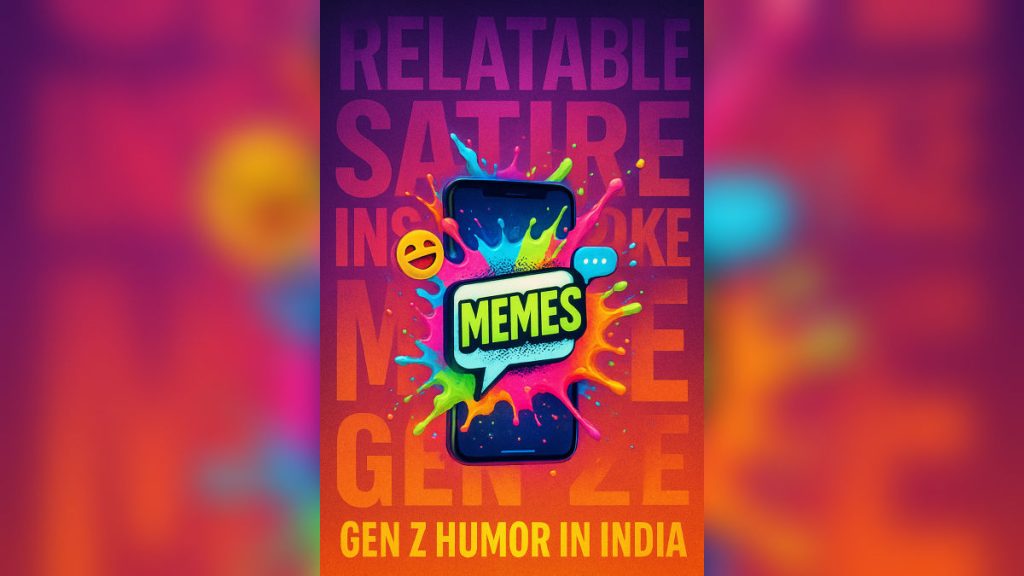
Short answer: Gen Z humour in India is absurd, ironic, multilingual and deeply self-aware, shaped by hyperconnectivity and information overload. According to a 2023 YouGov survey, 63% of Indian Gen Z use memes to cope with stress or anxiety, turning comedy into therapy, identity, and quiet political commentary all at once.
Open Instagram Reels. Or Moj. Or Chingari if that’s your thing. Scroll for thirty seconds. You’ll notice it immediately, Gen Z’s humour is not like the others. Bizarre memes that seem to make no sense, one-liners about existential dread wrapped in pastel text, the comedic language is strange and chaotic and unmistakably powerful.
So what exactly sets Gen Z humour apart, especially in India? And, more to the point, why does any of this matter?
Let’s decode the madness behind the memes.
Why are memes the new language of Gen Z?
For Indian Gen Zers, born roughly between 1997 and 2012, memes aren’t just entertainment. They’re language. They’re therapy. And, in a sense that older generations sometimes find unsettling, they’re reality.
Having grown up inside hyperconnectivity, Gen Z lives at the intersection of social media, rapid tech change and relentless information overload, and their humour reflects all of that chaos at once, which is why it lands as fast and fragmented and weirdly self-aware. Older folks loved sitcoms and stand-up specials. Gen Z thrives on content that’s short, absurd, and embedded in online subcultures most adults can’t even locate.
And in India, where one scroll exposes you to Malayalam lip-syncs, Tamil reaction memes, Punjabi meme pages and Hindi-dubbed dark humour skits, Gen Z humour isn’t only different. It’s multilingual, multi-layered, and multi-dimensional.
What are the defining traits of Gen Z humour?
1. Absurdity as art
One of the defining features of Gen Z humour is its love for the absurd. A cucumber dancing to a Bhojpuri remix. A cat captioned “me trying to explain depression to my dadi”. To older viewers it looks ridiculous. To Gen Z it’s hilarious because it’s surreal.
This love for the nonsensical chucks logic out the window entirely. Traditional setup-and-punchline structures get replaced by chaotic randomness, and that randomness is the joke.
2. Meta, irony, and inside jokes
Gen Z is hyper-aware of being watched, recorded and judged, both online and off. As a result their humour comes layered with irony. They laugh not just at the joke, but at the fact that they’re laughing at the joke.
Indian meme trends like “rizz” or “delulu is the solulu” start as inside jokes and spiral into cultural shorthand within weeks. The meta-humour feels exclusive, and that’s the whole point. It builds a world only Gen Z fully understands.
3. Self-deprecation and dark humour
From jokes about academic burnout to memes about mental health and toxic productivity, Gen Z doesn’t shy away from the dark stuff. And in India, where mental health is still heavily stigmatised, these jokes carry rare moments of raw honesty.
Take a meme that reads “Me: finally feeling better. My anxiety: don’t get used to it.” It’s funny. Painfully so. Humour like this isn’t just a punchline. It’s a coping mechanism dressed up in a screenshot.
Why does Gen Z humour matter?
1. Humour as a survival tool
Gen Z in India is growing up inside a world of political unrest, climate anxiety, brutal competition, rising unemployment and constant social media pressure. Naturally their humour reflects the tension.
According to a 2023 YouGov survey, 63% of Indian Gen Z respondents said they use memes to deal with stress or anxiety. For many, humour is a release valve, a way to process the chaos around them without having to actually say it out loud.
When everything feels overwhelming, laughing about it becomes a small act of resistance.
2. Humour as identity and belonging
In a country as diverse as India, humour also acts as a unifying force. A Gen Z-er from Jaipur can connect with a classmate in Kochi over a meme about online classes, NEET pressure, or Desi mom logic, no translation required.
Humour offers relatability in a hyper-digital world. Sharing a meme that says “Trying to explain to my family why I’m not married at 25” isn’t just a laugh, it’s a signal: I see you. I feel that too. That shared language fosters community, connection and a kind of solidarity that older formats never quite managed.
3. Social commentary wrapped in satire
What makes Gen Z humour even more potent is how it’s wielded to challenge authority and critique society. Memes about gender norms, caste privilege, corrupt politicians and Bollywood nepotism aren’t unusual. They’re routine.
Take the viral edits of news anchors shouting nonsensically, or the exaggerated reels mocking politicians’ empty promises. These aren’t just jokes, they’re sharp, witty, subversive critiques. Unlike previous generations, Gen Z doesn’t always march with placards. They meme with intent. The satire is often subtle but deeply political.
4. Reshaping language and communication
If you’ve ever been confused by phrases like “it’s giving”, “no cap” or “vibe check”, you’ve witnessed Gen Z humour rewriting everyday language in real time.
In India the evolution is just as fascinating. Hinglish dominates urban online spaces, while region-specific dialects shape meme pages across states. A reel captioned “Mood when Chintu bhaiya says UPSC is easy” is shorthand for an entire emotional narrative.
This remixing of language, tone and emoji is redefining how young Indians communicate, in a way that’s visual, contextual and rapid, often replacing long conversations with a single meme or reel that says everything in two seconds.
What about when the adults don’t get it?
Of course, not everyone is laughing.
Plenty of millennials and Gen Xers look at Gen Z’s humour with confusion. Or concern. “Why are they always joking about death?” “Why is everything a meme?” “Why do they laugh at things that aren’t even funny?”
Here’s the thing though. They are funny, just not in the traditional way. Gen Z doesn’t seek approval from older audiences. The humour isn’t meant to be polished, palatable, or even polite. It’s raw, messy, and deeply personal.
Maybe that’s the power of it.
More than just a meme
In India’s bustling digital landscape, Gen Z humour is more than chaotic videos or weird punchlines. It’s a mirror. A reflection of a generation navigating mental health, identity, climate anxiety, inequality and endless change with humour as their shield.
Understanding Gen Z’s humour isn’t about trying to “get the meme”. It’s about getting them, their fears, frustrations, hopes, and how they find connection in a world that often feels disconnected.
FAQs about Gen Z humour in India
Why does Gen Z humour feel so weird to older generations?
Gen Z humour is built on absurdity, irony and inside-joke layers shaped by online subcultures older audiences rarely visit. The setup-punchline structure that defined sitcoms and stand-up has been replaced by chaotic randomness that doesn’t translate without the cultural context.
Are memes really how Gen Z handles stress?
Yes. A 2023 YouGov survey found 63% of Indian Gen Z respondents use memes to cope with stress or anxiety. Humour becomes a release valve and, for issues like mental health that are still stigmatised in India, a way to discuss the difficult stuff without naming it directly.
What’s an example of Indian Gen Z humour as social commentary?
Memes about caste privilege, gender norms, Bollywood nepotism and corrupt politicians are common, alongside viral edits of news anchors and reels mocking politicians’ promises. These aren’t just jokes, they’re sharp political critiques wrapped in comedy that travels faster than an op-ed ever could.
How is Gen Z changing the way Indians communicate?
Hinglish dominates urban online spaces, region-specific dialects power meme pages, and shorthand phrases like “it’s giving” or “no cap” have entered everyday speech. A single meme or reel can replace what used to be a long conversation, making communication visual, contextual and very fast.
Is Gen Z humour just a phase?
Not really. It reflects a generation that’s grown up online and sees the world through layered, ironic, deeply self-aware framing. The format will keep evolving, but the underlying instincts, brevity, absurdity, satire and shared cultural shorthand, are likely here to stay.