
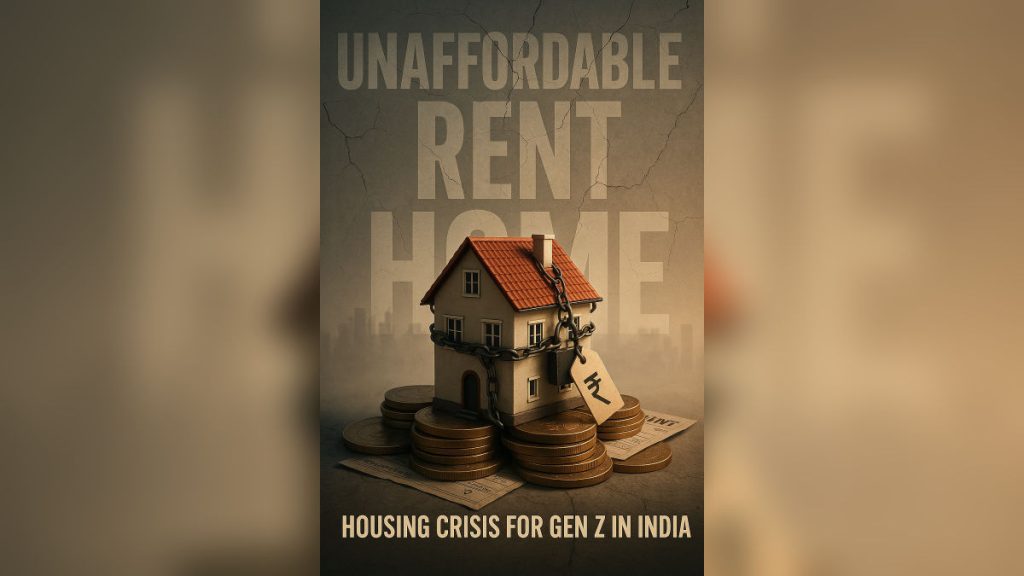
Short answer: Housing is unaffordable for Gen Z in India because property prices in Mumbai, Bengaluru and Delhi have raced past entry-level salaries of Rs 3 to 6 lakh a year, while a modest 1BHK runs Rs 70 lakh to over Rs 1 crore. A 2023 Clever Real Estate study found global housing affordability at its worst in 40 years. Fixes have to come from three sides at once, individual money habits, smarter government policy, and developers who actually build for first-time buyers.
For generations, owning a home stood for stability, success and security. In India, apna ghar isn’t just a roof, it’s a life goal celebrated with pujas, family gatherings and decades of saving. But for Gen Z, that dream keeps drifting further out.
Property prices keep climbing, salaries don’t, and the math gets harder every year. Many Indian Gen Zers are quietly asking themselves the same thing: will I ever own a flat? The answer isn’t simple, and it isn’t completely grim either. Let’s unpack why housing is unaffordable for Gen Z, and what can realistically be done about it.
Why is housing unaffordable for Gen Z in India?
Rising costs, stagnant wages
The biggest gap is between what young people earn and what flats cost. It’s a wide gap. In Mumbai, Bengaluru and Delhi, a modest 1BHK can run from Rs 70 lakh to over Rs 1 crore. Meanwhile, fresh-graduate salaries average Rs 3 to 6 lakh per annum depending on the industry, and once rent, groceries, EMIs and student loans are taken out, even a 10% down payment becomes a slog that stretches across years.
According to a 2023 study by Clever Real Estate, housing affordability globally hit its lowest point in 40 years, and India is no exception.
And that’s before we factor in the slow drip of lifestyle inflation, weddings, parental healthcare and the small joys nobody wants to give up.
Limited inventory and investor competition
A big chunk of new housing stock is built for upper-middle-class or luxury buyers. Compact, budget-friendly starter homes, the kind that used to anchor first-time ownership, are getting rare in Indian cities.
It gets worse. Property investors and NRIs (Non-Resident Indians) often outbid young Indian buyers, pushing prices up and inventory down in the urban centres where the jobs actually are. The result? Gen Z either rents indefinitely, or moves far from work in search of something they can afford.
What financial pressures are unique to Gen Z?
Student loans and low savings
Unlike earlier generations, Gen Z is carrying real education debt. Indian student loans aren’t quite as massive as Western ones, but they’re heavy enough to slow down wealth-building in the years when it matters most. Pair that with low savings rates and a rising cost of living, and a paycheck-to-paycheck cycle becomes the default rather than the exception.
Take Pune or Hyderabad. A 1BHK rent there can run Rs 15,000 to 25,000 a month, leaving very little for long-term savings. Emergency funds, upskilling and supporting family often take priority over a property down-payment that, even on paper, looks like a decade away.
“I want to own a home someday, but right now I’m focused on paying off my education loan and supporting my parents,” shares Tanya, 24, an IT analyst in Bengaluru.
Tanya’s not unusual. She’s the median voice of her cohort.
How are market dynamics and priorities shifting?
Why renting often makes more sense, for now
With flexible work and remote jobs, renting has quietly become the preferred option for a lot of Gen Z. It buys freedom, freedom to switch cities, change careers and skip the EMI-plus-maintenance grind altogether.
And there’s the trust angle. Real estate isn’t seen as the safest investment any more. Gen Z grew up watching the 2008 crash and lived through the COVID-19 pandemic, both of which left them more cautious, sometimes outright sceptical, about locking themselves into 20-year commitments.
Environmental risks and urban planning
India is grappling with climate-linked stress, flooding in Chennai, water shortages in Bengaluru, heat events nearly everywhere. Quite a lot of “affordable” property sits in climate-vulnerable zones, which inflates insurance costs and chips away at long-term value. So the calculation isn’t only financial any more, it’s a risk-management exercise too.
That changes the question Gen Z is asking. It’s not just can I afford this, it’s will this still be worth something in 2045?
What can be done about it?
Solving India’s housing affordability crisis isn’t a one-front war. It needs movement at the individual level, the policy level and inside the market itself. Here’s where to start.
Individual-level strategies
- Get serious about financial literacy. Schools and colleges should be teaching budgeting, investing and loan basics. Apps like Zerodha Varsity and platforms like ET Money already do this for free, the gap isn’t access, it’s habit.
- Co-buying and house hacking. Splitting a property with trusted friends or family, or renting out a room on Airbnb or to a tenant, can take real weight off an EMI.
- Look at tier-2 cities. With remote and hybrid work, Indore, Kochi and Nagpur offer lower property rates without giving up much on lifestyle.
- Try alternative ownership models. Rent-to-own schemes, co-living arrangements and fractional ownership are growing in urban areas, and they’re a way in for buyers who can’t pull together a 20% down payment.
Policy-level solutions
- Affordable housing incentives. Programs like PMAY (Pradhan Mantri Awas Yojana) point in the right direction, but urban execution still lags rural delivery.
- Subsidies and tax breaks. First-time buyers under 30 should get sharper tax relief, interest-rate subsidies, or down-payment support tied to income.
- Regulating speculative buying. Curbing bulk-buying by institutional investors and putting vacancy taxes on empty flats could push real stock back into the market.
Market-driven innovations
- Modular and micro-homes. Developers need to shift away from luxury-only models and design compact, sustainable homes that fit how young India actually lives.
- Promote financial transparency. Banks and NBFCs should simplify mortgage products, give cleaner fee breakdowns and build genuinely usable digital tools.
- Public-private collaborations. Joint efforts between government and real estate players can expand urban rental housing and student-friendly projects.
Is Gen Z rethinking what success looks like?
The new Indian dream
Gen Z is redrawing the success map on its own terms. A house is still desirable, but it’s no longer the only milestone that counts. Travel, gig work, mental health and personal freedom are sitting at the table now.
And maybe that’s not a bad thing.
“We don’t want to be stuck with a 20-year EMI for a flat in a polluted suburb,” says Rohan, 26, a graphic designer from Ahmedabad. “We want homes that make sense, financially, environmentally, and emotionally.”
Rohan’s framing matters because it shifts the conversation from when will I buy to what should I be buying. That’s a different question entirely.
A generation poised to rebuild the system
Indian Gen Z isn’t only complaining about unaffordable housing, they’re questioning the whole setup and hunting for better models. They’re more financially aware, more open to unconventional paths and louder about reform than any cohort before them.
But the homeownership dream can’t sit on Gen Z’s shoulders alone. It’ll take a combined push from individuals, developers, banks and government to reshape the housing ecosystem into something inclusive, innovative and future-ready. The work is everyone’s, or it doesn’t happen.
FAQs about housing affordability for Gen Z in India
How much does a 1BHK actually cost in Mumbai, Bengaluru or Delhi?
A modest 1BHK in these metros typically runs Rs 70 lakh to over Rs 1 crore. Entry-level salaries for fresh graduates sit between Rs 3 and 6 lakh per annum, which is why even saving a 10% down payment takes years for most Gen Z buyers.
Why are tier-2 cities a smart option for Gen Z homebuyers?
Cities like Indore, Kochi and Nagpur offer noticeably lower property prices without major lifestyle compromise, and remote or hybrid work makes them practical. For Gen Z buyers priced out of Mumbai or Bengaluru, a tier-2 city can mean ownership 5 to 10 years sooner.
What government schemes help young Indians buy their first home?
The Pradhan Mantri Awas Yojana (PMAY) is the main affordable housing programme. It offers interest subsidies for first-time buyers, though urban execution has been uneven. Several states also run their own first-time buyer subsidies layered on top.
Are co-living and rent-to-own actually viable in India?
Yes, both are growing in tier-1 and tier-2 cities. Co-living suits Gen Z renters who want flexibility and lower upfront costs. Rent-to-own and fractional ownership help buyers who can’t pull together a 20% down payment but want an ownership pathway.
Does the 2023 Clever Real Estate study apply to India?
The 2023 study found global housing affordability at its lowest in 40 years, and India fits that pattern. Property prices in Indian metros have outpaced wage growth significantly over the past decade, mirroring trends seen in major global cities.