

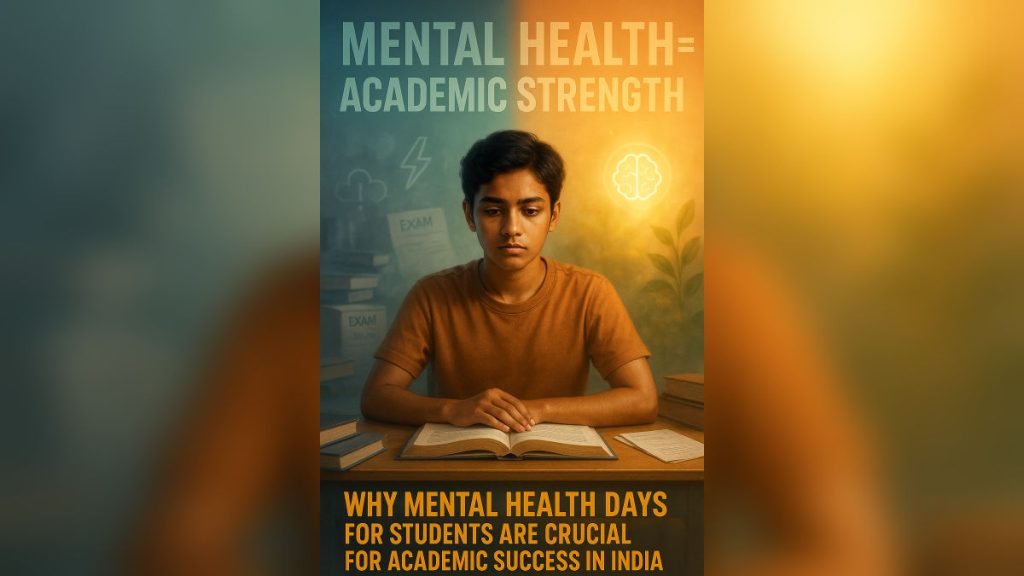
Short answer: Mental health days are scheduled time off school to rest, recover and prevent burnout. In India, where 1 in 7 students aged 13-17 face mental health issues (NIMHANS, 2022), normalising them isn’t soft, it’s smart. Countries like the U.S. and Australia already mandate them; India still has no formal policy, though Ashoka University and a few CBSE schools in Delhi are testing the waters.
In a country where education is treated as the gateway to success and respect, the conversation around student well-being has been pushed to the margins for years. With intense competition, family expectations and social pressure piling up, mental health issues among students are rising fast. But what if academic success didn’t have to come at the cost of a student’s mind? What if a single day off to rest could actually boost performance instead of derailing it?
Welcome to the conversation around mental health days. A concept long overdue for normalisation in Indian schools and colleges.
What is academic pressure doing to Indian students?
Walk into any classroom in India and you’ll find students wrestling with more than textbooks. Early-morning tuitions, late-night study sessions, schedules carved into the minute. Add the pressure to crack JEE, NEET or UPSC, and the picture sharpens. Mental fatigue, here, isn’t an outlier. It’s an epidemic.
A 2022 study by the National Institute of Mental Health and Neurosciences (NIMHANS) reported that nearly 1 in 7 Indian students aged 13 to 17 experience some form of mental health issue, ranging from anxiety and depression to suicidal thoughts. Those numbers are heavy. Yet mental health is still not treated with the same urgency as physical illness — or rather, it’s treated as something to push through.
What are mental health days, really?
A mental health day is a day taken off from school or academic responsibilities to rest, recharge, and address emotional or psychological well-being. It’s not laziness. It’s not escapism. It’s recovery.
Just as we’d rest at home when down with the flu, a mental health day lets the brain and emotions recuperate. Whether it’s burnout, anxiety, or a need to step out of the constant stress loop, the point is to acknowledge that mental well-being is part of overall health. Not separate from it.
Why is the stigma harder to break in India?
In India, mental health still carries social weight. Admitting you’re overwhelmed or anxious is often read as weakness. Students are expected to “tough it out,” with phrases like “yeh toh sabko hota hai” (this happens to everyone) tossed around in classrooms, drawing rooms and WhatsApp groups.
This toxic normalisation of stress and burnout keeps students from seeking help. Allowing and encouraging mental health days can chip away at that stigma. The message is clear: emotional health matters as much as grades.
Burnout is real, and it starts early
Burnout doesn’t only hit working professionals. Students, especially in urban centres, are increasingly facing academic burnout. A state of emotional, physical and mental exhaustion driven by prolonged stress. Symptoms? Fatigue, lack of motivation, poor concentration, declining performance.
Letting students take mental health days works as prevention. It gives them space to recalibrate, return to studies with cleaner focus, and pick up healthier coping strategies for the long haul.
Do mental health days actually help academic performance?
Let’s bust a myth. Taking a break doesn’t mean falling behind. Mental health days can lead to long-term academic gains.
When students are mentally rested, they:
- Concentrate better in class
- Retain information more effectively
- Engage more creatively with their subjects
- Participate actively in discussions and activities
It’s like rebooting a sluggish laptop. It runs smoother once given time to reset.
Anecdotally, many students who’ve taken mental health breaks report feeling more motivated, balanced and productive afterward. Riya, a Class 12 student from Pune, shared: “I was having panic attacks before every exam. One day, my teacher told me to take a break. That one day helped me breathe again. I studied better after that.”
Schools as support systems, not pressure cookers
Schools and colleges have to evolve. From being purely academic institutions to support systems for overall development. Recognising mental health days is a step in that direction.
Some progressive Indian schools have already started. A few CBSE schools in Delhi run “well-being periods” once a week. Ashoka University offers flexible attendance policies that account for mental health needs. These are promising. But we need many more.
Why does India still have no mental health day policy?
Despite the growing awareness, there’s no formal policy in India that allows or encourages mental health days in schools. Unlike countries like the U.S. or Australia (where states have legally mandated mental health days for students), India lacks a framework — or rather, lacks even the start of one.
It’s time for education boards like CBSE and ICSE to:
- Recognise mental health days as valid excused absences
- Train teachers and counsellors to spot signs of mental distress
- Integrate mental health education into the curriculum
- Offer confidential counselling services within schools
These systemic changes will ensure mental health isn’t only talked about during annual awareness days but is woven into student life.
Mental health days: a right, not a luxury
Some will argue that not every student can afford a day off, especially in rural or under-resourced schools. But mental health isn’t a luxury for the privileged. It’s a necessity for everyone.
Students from marginalised backgrounds often carry heavier psychological loads, financial instability, gender discrimination and caste-based exclusion among them. Recognising their need for mental health support isn’t just important. It’s an act of equity and inclusion.
A call to action
Normalising mental health days in Indian schools and colleges isn’t about lowering academic standards. It’s about raising human ones. It’s about building an education system that values resilience, compassion and balance as much as marksheets and ranks.
We must move past the idea that success comes only from relentless hustle. Let’s foster a generation that knows when to pause, reflect and care for itself. Because no exam result is worth sacrificing one’s sanity.
Let’s challenge our institutions to adapt. Let’s empower our students to speak up. And most importantly, let’s remember that mental health is not optional. It’s foundational.
FAQs about mental health days for students
What is a mental health day for students?
A mental health day is a planned day off school or college to rest, recharge and look after emotional well-being. It’s used to prevent burnout, manage anxiety, or recover from prolonged academic stress, much like a sick day for the mind.
How many Indian students struggle with mental health issues?
According to a 2022 NIMHANS study, nearly 1 in 7 Indian students aged 13 to 17 experience some form of mental health issue, ranging from anxiety and depression to suicidal thoughts. The numbers are rising with academic competition.
Are mental health days legally allowed in Indian schools?
No. India currently has no formal policy permitting mental health days for school students. Countries like the U.S. and Australia have state-level mandates, but Indian education boards like CBSE and ICSE have yet to recognise mental health absences officially.
Which Indian institutions support student mental health?
A few CBSE schools in Delhi run weekly “well-being periods,” and Ashoka University offers flexible attendance policies for students dealing with mental health needs. These are early-stage examples but signal a shift in how Indian institutions view well-being.
Do mental health days hurt academic performance?
No, the opposite tends to happen. Rested students concentrate better, retain information faster, and engage more creatively with subjects. Mental health days work as prevention, not interruption, helping students avoid the deeper costs of burnout.