
For a lot of young people today, the idea of a “good career” still follows a familiar script. It’s expected to be stable, predictable, and clearly defined. You choose a role, you grow within it, and over time, you build expertise in a structured way.
But if you look closely at how this generation actually thinks and works, that script doesn’t always hold up.
Gen Z, in particular, is wired a little differently. They value experiences over routines, exposure over repetition, and learning that happens in real time rather than within rigid boundaries. They do more than just work; they actually get involved, they create, and they prove the impact of what they’re doing.
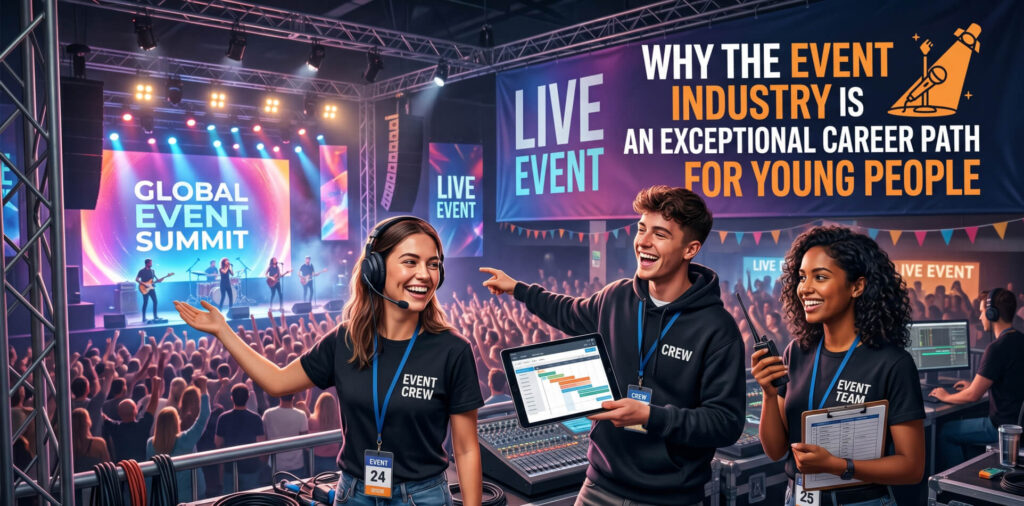
And that’s where the event industry quietly stands out. At first glance, events may seem like just another profession which involves planning, coordination, execution. But step into it, and you realise it’s far more dynamic than it appears. It’s one of the few industries where no two days look the same, where ideas move quickly from concept to reality, and where the outcome is something people don’t just see, but experience.
For someone starting out, that kind of environment can be incredibly powerful.One of the biggest advantages of the event industry is how quickly it accelerates learning. In many traditional roles, growth can feel gradual and structured. Here, it’s immediate and often unplanned. You could be working on strategy one moment, solving a logistical challenge the next, and managing people or clients right after. The learning isn’t compartmentalised; it’s continuous. And it’s not just about skills on paper, it’s about understanding people.
Events, at their core, are built around human experiences. Whether it’s a large-scale conference, a brand launch, or a community gathering, the goal is always the same: to create something that resonates with an audience. Being part of that process teaches you how people think, what they respond to, and how emotions shape engagement. These are insights that go far beyond the event itself and stay relevant across industries.
There’s also a certain energy to this field that’s hard to replicate elsewhere.The pace is fast, the stakes are high, and the margin for error is often small. But with that comes a sense of ownership that is rare, especially early in a career. You’re not only contributing to a process; you’re actively shaping an outcome that is visible, tangible, and immediate. When an event comes together, you don’t need a report to tell you it worked; you can see it, feel it, and hear it in the reactions around you.
But this experience also comes with its own set of challenges, ones that aren’t always visible from the outside. Behind every seamless event is a layer of intense coordination, tight timelines, and constant problem-solving. Technical setups, vendor management, on-ground logistics, last-minute changes, and contingency planning are all part of the process. Things rarely go exactly as planned, and often, the real test lies in how quickly you can adapt without letting the experience fall apart. But this is also where the learning deepens. It teaches you to think on your feet, stay composed under pressure, and find solutions in moments where there isn’t much time to think.
Another aspect that makes this industry particularly relevant today is how it sits at the intersection of multiple disciplines. Events are no longer just about physical setups or logistics. They bring together storytelling, technology, design, marketing, and human behaviour. A single event can involve digital integrations, content creation, audience engagement strategies, and real-time feedback loops.
For someone exploring their strengths, this exposure can be invaluable. It allows you to discover what you enjoy and where you naturally fit, without being restricted to a single function too early.
There’s also something to be said about the kind of confidence this industry builds.When you’re constantly interacting with people, managing expectations, and making decisions in high-pressure situations, you develop a certain clarity in how you think and act. Over time, you become more decisive, more aware, and more comfortable taking ownership. These are qualities that shape not just careers, but individuals.
Interestingly, some of the most impactful career journeys today are not linear; they are built on diverse experiences, cross-functional understanding, and the ability to adapt quickly. The event industry, in many ways, naturally prepares you for that kind of path. It doesn’t box you in; it opens you up.
So, is the event industry for everyone? Probably not.
But for young people who are curious, hands-on, and willing to step into the unknown, it offers something that many other industries take years to provide: real exposure, real responsibility, and real learning.
The real currency of a career today isn’t the title you hold, but the experiences that shape how you think and grow. And maybe that’s the real reason the event industry stands out. It doesn’t hand you a clear roadmap; it puts you in situations that help you figure one out for yourself.