Ask most Gen Z consumers whether they read magazines, and the answer is usually a quick no.
No print subscriptions.
No monthly issues.
No stacks of glossy magazines lying around.
At least, not in the traditional sense.
But here’s the interesting contradiction: the same Gen Z audience that claims to “never read magazines” actively consumes content from magazine brands every single day. They discover stories through Instagram reels, YouTube interviews, newsletters, creator collaborations, and viral social posts.
So perhaps the better question isn’t Does Gen Z read magazines?”
It is:
Which magazine brands still matter to Gen Z?
The answer reveals a lot about what young audiences care about today—identity, fashion, careers, music, mental health, entrepreneurship, and culture.
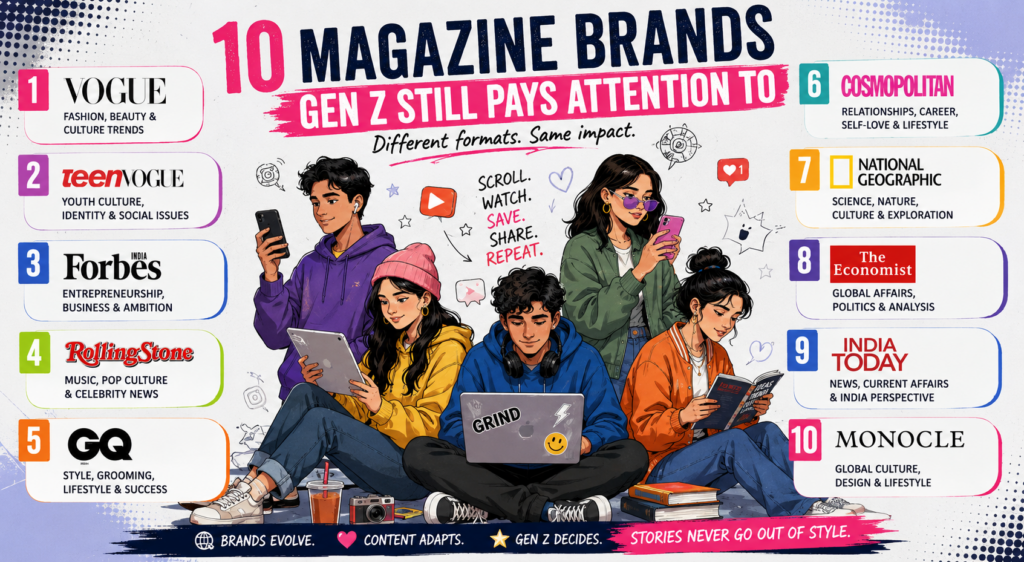
Here are 10 magazine brands that continue to command Gen Z attention in India and globally.
1. Vogue — Still the Global Fashion Bible
When it comes to fashion, Vogue remains unmatched in cultural authority.
Gen Z follows Vogue not because they want a physical magazine, but because they want access to:
– Fashion trends
– Celebrity style
– Beauty culture
– Red carpet commentary
For young creators and fashion enthusiasts, Vogue remains highly aspirational.
Its influence today is digital-first, visual, and social-media driven.
2. Teen Vogue — The Most Gen Z-Aligned Editorial Brand
Teen Vogue may be the best example of a successful Gen Z transformation.
It evolved from being a teen fashion magazine into a sharp editorial voice covering:
– Politics
– Identity
– Mental health
– Social issues
– Youth culture
Gen Z values brands with perspective.
Teen Vogue delivers exactly that.
3. Forbes India — Where Ambition Meets Youth
A decade ago, business magazines mostly appealed to professionals.
Today, Gen Z increasingly reads them.
Why?
Because ambition has changed.
Young Indians admire founders, creators, and entrepreneurs. Shows like Shark Tank India have made startups culturally exciting.
Students now actively seek stories about wealth creation and innovation.
That makes Forbes highly relevant.
4. Rolling Stone — Music, Fame, and Internet Culture
Music remains central to Gen Z identity.
Rolling Stone stays relevant because it understands the intersection of:
– Music
– Pop culture
– Celebrity
– Internet discourse
Whether it’s an artist profile or a viral interview, the brand still carries immense cultural weight.
5. GQ India — Masculinity, Style, and Modern Lifestyle
GQ has evolved beyond men’s fashion.
For Gen Z, it increasingly represents modern masculinity.
The content resonates across:
– Style
– Grooming
– Fitness
– Luxury
– Career success
Urban Indian Gen Z males, especially in metro cities, engage heavily with this category.
6. Cosmopolitan — Still Relevant for Young Women
Cosmopolitan has maintained relevance by staying close to topics young women deeply care about:
– Dating
– Friendships
– Career growth
– Self-worth
– Relationships
Its tone feels relatable rather than distant.
That matters to Gen Z.
7. National Geographic — Curiosity Never Goes Out of Style
Not every Gen Z media preference is driven by celebrity culture.
A large segment craves knowledge.
National Geographic remains powerful for audiences interested in:
– Science
– Climate
– Nature
– Global culture
– Exploration
Its visual storytelling works especially well in the digital era.
8. The Economist — For the Intellectually Curious
This may surprise some people.
Yes, Gen Z does consume serious long-form journalism.
Especially among:
– MBA aspirants
– Policy enthusiasts
– Startup founders
– Finance professionals
Young readers seeking macro understanding increasingly gravitate toward analytical media.
9. India Today — Still Trusted in India
Among Indian magazine brands, India Today remains highly relevant during moments that demand credibility.
It sees strong youth engagement during:
– Elections
– UPSC preparation
– Breaking national news
– Policy developments
Gen Z may consume snippets online, but trust in established brands still matters.
10. Monocle — Premium, Global, Aspirational
Monocle appeals to a niche but influential Gen Z segment.
It attracts globally minded readers interested in:
– Design
– Urban culture
– Entrepreneurship
– Global mobility
– Luxury lifestyle
This is especially relevant among affluent, globally exposed youth.
The Bigger Story: Magazine Power Is No Longer About Print
The most important insight isn’t which magazines Gen Z likes.
It’s why they still matter.
Magazine brands once derived power from physical distribution.
Today, they derive power from cultural authority.
Gen Z doesn’t care whether content arrives through paper, app, newsletter, or reel.
They care about three things:
– Is it relevant?
– Is it authentic?
– Is it worth my attention?
That is the new media equation.
So, do Gen Z read magazines?
Not in the old-school sense.
But they absolutely follow magazine brands that help them understand culture, ambition, identity, and the world around them.
The magazine may no longer sit on a coffee table.
But its influence lives on—in every scroll, swipe, and share.