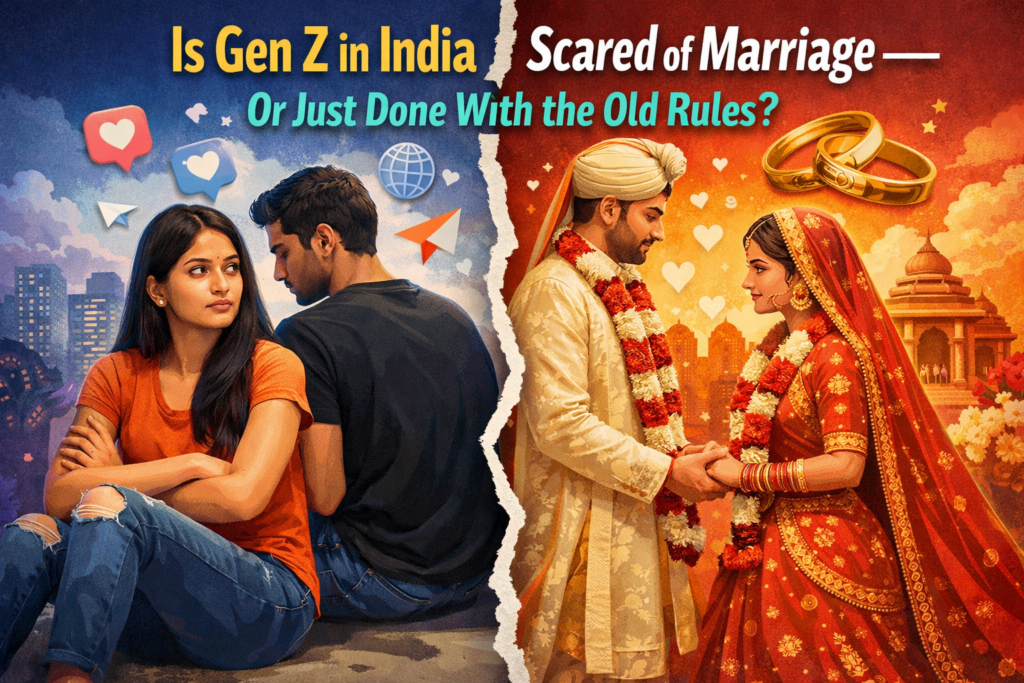
Short answer: Gen Z in India isn’t rejecting marriage. A Theyouthtalks survey of 100 respondents aged 18–27 found 84% feel some fear about it, yet 72% still want to marry someday. What they’re rejecting is the old script: fixed timelines, forced compromises, and marrying the wrong person.
Walk into any Indian household, bring up marriage, and you’ll hear the familiar refrain: “Ab settle ho jao.” It is reflexive. Predictable. Scripted.
Step outside that living room, into college campuses, coworking spaces, WhatsApp groups and late-night chai conversations, and the tone shifts. The urgency fades. The certainty dissolves. The enthusiasm? Questionable.

Gen Z in India isn’t rejecting love. They aren’t even rejecting marriage. What they are pushing back against is the traditional framework of marriage: the timelines, the compromises, the silent sacrifices previous generations quietly accepted.
To move beyond speculation, Theyouthtalks conducted a primary survey of 100 Gen Z respondents (aged 18–27 across urban India). The results didn’t point to one simple fear. They revealed something more layered, and more disruptive.
Are young Indians actually scared of marriage?
Start with the obvious question.
What the survey revealed
- 61% said they are “somewhat scared” of marriage
- 23% said they are “very scared”
- Only 16% said they are not scared at all
That’s striking. A full 84% of respondents expressed some level of fear. But here’s where the story turns.
When asked, “Do you still want to get married someday?”
- 72% said YES
- 18% said MAYBE
- Only 10% said NO
The contradiction is the whole point. Gen Z isn’t walking away from marriage. They’re approaching it with caution, perhaps for the first time in India’s cultural history.
Why is Gen Z anti-risk, not anti-marriage?
One insight stands out: Gen Z is not anti-marriage. They are anti-risk.
This generation has grown up watching both sides of the story. On one side, the ideal: celebrations, companionship, shared lives. On the other, the fractures: unhappy unions, emotional disconnect, silent endurance. Unlike previous generations, they are not willing to gamble blindly.
What exactly is scaring Gen Z?
We asked respondents to name their biggest fear about marriage.
Top concerns
- Choosing the wrong partner — 42%
- Loss of freedom or independence — 21%
- Financial pressure — 18%
- Divorce or failed marriage — 12%
- Family or societal pressure — 7%
The dominant fear is not commitment. It is commitment to the wrong person.

One respondent put it bluntly:
“I’m not scared of marriage. I’m scared of being stuck with the wrong person forever.”
That word, stuck, shows up more than you’d expect. It reflects an anxiety about permanence in a world that feels uncertain.
How does Gen Z balance love and logic?
The most interesting tension is between emotion and practicality. This is a generation raised on contradictions.
They have grown up watching:
- Marriages that survived but weren’t necessarily happy
- A culture of “adjustment” that often came at a personal cost
At the same time, they have been exposed to:
- Conversations around mental health
- The importance of boundaries
- The idea that self-worth should never be compromised
Survey insights
- 68% said emotional compatibility matters more than financial stability
- Yet 74% said they would not marry without financial security
It isn’t confusion. It is complexity. Gen Z wants love and logic. Emotion and stability. Passion and practicality. And if they can’t have both? They are willing to wait.
Why is marriage no longer urgent?
For decades, marriage in India followed a rough timeline. Graduate. Get a job. Get married, preferably before 30. That timeline is quietly dissolving.
Preferred age for marriage

- Before 25 → 9%
- 25–30 → 41%
- 30+ → 38%
- Not sure → 12%
The idea of a “right age” is fading. In its place sits a more fluid, individual approach. People aren’t asking “Am I old enough?” anymore. They’re asking: “Am I ready?”
Readiness, for Gen Z, includes emotional maturity, financial independence and clarity about life goals.
What about the independence factor?
There is a quieter undercurrent in this shift: the fear of losing oneself.
Key insight
- 57% believe marriage can limit personal freedom
The sentiment is stronger among women, many of whom see marriage not as a partnership alone but as a possible restructuring of identity. There is a growing resistance to:
- Sacrificing career ambitions
- Adjusting to traditional gender roles
- Losing autonomy in decision-making
Earlier generations often equated marriage with stability. Gen Z sometimes associates it with compromise.
Is social media making it worse?
Yes, but not the way you’d guess. Social media hasn’t changed only how people date. It has reshaped expectations. From curated couple photos to extravagant wedding reels, Gen Z is constantly exposed to idealised versions of relationships.
Survey insights
- 49% said social media has increased their expectations
- 36% said it has made them more confused about commitment
It is a paradox. More exposure should lead to clarity. Instead, it feeds comparison, overthinking and decision paralysis. Too many options. Too many benchmarks. Too many “what ifs.”
So what does Gen Z actually want?
After all the hesitation and delay, what does this generation truly seek? We asked respondents: “What would make you feel ready for marriage?”
The answers were consistent:
- Emotional maturity (both partners)
- Financial stability
- Clarity in life direction
- Genuine compatibility
These are not unreasonable demands. They suggest a more thoughtful, deliberate approach to relationships.
How is Gen Z redefining marriage?
For Gen Z, marriage is no longer:
- A default milestone
- A societal obligation
- A box to tick by a certain age
It has become a conscious, high-stakes personal decision, one that needs alignment, not affection alone.
The brutal truth
Every generation has its fears. Previous generations feared loneliness, social judgement and the idea of “ending up alone.” Gen Z fears something different:
- Being stuck in the wrong relationship
- Settling for less than they deserve
- Losing their identity in the process
It isn’t fear. It is awareness.
India isn’t rejecting marriage. It is rewriting it.
The narrative that “Gen Z is scared of marriage” is too tidy. The reality is more layered. This generation is asking harder questions, taking fewer emotional risks and refusing to trade happiness for stability.
They are not abandoning marriage. They are redefining it on their own terms. And in doing so, they may be setting the foundation for healthier, more conscious relationships ahead.
Research methodology
This study was conducted by Theyouthtalks in March 2026 with a sample size of 100 respondents aged 18–27 across urban India. Data was collected through online surveys and anonymised responses.
FAQs on Gen Z and marriage in India
Is Gen Z in India scared of marriage?
Partly. In the Theyouthtalks survey of 100 respondents aged 18–27, 61% said they were “somewhat scared” and 23% “very scared” of marriage. But 72% still want to get married someday, so the fear is about risk, not the institution itself.
At what age does Gen Z in India want to get married?
The preferred age is shifting later. 41% prefer 25–30, 38% prefer 30 or later, 12% are unsure, and only 9% want to marry before 25.
What is Gen Z’s biggest fear about marriage?
Choosing the wrong partner, cited by 42% of respondents. Loss of independence (21%) and financial pressure (18%) follow.
Does Gen Z prioritise love or money in marriage?
Both. 68% said emotional compatibility matters more than financial stability, yet 74% said they would not marry without financial security.
Is social media changing how Gen Z sees marriage?
Yes. 49% said social media has raised their expectations of relationships, and 36% said it has made them more confused about commitment.