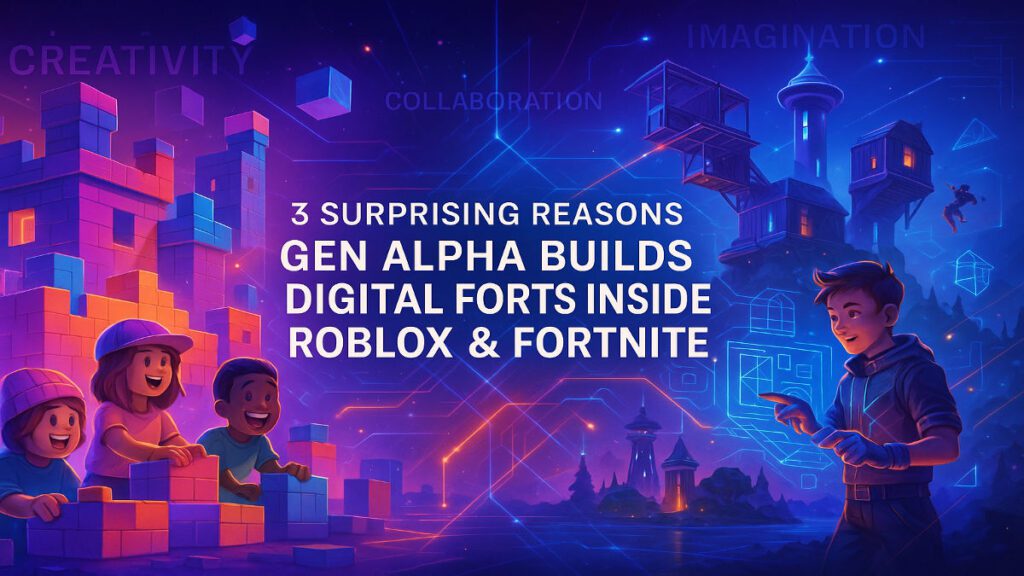
Short answer: Gen Alpha kids build digital forts in Roblox and Fortnite because these spaces hand them creative freedom, coding tools, and shared hangouts. Over 50% of kids in Fortnite Creative now spend more time building than battling, a sharp shift from pure battle royale play.
In 2025, the backyard fort has gone digital.
Generation Alpha, kids born from 2010 onwards, are trading sticks and blankets for pixels and code. In their world, building forts is not just playtime. It is an act of creativity, collaboration, and digital self-expression. Two games dominate the frontier: Roblox and Fortnite.
These forts are not about defence or decoration. They are blueprints of identity, friendship, and imagination.
Why is the digital playground the new neighbourhood?
For Gen Alpha, Roblox and Fortnite are more than games. They are living social ecosystems where friendships form, skills sharpen, and creativity runs loose.
According to Agentur LOOP and PurpleTutor, Gen Alpha prefers games that let them shape the environment around them, instead of following preset narratives.
And building forts? It is the easiest way into that creative world.
How do kids build forts in Roblox?
A universe built by kids, for kids
Roblox is a massive user-generated content (UGC) platform. Kids design everything here: characters, outfits, obstacle courses, and battle arenas. Forts are only the starting point.
Using Roblox Studio, young creators build terrain, drag-and-drop objects, and place walls, towers, and secret passageways. The tools stay kid-friendly but go surprisingly deep.
Where code meets creativity
For kids ready to push past the basics, Roblox offers Lua scripting. Want a digital fort that launches water balloons? An alarm that trips when someone sneaks in? Lua handles it.
“My 10-year-old created a trapdoor in his fort that opened when a fake treasure chest was touched,” shared one parent. “I couldn’t believe he wrote the code himself.”
Social design in action
The best part is that these are not solo projects. Kids invite friends to co-build, share creations with the wider community, and get real-time feedback. That is an early lesson in teamwork, iteration, and community — no classroom required.
How does Fortnite Creative turn battles into blueprints?
Creative mode as an unlimited canvas
Fortnite made its name in battle royale, but its Creative mode has become a quiet powerhouse for Gen Alpha builders.
Kids get their own private islands: blank slates for castles, sci-fi bases, treehouses, and anything else they dream up.
With the game’s core building mechanics, players drop walls, ramps, and floors in a few quick clicks. The result is a mix of fast-paced gaming with deeper design thinking.
Co-op building and bragging rights
Building in Fortnite is rarely solo. Friends jump in together, lay out fort designs, test defences, and try weird themes. One day it is a pirate hideout. The next, it is a neon dance club with laser traps.
When the build is done, creators publish and share it, and others can explore or compete inside it.
According to Epic Games Developers, over 50% of kids in Creative mode now spend more time building than battling, a radical shift from a few years ago.
Why are Gen Alpha kids drawn to fort-building?
Four drivers sit behind the pattern.
1. Creative freedom
These platforms give kids something most apps and classrooms do not: open-ended freedom to create. A floating sky fortress. A medieval castle filled with lava. They design their world their way.
2. Problem solving by design
Forts are engineering puzzles. Builders think about structure, logic, balance, and security. That sharpens spatial reasoning and planning.
3. Digital friendship
Forts are shared spaces, built with friends, explored together, and talked about long after the screen turns off. Playground, hangout spot, and collaboration hub rolled into one.
4. A sense of control
In a world that often feels out of their hands, a digital fort gives Gen Alpha ownership. It is theirs, from the blueprint to the final flag on top.
What do these forts say about the future?
Generation Alpha is not waiting for the digital world to be handed to them. They are building it, brick by virtual brick.
Whether inside Roblox or Fortnite, these forts are more than structures. They are statements of self, arenas of imagination, and training grounds for the next generation of designers, engineers, and storytellers.
The next time you look over your child’s shoulder and see a glowing tower or a secret passage taking shape, skip the “screen time” label. Digital fort-building is their version of making something real — something that belongs to them.
FAQs on Gen Alpha digital forts
What age group is Generation Alpha?
Generation Alpha covers kids born from 2010 onwards, which makes the oldest around 14–15 in 2025.
Is Roblox safe for kids to build forts in?
Roblox is designed for young creators with kid-friendly tools inside Roblox Studio. Parents still need to set privacy controls, review chat settings, and check what their kids are sharing or joining.
Do kids need to code to build in Roblox?
No. Basic forts use drag-and-drop terrain, walls, towers, and passageways. Lua scripting is optional and lets kids add advanced features like trapdoors, alarms, and interactive props.
What is Fortnite Creative mode?
Fortnite Creative is a mode where kids get private islands to build on — castles, sci-fi bases, treehouses, dance clubs. Over 50% of kids in Creative mode now spend more time building than battling.
Why do kids prefer building to battling in Fortnite?
Building offers ownership, creativity, and shared projects with friends. It rewards design thinking rather than reflexes, which suits a generation that values making and self-expression.