
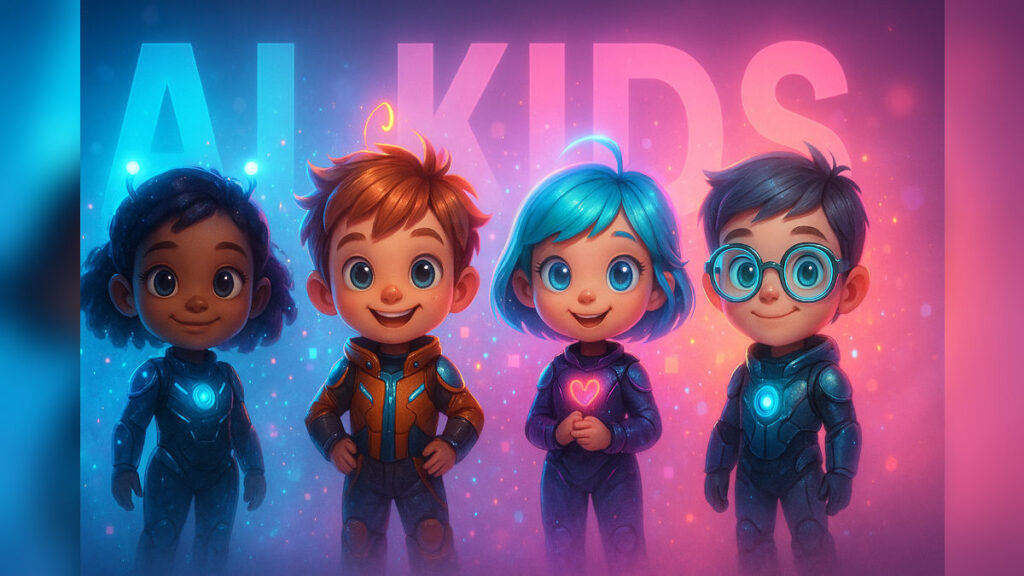
Short answer: AI kids characters are winning over young viewers in 2025 because they are faster to produce, can interact and adapt to each child, and reach more languages and abilities than traditional animation. The trade-offs are real too: data privacy, emotional dependency, bias, and creative job loss.
In 2025, your child’s favourite cartoon might not be drawn by an artist or voiced by an actor. It may be generated by artificial intelligence. AI-generated characters are becoming the stars of children’s entertainment, transforming animated shows, games, educational apps and interactive stories.
The trend isn’t only about new tech. It’s about how kids connect with characters, and how technology is reshaping storytelling itself for better and sometimes for worse.
How is AI changing children’s content creation?
Animation no longer requires months of frame-by-frame work. AI algorithms can automate motion capture, rotoscoping and rendering, cutting production time and costs.
What once took a studio of animators now sometimes takes one person and a few powerful tools. AI brings characters to life with expressive animations and realistic movement at speeds traditional methods can’t match.
AI-generated voiceovers are pushing further. With the right software, creators can produce a child’s voice in any accent, age or emotional tone, making dubbing and multilingual releases more accessible. “The voice of our lead character, Tara, was entirely AI-generated,” shares Sneha, a Mumbai-based animator. “It allowed us to quickly prototype scenes and test audience reactions before casting a human actor.”
Scriptwriting is shifting too. Tools like ChatGPT are being used to co-write plots, develop characters and brainstorm story arcs, letting smaller teams produce strong narratives in record time.
How does AI make kids’ media interactive?
The most exciting shift is interactivity. AI-driven characters in educational games and apps adapt based on how a child responds. If a young user struggles with a math concept, the AI tutor might slow down, offer encouragement or switch strategies.
This responsive technology makes learning more engaging and personal, and helps children stay motivated. It works like a teacher, a friend and a game character rolled into one.
My niece, Rhea, 7, adores her AI reading companion. “He knows when I’m stuck on a word,” she told me proudly. “He doesn’t get mad. He just helps me try again.” That gentle persistence is something many parents and educators appreciate.
Why are AI kids characters winning hearts? The big benefits
AI’s role in children’s entertainment opens up several real opportunities:
- Speed and efficiency mean more diverse content, faster production and lower costs, especially valuable for independent creators and educational platforms.
- Personalisation lets characters reflect individual preferences, learning styles and cultural nuances.
- Accessibility improves through automatic subtitles, multiple language support and visual enhancements that help reach children of all abilities.
And on creativity, AI isn’t replacing imagination, it’s amplifying it. Writers, animators and designers now have tools that can generate hundreds of ideas or styles in one click, freeing them to focus on storytelling and refinement.
What are the risks of AI characters for children?
Innovation brings responsibility.
Data privacy is a major concern. Interactive AI characters often learn from user behaviour, which raises questions about how children’s data is collected, stored and used. Transparency from developers and strict parental controls are non-negotiable.
Emotional dependency is the next worry. If children form strong bonds with AI companions, will it affect how they relate to real people? Some AI characters are designed to be supportive and friendly, but experts urge caution. “We must remember these are simulations,” says child psychologist Dr. Aarti Mehra. “They mimic empathy, but they don’t feel it.”
Bias is a third risk. If AI tools are trained on unbalanced data, they may perpetuate stereotypes. A lack of diversity in AI-generated characters can limit a child’s exposure to different cultures, perspectives and realities.
And as more content tasks are automated, questions around job displacement in creative industries are rising. Writers, illustrators and voice actors may find themselves competing with algorithms.
Where do we go from here?
The rise of AI in kids’ media isn’t a passing trend. It’s a structural shift that’s here to stay. In 2025, AI-generated characters are entertaining children and shaping how they learn, play and interact with the world.
That’s why this moment matters. We’re at a crossroads where innovation has to sit alongside intention. Parents, educators, creators and tech developers all have a role. Ask hard questions, set thoughtful limits, and make sure the stories we tell still have heart, even when they’re written by machines.
FAQs about AI kids characters in 2025
What are AI kids characters?
AI kids characters are animated characters in shows, games or educational apps whose visuals, voice or behaviour are generated or driven by artificial intelligence. Some are pre-rendered like a traditional cartoon character, while others adapt their responses in real time as a child interacts with them.
Are AI characters safe for children?
They can be, but safety depends on the platform. Parents should look for transparent data practices, strong parental controls, and clear age ratings. Child psychologist Dr. Aarti Mehra cautions that these systems mimic empathy without feeling it, which is worth keeping in mind during long sessions.
Will AI replace human animators and voice actors?
AI is already automating tasks like motion capture, rendering and voiceover production, which is reshaping creative jobs. Many artists are using AI as a tool to work faster rather than being replaced outright, but job displacement in scriptwriting, illustration and voice acting is a real concern.
How do AI tutors and reading companions help kids learn?
AI tutors adapt to a child’s pace. If a child struggles with a math problem or a tricky word, the AI can slow down, offer encouragement or change its approach. This personalisation often makes learning feel less stressful and more engaging.
What should parents check before letting kids use AI characters?
Check the privacy policy, the data the app collects, and the parental controls available. Look at who built the app, whether the characters reflect a diverse cast, and how much screen time is healthy for your child’s age.